
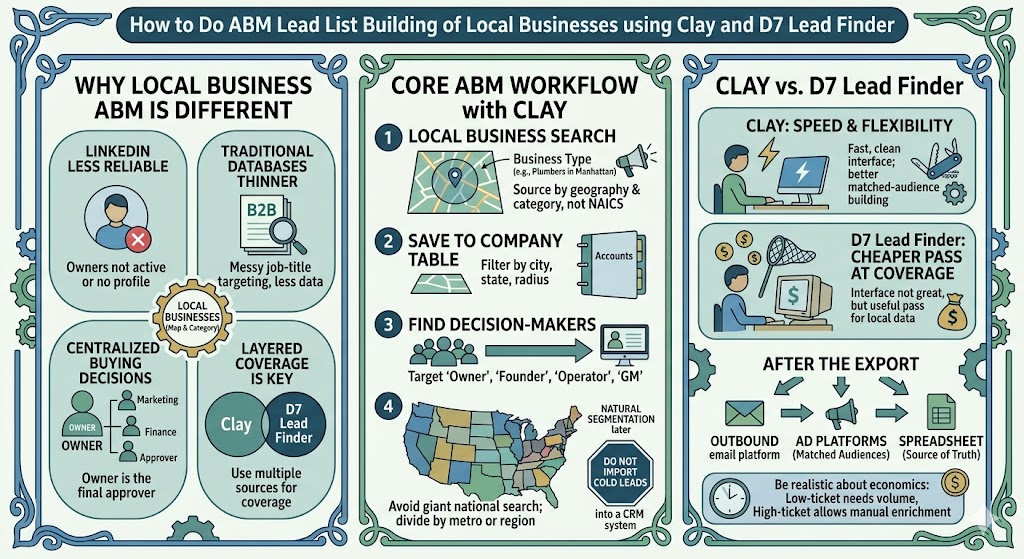
How to Do ABM Lead List Building of Local Businesses using Clay and D7 Lead Finder
A tactical walkthrough for building ABM lists of local businesses by starting with company data, finding the right owners or operators, and combining Clay and D7 Lead Finder for better market coverage.

Local Business ABM Plays by Different Rules
ABM list building gets a little more interesting when you move out of the usual B2B SaaS world and into local businesses.
If you’re targeting plumbers, restaurants, dentists, roofers, local healthcare groups, or other neighborhood-level businesses, the normal playbook breaks pretty quickly. LinkedIn becomes less reliable. Traditional B2B databases get thinner. Job-title targeting gets messy. And in many cases, the owners you want either do not maintain LinkedIn profiles or barely use them.
That’s why local-business ABM requires a different approach.
Start With Businesses, Then Find the People
Instead of starting with people, you usually start with places. You build a list of businesses first, then turn that company list into a people list, and then enrich the owners or decision-makers you actually want to reach.
Clay and D7 Lead Finder are both useful for this, but they play different roles.

Clay vs. D7 Lead Finder
Clay is usually the more flexible option. D7 is often the cheaper option. Clay is faster and cleaner to use. D7 is a bit rougher around the edges, but still valuable when you need another source of local coverage.
In the training I described it pretty bluntly: the interface is not great, but it is cheaper than Clay. That is still the right way to think about it.
If Clay gives you speed and flexibility, D7 gives you another pass at coverage. And for local-business ABM, coverage is the whole game.
The Core Workflow
The core idea is simple: find local businesses by geography and category, save them into a company table, and then turn that company list into contacts.
That first step is where Clay’s local business search shines. It lets you use Google Maps-style sourcing by radius and free-text business type. In the training, I used examples like plumbers in Manhattan and restaurants across wide geographies because that is often exactly how local-business prospecting needs to work. You are not relying on a polished NAICS taxonomy. You are searching the real world.

This is why I like starting with a direct, practical search. If you sell to restaurants, search restaurants. If you sell to med spas, search med spas. If you sell to HVAC contractors, search HVAC contractors.
Then save that output as an account table.
Once you have that table, you can run the next move inside Clay: “Find people that work at those companies.” That step is what turns a map-based business list into a real ABM list.
For local businesses, the most important title is usually owner. In some markets it might be founder, operator, partner, general manager, or director. But owner is the cleanest place to begin.
Expect Lower Contact Coverage Than Traditional B2B Data
The reason this matters is that local-business buying decisions are usually much more centralized than what you see in mid-market SaaS. The owner often is the marketing department, the finance department, and the final approver all at once. If you get the right person, the sales cycle can be much faster.
What you should expect, though, is lower data coverage than you would get in a corporate B2B market.
That is normal.
One of the most helpful moments from the transcript was the restaurant example, where a small sample of local businesses produced only a modest number of owner contacts. That is not a sign the process is broken. It is a sign that local-business data is just harder. The businesses exist. The challenge is contact coverage.
That’s why this kind of ABM work is really a layered process.
A good workflow looks like this:
- Use Clay to build the local business list by geography and category.
- Save the businesses into a company table.
- Find owners or other decision-makers at those companies.
- Export the domains and company names.
- Run a second pass through another provider if needed.
- Deduplicate and enrich the final list.
Get the Geography Design Right
Another point that matters a lot in local business is geography design.
If you want national coverage, you often cannot rely on one giant search. You may need to divide the country into multiple radiuses, metros, or states. With Clay, that could mean using one search centered on one part of the country and another elsewhere. With D7, it may mean city-by-city pulls.
That sounds manual, but it is actually a strength because it gives you natural segmentation later for outbound and ads.
For example, you may eventually want one campaign for restaurant owners in Texas, another for Florida, and another for California. Local markets behave differently. Segmenting at the list-building stage gives you better control later.
Why This Approach Is Still True ABM
I also like using this process because it forces you to think at the account level first, which is exactly what ABM should encourage. You are not just buying random contacts. You are building a defined map of the local businesses in your market and then finding the people who matter inside that map.

That difference matters when you move into actual execution.
Once your list is ready, the same three destinations apply:
- Your outbound email platform.
- Your ad platforms as matched audiences where possible.
- Your spreadsheet or cloud table as the source of truth.
And just like in broader B2B list building, cold leads should not go straight into your CRM. “Do not import cold leads into a CRM system.” That advice matters just as much for local businesses.
Final Thought
Be realistic about economics. If you are selling a low-ticket offer to local businesses, you need volume. If you are selling a high-ticket service to owners, then slower, more manual enrichment can still make sense because each account is worth more.
But if your market is worth it, Clay and D7 together give you a very workable way to do what most teams never do well: build a real ABM list of local businesses instead of guessing at one.