
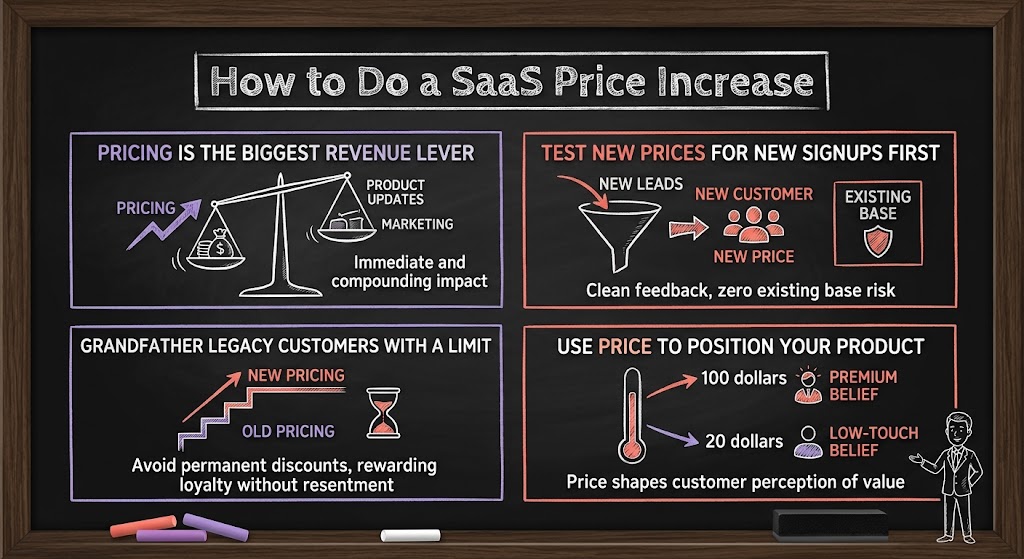
How to Do a SaaS Price Increase
A practical playbook for raising SaaS prices, drawn from founders who have done it: why pricing is your biggest revenue lever, how to test with new customers first, what to do about grandfathering, and how to read your churn data before you move.

On a recent SaaSRise mastermind call, one of our founders brought a question that every SaaS company eventually faces and most of us handle badly: how do you actually do a price increase? Her situation will sound familiar. The product is about six years old. They raised prices once, early on, mostly to catch up from a deliberately low launch price, and it's been roughly five years since then. She's been watching competitors raise prices around her and knows the company probably should too. But her market has entrenched players, switching costs are low, and her pricing tiers are built on a different value metric than most of her competitors use, which makes direct comparison messy. Her questions were the right ones: what metrics do you look at to decide the size and shape of an increase, and do you grandfather existing customers?
The discussion that followed came from founders who have run real price increases, including one who had spent the previous two months deep in a pricing overhaul. Here's the playbook that emerged.
Pricing is the biggest lever you have
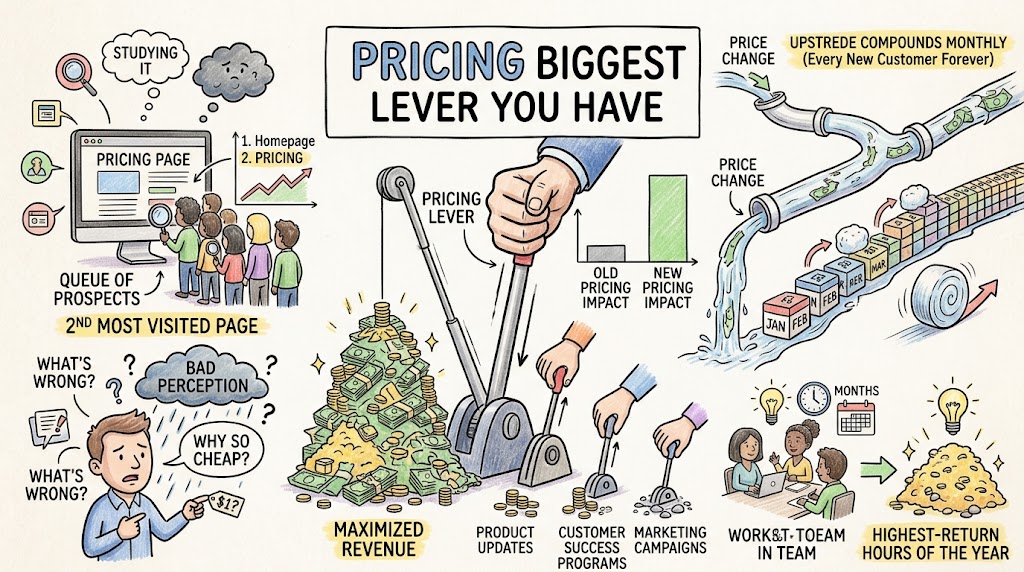
The first thing the group did was raise the stakes. One member, fresh off his own pricing project, made the case bluntly: pricing is the single decision with the biggest immediate impact on your revenue. No product update, no customer success program, and no marketing campaign will move the needle the way pricing does. In his own modeling, the difference between his old pricing and his new pricing across the customer base was enormous, the kind of number that dwarfs anything else on his roadmap.
- Your pricing page is already a top page. For his company, pricing is the second most visited page after the homepage, and that's true for most SaaS sites. People are studying it whether you're proud of it or not.
- The upside compounds monthly. A price change applies to every new customer forever, which is why it outweighs one-off wins.
- Underpricing has quiet costs too. Several members noted prospects who ask, why are you so cheap? A too-low price makes buyers wonder what's wrong.
If pricing really is the biggest lever, then the months of careful work an increase requires aren't overhead. They're some of the highest-return hours you'll spend this year.
Raise prices for new customers first
On mechanics, the clearest pattern came from a member who has made price increases a routine rather than a crisis. His company raises prices for new customers roughly every two years. Existing customers keep their old pricing at first, and only migrate to the new structure gradually, over the following two or three years. That separation matters, because it splits one scary decision into two manageable ones: what should the price be, and how do we transition the base.
Before touching the number, he does the homework on his existing customers. He looks at what each group actually uses in the platform, breaks the base into segments by size and behavior, and forms a view of what each segment would plausibly pay. Then the new pricing goes live on the public pricing page for new signups only, and he watches how it converts before deciding anything about the existing base.
- Segment before you set the number. Group customers by what they use and what they'd plausibly pay, rather than treating the base as one blob.
- Test on new customers. New signups give you clean feedback on the new price with zero churn risk in your existing base.
- Let customers tell you which meter is acceptable. His instinct said charging per user would be unacceptable, and he was wrong. His buyers happily pay for additional admin accounts. Test the value metric, don't assume it.
- Expect a failed experiment or two. He tried value-based pricing as a percentage of transactions and it failed spectacularly. He adjusted and moved on.
One more tactic from his playbook: when an increase is coming, tell the leads already in your pipeline. A simple heads-up that prices go up next month has closed deals for him. And for products that sell more like prosumer software than enterprise deals, the founder who raised the question has seen the public version of this work well, a lock-in-your-price-now campaign that gives fence-sitters a reason to finally commit and gives your affiliates something urgent to promote.
Grandfather with a time limit, or not at all
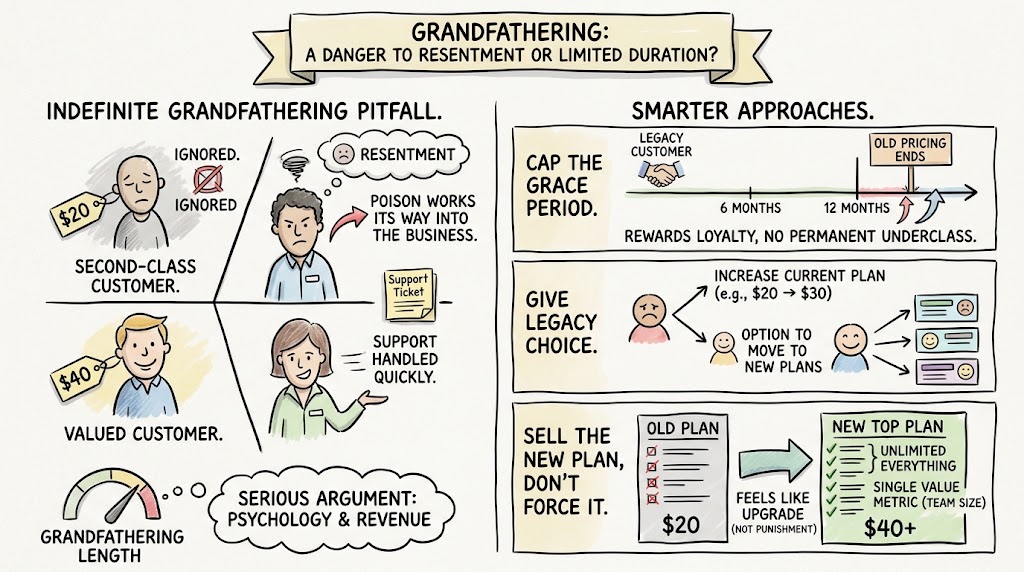
The sharpest disagreement with conventional wisdom came on grandfathering. The founder asking was leaning toward grandfathering her existing customers indefinitely, and one member pushed back hard from experience. His warning: never grandfather anybody for life, because you will end up resenting those customers. When someone paying 20 dollars files a support ticket while everyone else pays 40, some part of you starts treating them as second-class, and that poison works its way into the business.
- Cap the grace period. Six or twelve months of honored old pricing rewards loyalty without creating a permanent underclass of discounted accounts.
- Give legacy customers a real choice. His own approach: existing customers see an increase on their current plan, but get the option to move into the new plans if those fit better.
- Sell the new plan, don't force it. He designed his new top plan to be so clearly better, with everything unlimited and a single value metric based on team size, that switching feels like an upgrade rather than a punishment.
The founder's market has quirks that make her cautious, and that's fair. Grandfathering length is a dial, not a principle. But the resentment argument is one I'd take seriously, because it's about your own psychology as much as your revenue, and I've seen it play out exactly the way he described.
Your price is your positioning
Midway through the conversation, the discussion turned from mechanics to strategy, and this is where I think the most valuable insight landed. The founder kept returning to the fact that her competitors all price in a similar band, so buyers expect her to sit in that band too. The response from the member who'd just finished his pricing overhaul: pricing has to tell a story. Be the least expensive option or be the most expensive one, because if you try to fit in the middle, you get lost in the middle.
His point went further than positioning on a chart. The price itself shapes what buyers believe about your product before they ever try it. Someone landing on a pricing page at 20 dollars a month forms one idea of what the product does, and the same person landing on 100 dollars a month forms a completely different one. As he put it, you control the positioning with your pricing. The founder admitted she had simply assumed buyers would expect her to match the category, and that assumption, not the market, was the real constraint.
Read your churn data before you move
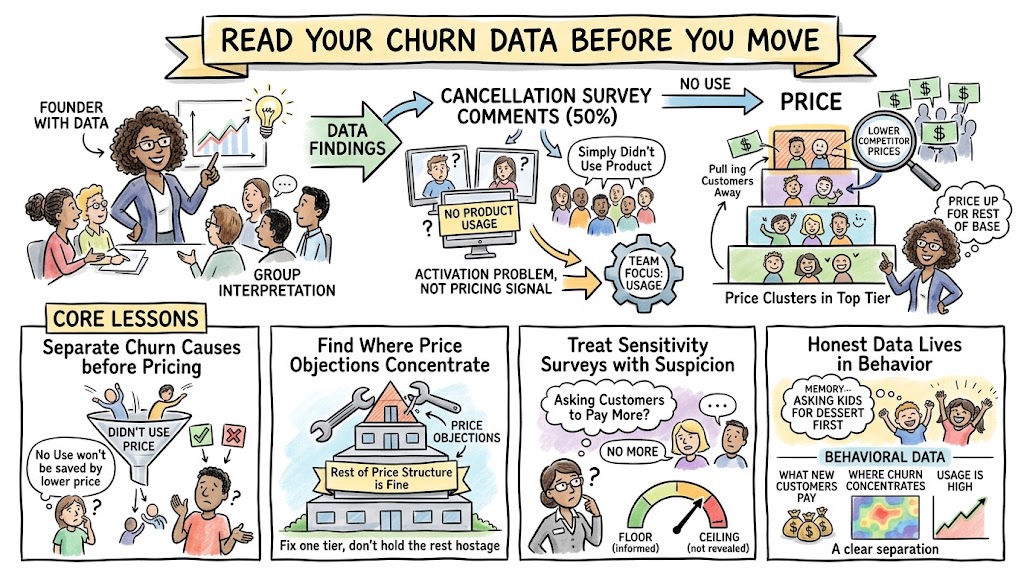
The founder came armed with data, and the way the group helped her interpret it is a lesson in itself. Her cancellation surveys showed that about half the customers who leave a comment when churning say they simply didn't use the product. That's an activation and engagement problem rather than a pricing signal, and her team is rightly making usage its focus. Meanwhile, the customers who do cite price cluster in her top tier, exactly where competitors undercut her with a more generous offer. Across the rest of the base, price barely registers as a churn reason, which is why she came away feeling good about an increase.
- Separate churn causes before pricing. People leaving because they didn't use the product won't be saved by a lower price or lost to a higher one.
- Find where price objections concentrate. If one tier drives the complaints, fix that tier's value story instead of holding the whole price structure hostage to it.
- Treat sensitivity surveys with suspicion. One member suggested a price sensitivity survey, and others immediately added the caveat: no customer will ever tell you to charge more. Surveys can inform the floor, but they will never reveal the ceiling.
That last point drew knowing laughs on the call, because everyone had seen it. Asking your customers whether you should raise prices is like asking your kids whether you should serve dessert first. The honest data lives in behavior: what new customers actually pay, where churn actually concentrates, and what usage actually looks like.
The sequence, start to finish
Put together, the group handed our founder, and the rest of us, a sequence worth writing down. Study your churn and usage data to confirm price is genuinely not your problem. Segment your base and pick the value metric your customers have shown they'll accept. Launch the new pricing for new customers only, and watch conversion. Announce the change to your pipeline and fence-sitters to pull demand forward. Then migrate existing customers with a time-limited grace period and a genuinely attractive new plan to land on.
And through all of it, remember that the price is far more than a number on a page. It's the loudest single statement of what your product is worth, and after five years without an increase, the question usually isn't whether your customers believe you're worth more. It's whether you do.