
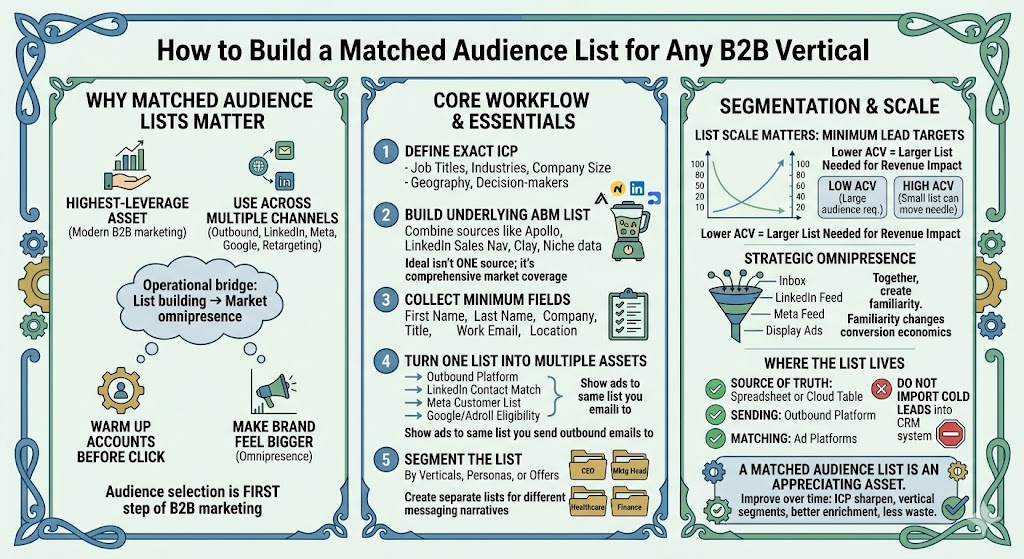
How to Build a Matched Audience List for Any B2B Vertical
A clear framework for building matched audience lists that can be used across Meta, LinkedIn, Google, and outbound, so your brand stays visible to the exact people you want to reach.

Why Matched Audience Lists Matter So Much
A matched audience list is one of the highest-leverage assets in modern B2B marketing.
Once you have it, you can use the same audience across outbound, LinkedIn, Meta, Google, and retargeting. You can warm up accounts before they ever click. You can stay visible after they do click. And you can make your brand feel much bigger than it actually is because the right people keep seeing you everywhere.
That is the entire point.
A matched audience list is not just a file you upload to an ad platform. It is the operational bridge between list building and market omnipresence.

Start With the Market, Not the Channel
The best way to build one is to stop thinking channel-first and start thinking market-first. Before you worry about Meta formatting or LinkedIn upload rules, define the exact group of people you want to own.
That means getting specific on:
- the job titles you want,
- the industries or verticals you serve best,
- the company size bands that fit your offering,
- the geographies you can realistically sell into,
- and the decision-makers or influencers who shape the buying process.
This is why I keep repeating a core principle from the program: “The first step of B2B marketing is audience selection.” If you rush that step, every downstream tactic becomes less effective.
Build the Underlying ABM List First
Once the ICP is clear, the next move is to build the underlying ABM list using one or more lead sources. That could be Apollo, Instantly, ListKit, Clay, LinkedIn Sales Navigator, niche databases, public lists, or some combination of those.
And that last part is important. Some of the best matched audience lists are blended. Different tools have different coverage strengths. One may have broader account coverage. Another may have fresher job-title accuracy. Another may be stronger for local business, ecommerce, healthcare, or venture-backed companies.
The goal is not loyalty to a tool. The goal is coverage of the market.
That is why one of the most important lines in the whole training is this: “The ideal isn’t to just get one leads source exported. It’s to build a comprehensive list of everyone in your target market.”

That is exactly how you should think about matched audiences.
The Minimum Fields You Need
At minimum, your base list should include the essentials: first name, last name, company, title, work email, and location fields when possible. Those fields make the audience usable across both outbound and advertising.
Then you turn that same list into multiple assets.
One version goes into your outbound platform.
Another version gets uploaded into LinkedIn as a contact match audience.
Another goes to Meta as a customer list.
Another can go into Google or Adroll where eligibility allows.
Use the Same List Across Channels
This is where the strategy gets more powerful than most B2B teams realize. You are no longer relying on one channel to do all the work. You are surrounding the same defined market from multiple directions.
That is the whole omnipresence idea.
As I explain it in the program, “The B2B SaaS Growth System makes your brand omnipresent within your target market using a combination of digital ads and outbound emails.” That is not just a slogan. It is the practical outcome of building the right matched audience list.
When you do this well, your prospects start seeing your brand in their inbox, on LinkedIn, on Meta, in display ads, and later in retargeting. Each touch by itself may not create a conversion. Together, they create familiarity.
And familiarity changes conversion economics.
This is why I recommend using the same ABM list for both email and ads. “We strongly recommend showing matched audience ads to the same list you are sending outbound emails to.” When someone opens the email and then sees the brand again in-feed, you shorten the gap between cold recognition and real trust.
That works across almost any B2B vertical.
Make Sure the List Is Big Enough to Matter
A good matched audience list also needs enough scale to matter. This is where ACV matters a lot.
If you have a very high ACV, you can move the needle with a smaller list. If your ACV is lower, you need a larger list because your conversion requirements are simply higher. In the training, I shared minimum lead targets by ACV band for exactly this reason. The lower the ACV, the more people you need in the audience to create meaningful revenue impact.
So when you build the list, always ask a practical question: is this large enough to matter financially if we execute well?
That keeps you from building an audience that looks good in a spreadsheet but does nothing for the business.

Segment the List When the Message Needs to Change
Another thing that improves matched audience performance is segmentation.
If you have multiple verticals, different personas, or distinct offers, separate those lists. Don’t force one giant bucket to serve five different narratives.
For example:
- One matched audience for CEOs.
- One for heads of marketing.
- One for a healthcare vertical.
- One for a financial-services vertical.
That lets you tailor ads, landing pages, and outbound copy so the message actually feels relevant.
This is why I often say that if you want different ads or messaging by vertical, “create two separate ABM lead lists,” or three, or five. You are not creating more work for the sake of complexity. You are giving each market the right story.
Where the List Should Actually Live
The other practical question is where the list should live operationally.
For most companies, the answer is simple: a spreadsheet or cloud table as the source of truth, your outbound platform for sending, and your ad platforms for matching. That is usually enough. What you should not do is dump all of your cold leads directly into your CRM.
The guidance there is very clear: “Do not import cold leads into a CRM system.” Keep your CRM for warm leads, pipeline, and customer management. Keep cold audience infrastructure separate until someone actually engages.
Final Thought
Remember that a matched audience list is not static. It should improve over time.
As your ICP sharpens, the list gets better. As you add vertical-specific segments, the list gets more useful. As you enrich records with better identifiers, match rates improve. As you remove bad fits, your ad waste drops.
The list becomes an appreciating asset. And once you start treating it that way, matched audience marketing stops feeling like a tactic and starts feeling like what it actually is: a repeatable way to stay visible to the exact market you want to win.