
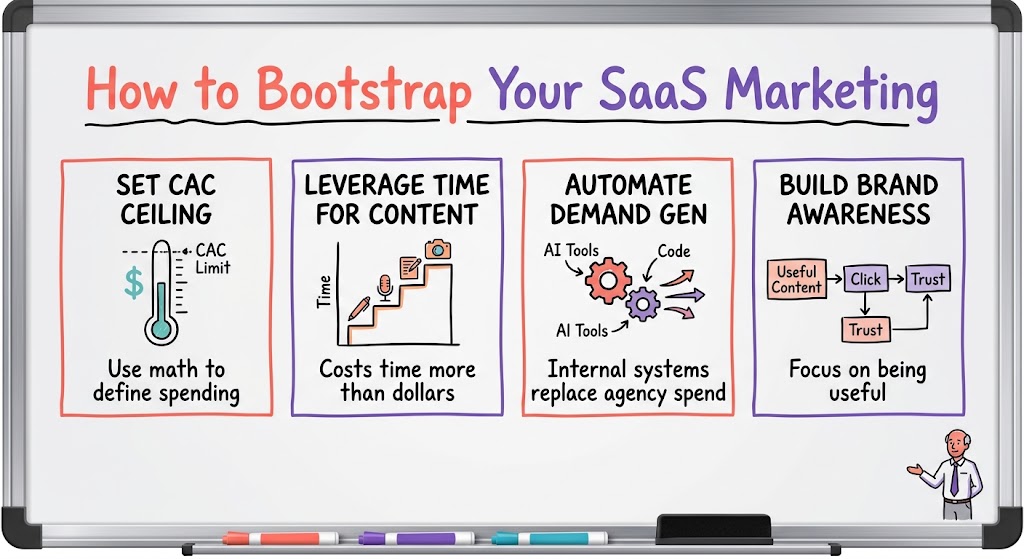
How to Bootstrap Your SaaS Marketing
What to do when you have a real product, real customers, and no marketing budget at all, based on a founder Q&A where the answer wasn't a single tactic but a framework for choosing one.

"We have no marketing. Where do I even start?" That was a founder's actual question on a recent SaaS mastermind call, and it's a more common place to be than people admit. He'd built a solid product, picked up a few dozen paying customers through outbound email and referrals alone, and had no marketing budget to speak of. The conversation that followed is a good template for any founder starting from zero.
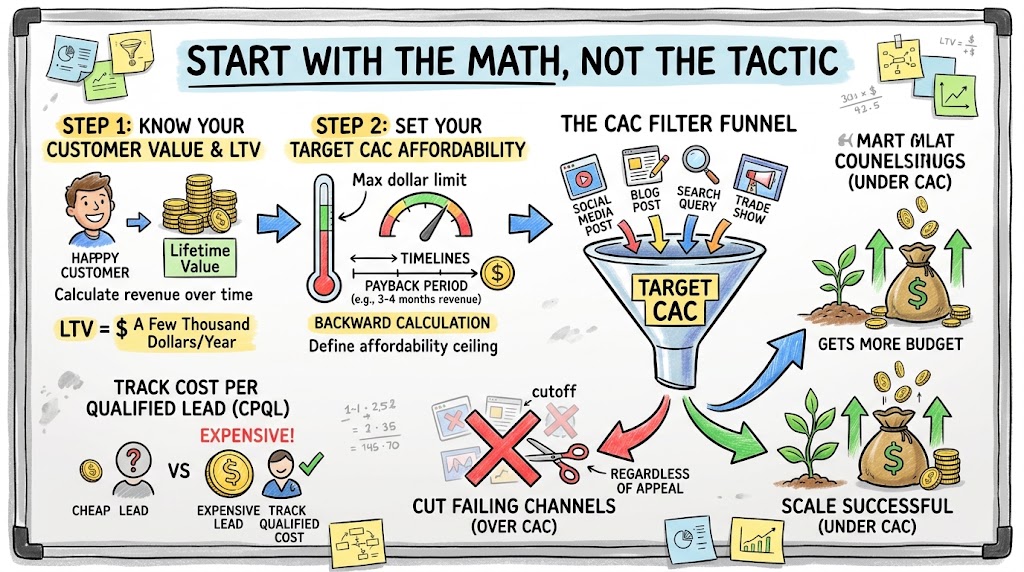
Start with the math, not the tactic
Before recommending a single channel, the first question was about the business itself: what does a customer pay, and what is a customer worth? Once you know a customer is worth a few thousand dollars a year, you can work backward to a customer acquisition cost you can actually afford, based on how many months of revenue you're willing to spend to win the customer. That number becomes the filter for every channel you try next. A channel that gets you customers under your target cost gets more budget. One that doesn't, gets cut, no matter how appealing it looks on paper.
- Know your target CAC before you spend a dollar. If you want to pay back a customer's acquisition cost in three to four months, work out what that ceiling actually is in dollars, not just as a vague idea.
- Track cost per qualified lead, not just cost per lead. A cheap lead that never converts is more expensive than an expensive one that does.
- Let the math decide what to scale. Whatever channel is producing customers below your target CAC is the one worth pouring more resources into, regardless of which channel you expected to win.
The channel menu when the budget is zero
With the math in hand, the channel list for a founder starting from nothing is genuinely broad: organic search and answer-engine optimization, content creation, affiliate marketing, paid advertising in its various forms like retargeting and lookalike audiences, LinkedIn posting, and even trade shows. The point isn't to run all of them at once, it's that a founder with no budget and no team still has real options beyond just running more cold email.
- Retargeting is the cheapest paid add-on. If someone already hit your site once, showing them more content afterward reinforces your brand without needing to win a stranger's attention from scratch.
- Content and organic search play the long game. They cost time more than money, which makes them a natural fit when cash is the scarce resource, not hours.
- Outbound and affiliate marketing can both scale without a big budget. Both rely more on effort and relationships up front than on ad spend.
Let AI do the work an agency used to do
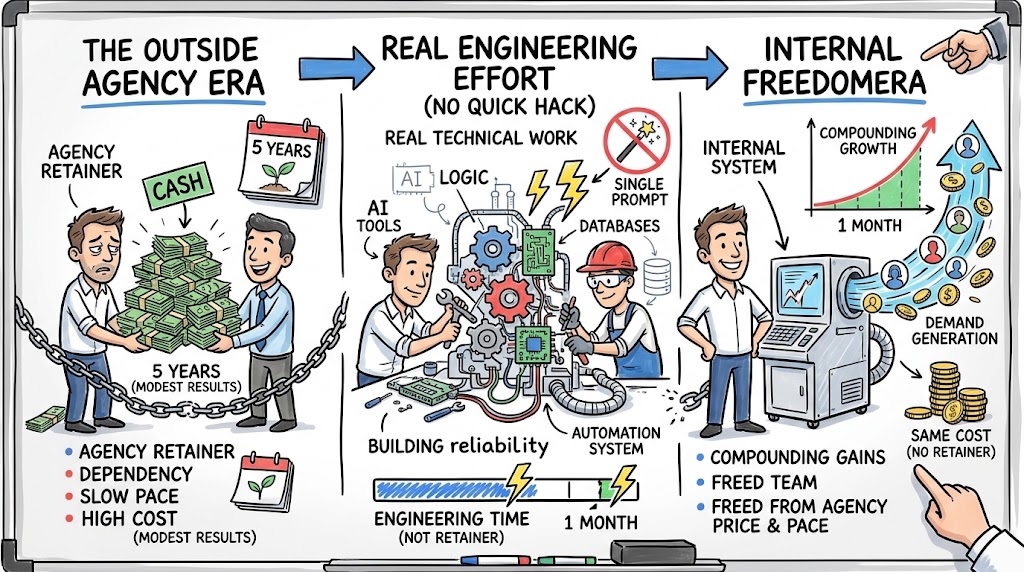
One founder in the group described a different kind of bootstrap: instead of paying an agency, he built an internal automation system using AI tools to generate demand, and it replicated in about a month what an agency relationship had produced over roughly five years. He was quick to add a caveat worth taking seriously: this wasn't a weekend project. It took real engineering effort to build the automation and get it working reliably. But once it was live, it freed his team from being dependent on an outside agency's pricing and pace.
- AI-built demand generation can replace agency spend over time. The upfront investment is engineering time, not a monthly retainer.
- It's not a quick hack. Building a reliable automated system takes real technical work, not a single prompt.
- Once it's built, it compounds. Unlike an agency relationship you're paying for every month, an internal system keeps running at the same cost once it's working.
Build brand equity even before you can attribute a sale to it
Another founder took a slower, brand-first approach. She started publishing a regular newsletter under her own name and persona, focused entirely on being useful, common mistakes in her industry, regulation changes that affect her buyers, with no sales pitch attached. Click rates were noticeably higher than her cold email campaigns had ever achieved, even though she couldn't yet point to a single converted customer from it. Her logic was straightforward: every click builds her site's domain authority, every open builds familiarity with her brand, and over time that compounds into something that shows up in both organic search performance and how warm a prospect is by the time outbound reaches them.
- Not every channel needs to convert on day one. A content channel building brand and domain authority is doing real work even before you can trace a dollar back to it.
- Give away real value, not a pitch. Content that only teaches something useful earns the open and the click; content that's secretly a sales pitch usually doesn't.
- Watch the leading indicators. Click-through rate and repeat opens are a reasonable proxy for whether the content is working, even before conversion data exists.
Consider distribution through other people's audiences
The conversation closed on a distribution model that's easy to overlook: instead of selling directly to end customers, sell through people who already have an audience or a customer base of their own. One approach mentioned was white labeling, letting other businesses resell your software under their own name in exchange for a monthly cut, rather than trying to win every customer under your own brand. Several well-known SaaS companies grew this way early on, building a customer base of agencies that depended on their software to run their own client work.
- Selling to businesses that resell to their own customers multiplies your reach. One agency partner can bring you dozens of end customers you'd never have reached individually.
- White labeling removes your brand from the equation. That can be a feature, not a bug, if it makes the software easier for a partner to say yes to.
- Ask who already has the audience you want. The fastest path to customers you don't have yet is often through people who already have relationships with them.
Retargeting: the cheapest thing worth doing today
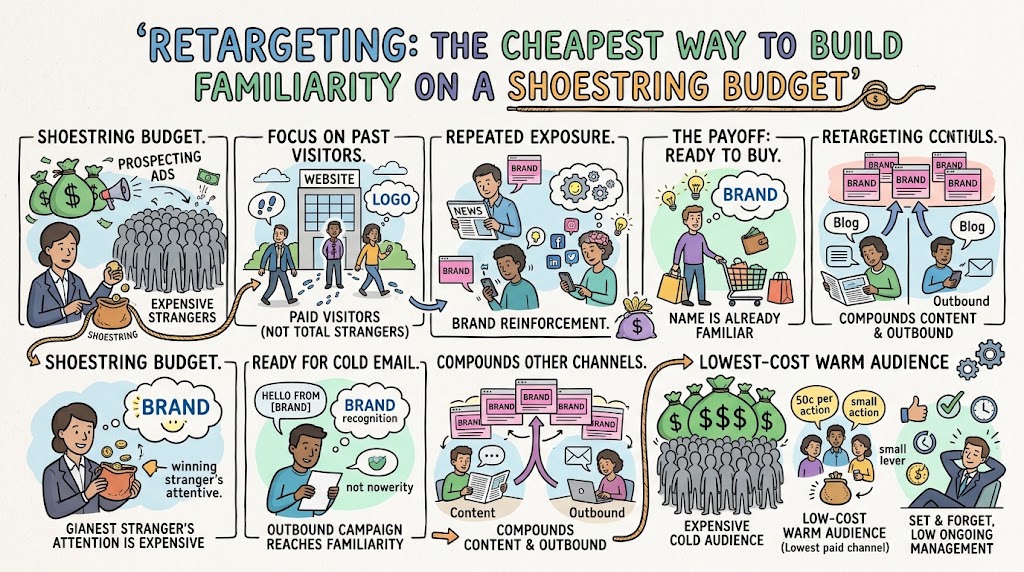
If you can only add one paid element to a shoestring budget, several founders pointed to the same answer: retargeting. It's inexpensive relative to prospecting ads because you're only showing content to people who already visited your site once, which means you're not paying to win a total stranger's attention. That repeated exposure reinforces the brand in a prospect's mind, so that by the time they're ready to buy, or ready to open a cold email from your outbound campaign, your name is already familiar instead of coming out of nowhere.
- Retargeting compounds with your other channels. It doesn't replace outbound or content, it makes both of them more effective by keeping your brand visible to people they've already reached.
- It's usually the lowest-cost paid channel available. Because the audience is warm already, the cost per impression and per click tends to run well below cold prospecting.
- Set it and mostly forget it. Unlike a full campaign build, a basic retargeting setup takes little ongoing management once it's live.
It's a small lever, but it's the kind of small lever worth pulling before anything more ambitious, because the cost of getting it wrong is low and the payoff, more familiarity at the moment someone is actually ready to convert, is real.
Watch out for the basics that quietly sink a campaign
One founder on the call flagged something easy to overlook when you're focused on channels and budgets: whether your website can actually be reached at all. A fellow member's outbound-focused domain had landed on a security blacklist, which meant a chunk of prospects opening a cold email and clicking through were hitting a browser warning instead of a landing page. It's a small, unglamorous thing to check, but it's the kind of issue that quietly undercuts every other channel you're running, since no amount of clever targeting matters if the click doesn't land.
- Check your domain's reputation periodically. A blacklisted or flagged domain silently tanks conversion on every channel driving traffic to it, without showing up as an obvious problem in your metrics.
- Test your own funnel from a fresh machine. Loading your own site from a browser and network you don't normally use can surface warnings or blocks you'd otherwise never see.
- Fix infrastructure issues before optimizing creative. A perfectly written cold email is wasted if the landing page behind it throws up a security warning.
If there's one thread running through all of this, it's that "no marketing budget" doesn't mean "no marketing options." It means picking channels that trade time, relationships, or engineering effort for the dollars you don't have, and being disciplined enough to measure what's actually working against a number you set before you started spending anything at all. Start with the math, pick one or two channels you can actually execute without a team, and let the results tell you where to double down next.