How SaaS Founders Are Using AI to Scale Their Businesses
A look at how SaaS founders are actually deploying AI right now, across internal operations, revenue generation, and product development, and why the real constraint isn't the technology but getting the whole team to use it.

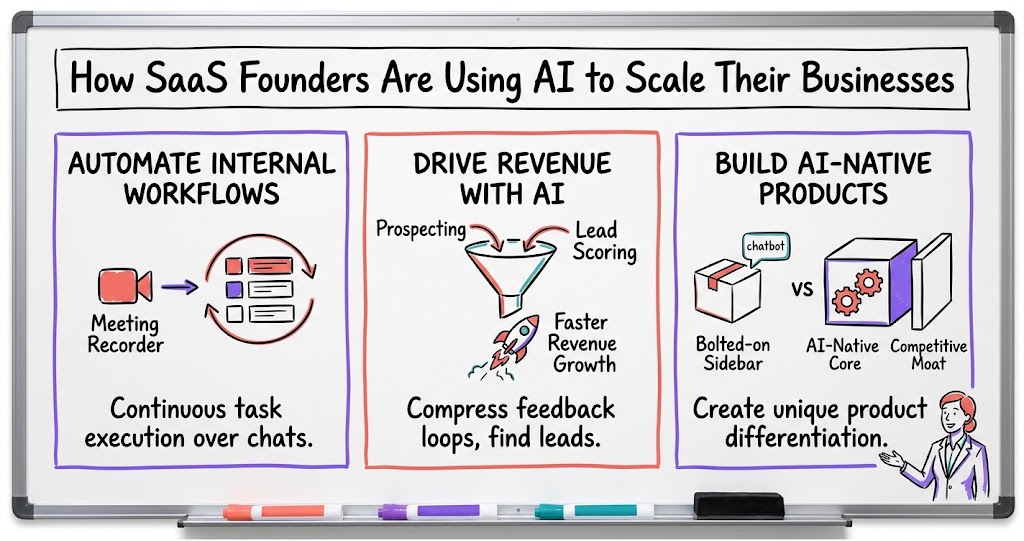
A year ago, most of the AI conversation in founder circles was speculative. What will this mean for our industry, should we be worried about it, is this actually going to change how we work. That conversation is mostly over. Talk to a handful of SaaS founders right now and you'll find people who have already rebuilt pieces of their internal operations, their go to market motion, and even their product roadmaps around AI, and they're comparing notes on what's working the way other founders used to compare notes on paid acquisition or hiring. AI stopped being a future consideration somewhere in the last year. It's an active lever for growth today, and the founders pulling on it hardest are seeing it show up in three places: how their team gets work done internally, how they generate and close revenue, and what they're actually building.
Internal operations: from chatbot to compounding workflow
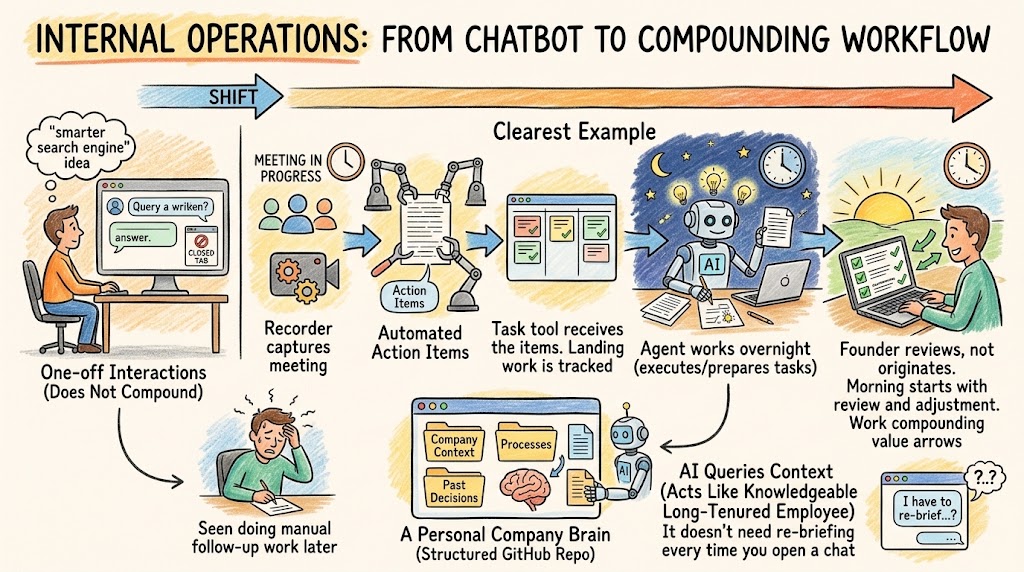
The biggest shift isn't that people are using AI more. It's what they're using it for. Early on, most founders treated AI like a smarter search engine. You'd open a chat window, ask a question, get an answer, close the tab. That's a one-off interaction, and one-off interactions don't compound. What's changing now is founders building actual workflows where AI does real work continuously, on a schedule, without someone having to remember to go ask it something.
The clearest example of this is what's happening around meetings. Instead of someone taking notes and then, days later, half remembering to follow up on the action items, a meeting recorder captures everything that was decided, pushes the action items straight into a project management tool, and an AI agent starts executing or preparing those tasks overnight. Founders using this setup describe waking up to work that's already most of the way done, so the first hour of the day is review and refinement instead of a blank page.
- The recorder captures the meeting. Action items get pulled out automatically instead of relying on someone's notes.
- The task tool receives the items. Nothing sits in a transcript no one reopens; it lands where work actually gets tracked.
- An agent works overnight. Tasks get drafted, researched, or partially completed before the team logs back on.
- The founder reviews, not originates. The morning starts with checking and adjusting finished work instead of starting from zero.
That kind of workflow only works if the AI actually understands the business, which is why a second pattern is showing up alongside it: founders building what amounts to a personal brain for the company. This is usually a structured repository, often just a well organized GitHub repo, that holds company context, past decisions, and documented processes. The point isn't to have a tidy archive. It's that an AI agent can query that repository at any time and answer questions the way a knowledgeable long-tenured employee would, instead of an agent that has to be re-briefed on the business every time you open a new chat.
Where AI is already showing up in revenue
Operations is where a lot of the early AI work happened because it's lower risk. Revenue is where founders are now pushing harder, because the payoff is direct and the tools have gotten good enough to trust with things that used to require a human's full attention. On the marketing and content side, several founders are running weekly AI-generated research reports that get published straight to their blog and email list, turning what used to be a time-consuming content production cycle into something closer to a standing process. On the sales side, the pattern is similar: AI handling prospecting and building account-based marketing lists that used to eat up hours of a sales development rep's week.
- Weekly research reports. AI drafts recurring content for the blog and email list instead of it depending on someone finding the time.
- Automated prospecting and ABM lists. List building that used to be manual research now runs as an ongoing process.
- Live KPI dashboards. Dashboards connected directly to billing and CRM tools give founders a real-time read instead of a monthly export.
- Auto-summarized call notes. Client calls turn into searchable files without anyone having to write them up after the fact.
The outbound motion is where this gets especially practical. AI-assisted pre-call research means a rep walks into a call already knowing a prospect's history in the CRM, so the outreach sounds personalized instead of generic, without the rep having to spend twenty minutes digging through notes beforehand. And on the coaching side, founders are scoring call transcripts against a custom discovery framework, which turns feedback that used to happen in a monthly one-on-one, if it happened at all, into something a rep can get within a day of the call itself.
That faster feedback loop matters more than it sounds like it should. A rep who finds out three weeks later that they skipped a key discovery question on ten different calls has already lost ten calls' worth of learning. A rep who gets that same feedback the next morning fixes it on call eleven. Compressing that loop from weeks to a day is one of the more underrated ways AI is actually moving revenue numbers right now, even though it doesn't look as flashy as an AI-generated research report.
Building AI-native products, not bolting AI onto old ones
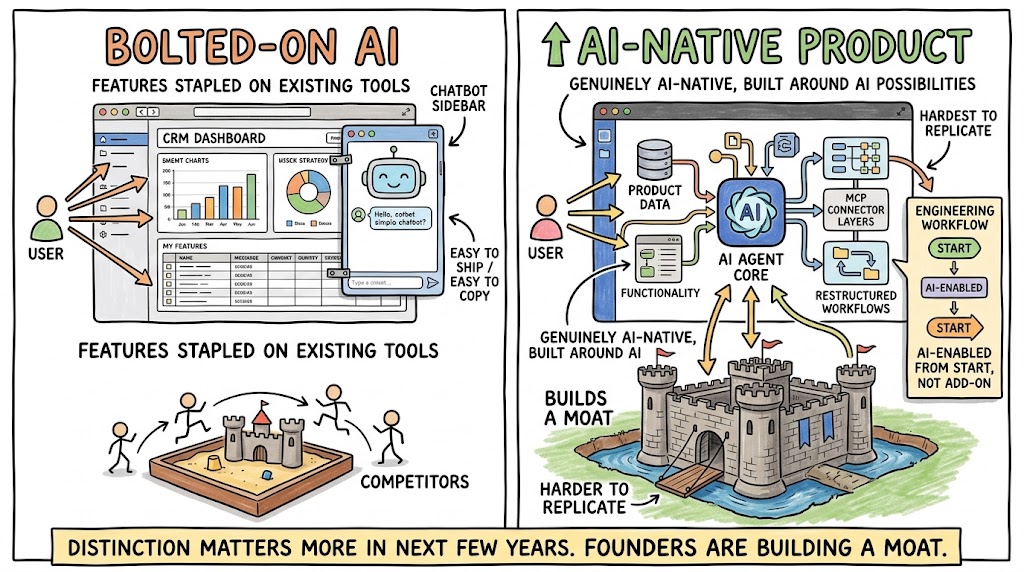
The third area is the product itself. Founders aren't just using AI to run their companies faster, they're building it into what they sell. That's showing up as genuinely AI-native products designed around what AI makes possible rather than features stapled onto an existing tool, and as MCP, or Model Context Protocol, connector layers that let AI agents interact directly with a product's data and functionality. Engineering workflows themselves are getting restructured to be AI-enabled from the start, rather than treating AI as an add-on to how the team already builds software.
This distinction, AI-native versus AI-bolted-on, is going to matter more over the next few years, not less. A chatbot dropped into an existing product's sidebar is an easy thing to ship and an easy thing for a competitor to copy. A product genuinely rebuilt around what an AI agent can do for the user, with the connector infrastructure to back it up, is a harder thing to build and a harder thing to replicate. Founders who are early on this now are effectively building a moat while most of the market is still shipping the sidebar version.
The real bottleneck isn't the technology
Here's the part that founders talk about the most once you get past the tooling questions: building the AI capability is the easy part. Getting the whole organization to actually use it is the hard part. Managers and customer success teams in particular tend to default back to manual processes the moment leadership stops actively reinforcing the new way of doing things. It's not that people are opposed to using AI. It's that old habits are the path of least resistance, and without consistent reinforcement, teams drift back toward them within a few weeks.
- Adoption lags capability. The tools are often ready well before the team has actually changed its daily habits.
- CSMs and managers default to manual. Without active reinforcement, the old process is still the easiest one to fall back on.
- Leadership example is the lever. Teams follow what leadership visibly does, not what a memo says they should do.
- This has to be repeated, not announced once. A single rollout announcement doesn't change behavior; ongoing reinforcement does.
The founders who are furthest ahead treat this as a leadership problem, not a training problem. Sending out a one-time announcement about a new AI tool rarely changes behavior on its own. What actually shifts a team is leadership using the tools constantly and visibly, so that the new workflow becomes the obvious way to work rather than an optional add-on that competes with the old way. Democratizing AI adoption across a whole team, not just the founder or the engineering group, turns out to be the harder and more valuable problem to solve.
Where this is heading
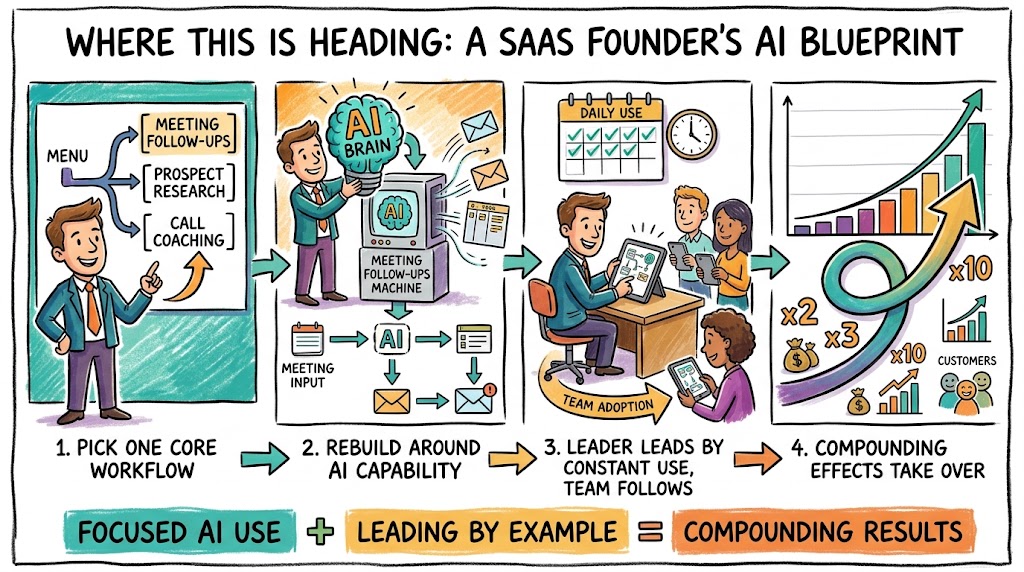
None of this requires a founder to become an AI expert. It requires picking one workflow, whether that's meeting follow-ups, prospect research, or call coaching, and actually rebuilding it around what AI can do today, rather than treating AI as a tool you occasionally remember to open. The founders getting the most out of this moment aren't the ones with the fanciest AI stack. They're the ones using it constantly, leading by example so the rest of the team follows, and letting the compounding effects take over from there. That's a simpler formula than it sounds like, and it's exactly why it's working.