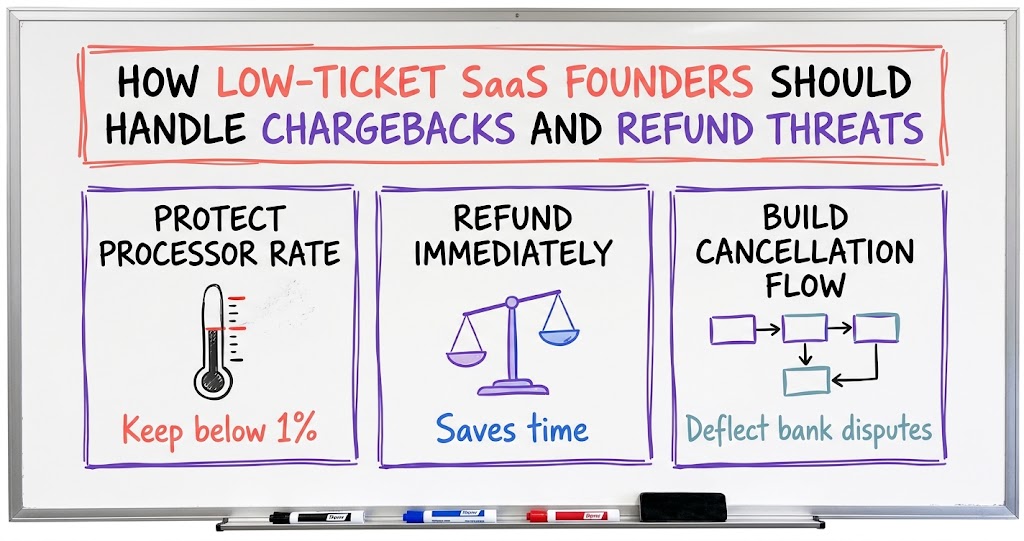
How Low-Ticket SaaS Founders Should Handle Chargebacks and Refund Threats
When a customer threatens a chargeback or a bad review over a small subscription, what should you do? Here's how experienced SaaS CEOs handle disputes, design refund flows, and attract customers who won't cause them in the first place.

There's a particular kind of bad day that every founder with a low-priced product eventually has. Most of your customers are happy and quietly using the product. Your support team, or your AI support agent, handles the routine questions. And then a few escalated messages land on your desk at once: angry customers threatening to file a chargeback, leave a bad review, or call your product a scam.
A founder in our weekly mastermind brought this to the group. They run an outreach automation product with a low monthly entry price, a short free trial, and optional add-ons for heavier users. Their funnel had recently taken off, and with that growth came the first real wave of disputes. In one case, the product had already generated real leads for the customer, and they still threatened a dispute. The founder's question was direct: when someone threatens a chargeback or a bad review, do you just give them a refund? It felt like giving in to blackmail. The CEOs in the room had a lot of experience here, and their answers were practical.
Know your numbers and where the real risk is
My first question was about the dispute rate, and it was running around 1% of transactions. The founder had won every dispute they'd contested so far. That sounds good, but a member who has run a low-ticket SaaS business for years pointed out that winning matters less than you'd think, because the real risk is your payment processor. If your dispute rate gets excessive, they'll cut you off, and you don't want that to happen.
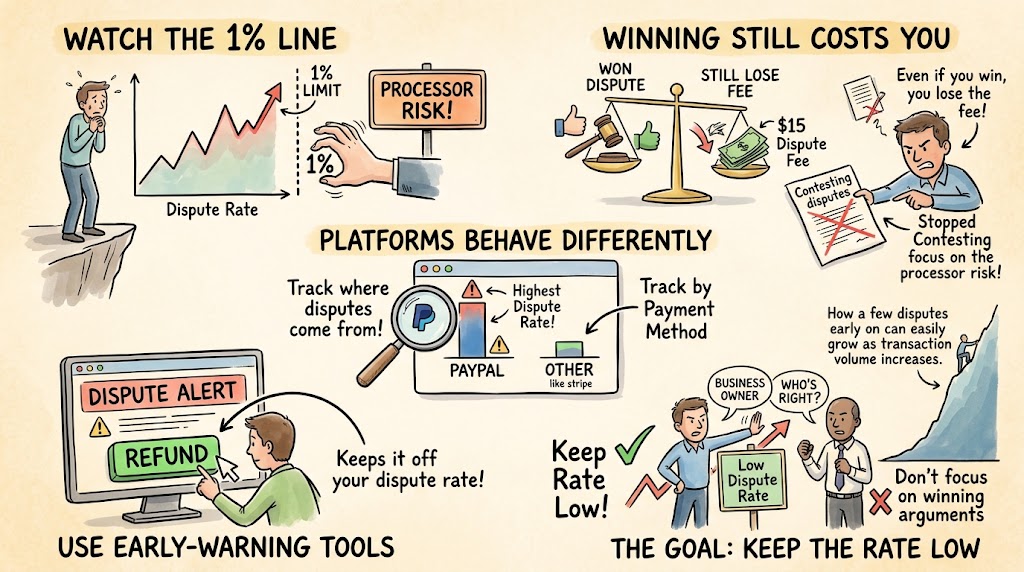
- Watch the 1% line. Around 1% of transactions is roughly where you don't want to go much higher, because processors start paying attention.
- Winning still costs you. That member noted Stripe changed its policy so you lose the dispute fee even when you win, so they stopped contesting disputes altogether.
- Platforms behave differently. The founder saw the highest dispute rate on PayPal, so track rates by payment method, not just overall.
- Use early-warning tools. Some processors let you refund a charge before it becomes a formal dispute, which keeps it off your dispute rate.
It's also worth remembering that at low price points, the absolute numbers are small. A handful of disputes in the first couple of months is simply an early signal to put a policy in place before volume grows and the same percentage turns into dozens of cases a month.
Once you see disputes as a processor-risk problem rather than a who's-right problem, the decision gets much simpler. Your goal is to keep the rate low, not to win every argument.
Refund the small stuff and move on
The consensus in the room was clear: for low-ticket products, when someone sends a threatening message, refund them and move on. The member running the low-priced product said that when they get what he calls a "nastygram," a truly nasty email, he'll often just tell the team to refund a few months so they can stop spending time on it. His company also offers a 30-day, no-questions-asked refund policy, partly because people sometimes get billed and realize they meant to cancel.
Another CEO framed it in terms of opportunity cost. You don't want to give money back after someone has paid, but every escalated dispute costs you time and energy, and some people will happily cost you ten, a hundred, or a thousand times more than the refund would. Both CEOs landed in the same place: the refund is the cheap option.
- Value your time correctly. A founder spending an hour fighting over a small subscription is losing money on the deal.
- Refund threats quickly. For small charges, a fast refund ends the conflict and protects your dispute rate.
- Expect some chargeback fraud. At the low end of the market, some buyers dispute charges by habit, whether or not you delivered.
- Clean up zombie subscriptions. Some disputes come from people who forgot they were subscribed. Clear reminders and easy cancellation reduce these.
I'd add one more piece of advice that I gave the founder directly. Don't sweat the small charges. As I put it, "focus on the things that have five or six numbers in them." You'll be happier, and your attention will go where it actually moves the business.
Build a refund flow so anger has somewhere to go
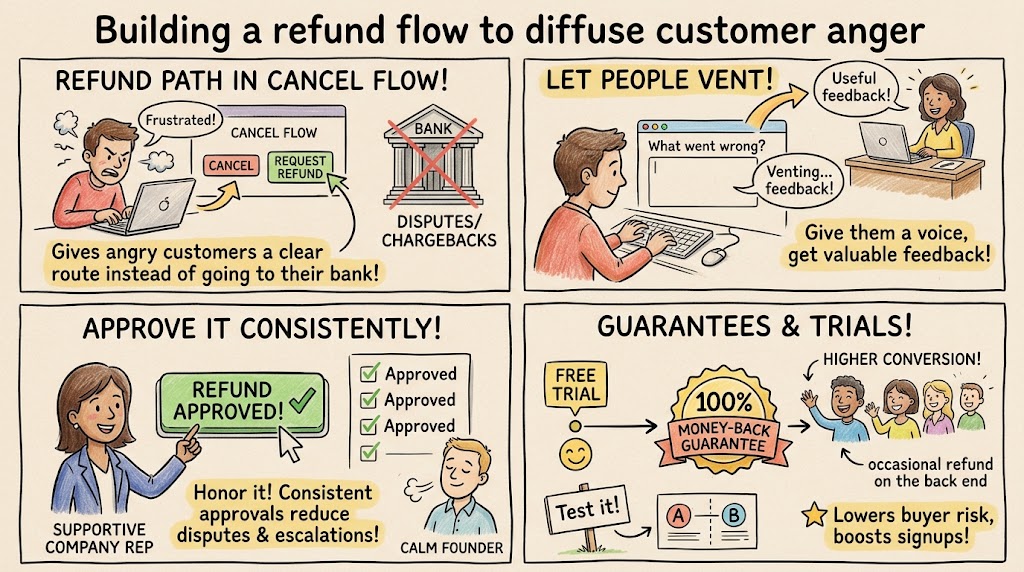
Another founder in the room had a smart middle ground. They used to offer default refunds, then moved to free trials and stopped refunding automatically. But in their cancel flow, upset customers can choose to cancel or request a refund. Either way, they get to explain what went wrong, and the team accepts the refund request every time. For the small number of customers this affects, it took a lot of emotional weight off the founder and reduced disputes.
- Offer a refund path in the cancel flow. Giving angry customers a clear route to a refund keeps them from going to their bank instead.
- Let people vent. A short form where they explain what went wrong gives them a voice and gives you useful feedback.
- Approve it consistently. If you're going to offer the path, honor it. Inconsistency creates more escalations.
- Keep trials and refunds aligned. If you offer a free trial, decide clearly how refunds work afterward and communicate it plainly.
A third member added a point about guarantees. A clear money-back guarantee usually increases signups, because it lowers the buyer's risk. You'll pay some refunds on the back end, but you should more than make up for it with higher conversion on the front end. The founder wasn't sure how to communicate a free trial and a guarantee together, and the advice was simple: test it.
Repel the customers who will never be happy
The deeper fix is upstream. The founder explained that some customers fail because their own offer is weak. If what they're selling isn't compelling, no outreach tool will magically fix that, and those customers tend to be the angriest. Several members suggested using marketing to repel those buyers before they sign up.
- Say the quiet part in your marketing. One member suggested telling prospects plainly that great outreach won't save a weak offer.
- Block bad-fit categories at signup. The founder already blocked certain business types automatically. The same approach can screen out profiles that consistently struggle.
- Find your best customers and target them. Study who gets the most value, then focus your marketing there, even if the audience gets smaller.
- Sell the missing piece. If customers fail because of a weak offer, helping them build a better one could be a far more valuable product.
That last idea got the room excited. A member pointed out that if the product works much better when the customer has a strong offer, helping them build that offer could let the founder charge ten or a hundred times more. The founder already had customers buying larger credit packages and add-ons, which suggests a higher-value segment is there to be found.
There's a real tension here, and the founder named it. A bolder offer brings more people into the funnel and often lowers your cost per acquisition, but it also attracts more people with unrealistic expectations. When a funnel is working, you don't want to break it by tinkering too much. So the move is to keep the headline bold and add a few honest filters around it: clear messaging about who the product is for, screening at signup, and onboarding that sets expectations about what results depend on.
Stay stoic and protect your velocity
The founder was honest that part of the problem was emotional. When you're working 70 to 100 hours a week and an AI agent handles all the happy messages, the only ones you see are the angry escalations. Three in one day can sting. One member joked that the feeling goes away in about 20 years. Another said you eventually accept that the few customers acting badly are the problem, not you.
My best advice on this is that in business, it's all about velocity, and part of having fast velocity is learning to be stoic and not taking things personally. I'm an Epicurean in my personal life, but in my business life I'm definitely a Stoic. Disputes and nasty emails are a cost of running a business at volume. Handle them with a clear policy, a fast refund, and a good refund flow, then put your energy back into the customers who are getting value and the deals that actually move the needle.
- Set the policy once. Decide in advance how you'll handle threats so each one isn't a fresh emotional decision.
- Let support execute it. Give your team or agent clear authority to refund within the policy.
- Look at the pattern, not the message. One angry email is noise. A rising dispute rate in one segment is a signal worth acting on.
Handled well, chargebacks and refund threats become a small, predictable line item. Handled emotionally, they can eat your week. The founders who scale low-ticket products are the ones who make that shift early.