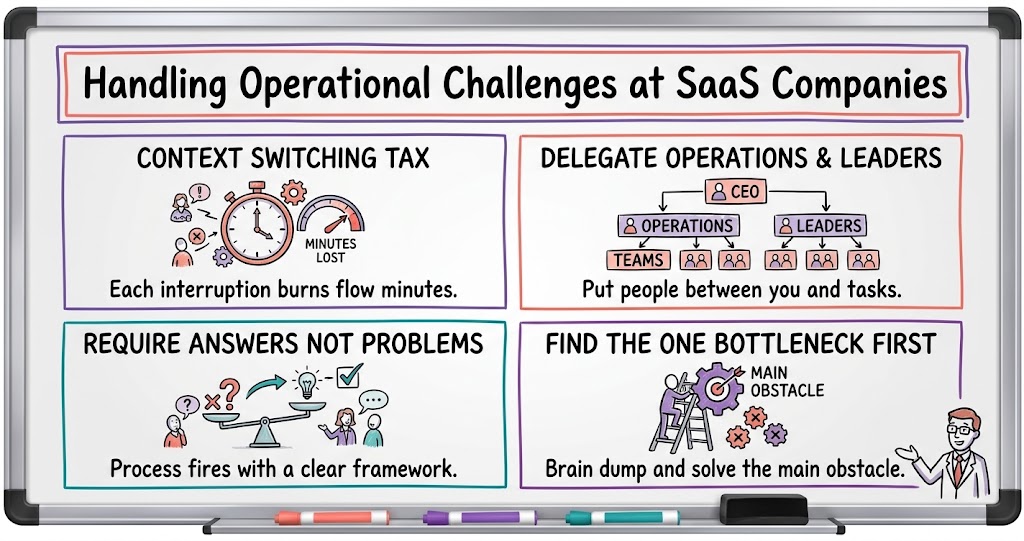
Handling Operational Challenges at SaaS Companies
What to do when you're the CEO and also the default catch-all for everything, covering context switching, when to hire a COO or department leaders, faster hiring trials, and training your team to bring answers instead of fires.

On a recent SaaSRise mastermind call, one of our founders laid out a situation that I'd guess describes half the bootstrapped SaaS CEOs I know. He runs a company of around 45 people, most of them offshore in engineering and support, with only a couple of people in his home market. He's the CEO, and he's also personally covering product, marketing, and operations. Because he does everything, he's become the default catch-all for the whole company. Everyone's problems flow to him, he gets dragged in every direction, and he knows he's not spending his time on the things that would actually move revenue. To top it off, his head of sales had resigned the week before.
His question to the group was simple: do I invest in hiring someone to take operations off my plate, or are there tools and systems that can get me out of this? The conversation that followed pulled in almost everyone on the call, because every founder in the room had lived some version of it. Here's what came out of it.
Context switching is the silent tax
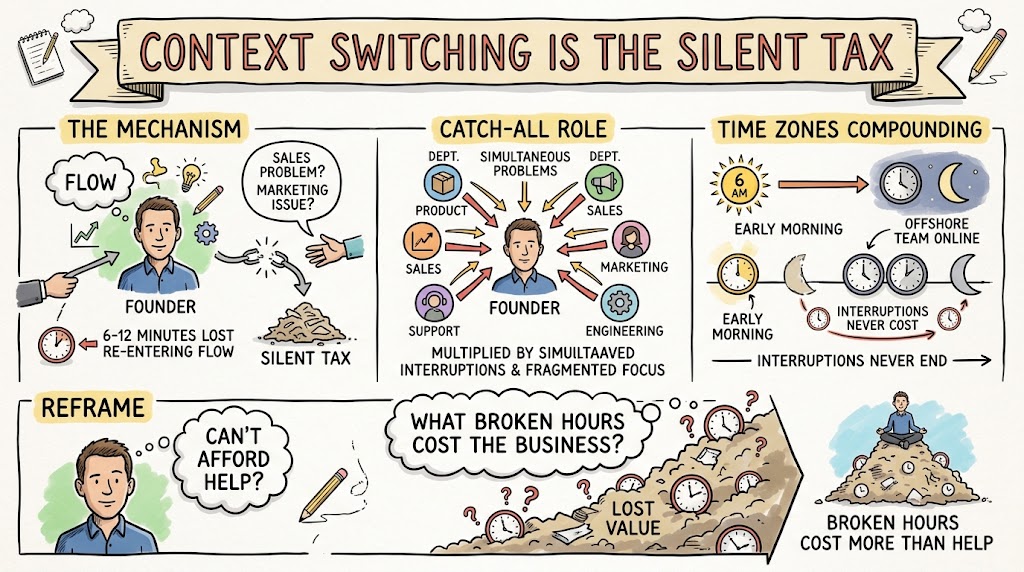
Before getting to hiring, it's worth naming the actual mechanism that was hurting this founder, because he named it precisely himself: context switching. He can be creative and productive when he's in flow, but every time someone pulls him out with an unrelated question, he loses the thread and burns time rebuilding it. One member pointed out that this is well-studied territory. Published estimates put the cost of a single context switch somewhere between 8 and 20 minutes of lost productivity, and even if you take the conservative end, the math gets ugly fast.
- Every interruption costs real minutes. Call it 6 to 12 minutes in practice to fully re-enter deep work after a switch.
- The catch-all role multiplies the switches. When every department reports to you, every department's surprises become your interruptions.
- The cost compounds across time zones. This founder was stretched from 6 a.m. until his offshore team came online in the evening, which means the interruptions never had a natural end.
Seen through that lens, the question stops being whether you can afford help and becomes what all those broken hours are costing the business.
You need someone between you and the people
The most direct advice on the call came down to one sentence from a member who has scaled his own team: you need someone between you and the people. The founder already had a virtual assistant, and a good one, who had taken email triage and routine paperwork off his plate for over a year. But he was hoping to stretch her into mediating customer escalations and coordinating between teams, and the group pushed back hard on that. A VA can book flights and handle process, but the role he was describing is a COO-level job for someone who genuinely loves dealing with people and thrives on it.
Another member framed the hiring decision with a piece of math I think every founder at this stage should sit with. If you freed a CEO at this size to focus purely on growth, most could plausibly generate somewhere between half a million and a million and a half dollars in additional revenue. A VP of Operations costs nowhere near that. As he put it, he has never regretted hiring a great employee.
- Match the role to the problem. An EA or VA absorbs tasks; a COO or VP of Operations absorbs people and decisions. This founder's problem was the second kind.
- Run the opportunity-cost math. Compare the revenue you could drive with your freed-up focus against the fully loaded cost of the hire, not against zero.
- Install department leaders. For a 45-person company, having engineering, support, and sales all effectively report to the CEO is too many threads. Put leaders over the lines of business you're either not interested in running or not the best person to run.
- Consider fractional help first. One member offered to connect him with a fractional COO who works as an EOS integrator, which is a lower-commitment way to test the structure before a full-time hire.
None of this is cheap for a bootstrapped company, which is exactly why the group kept returning to the opportunity-cost framing. The expensive option is usually the CEO continuing to do four jobs badly instead of one job well.
Hire fast, evaluate fast
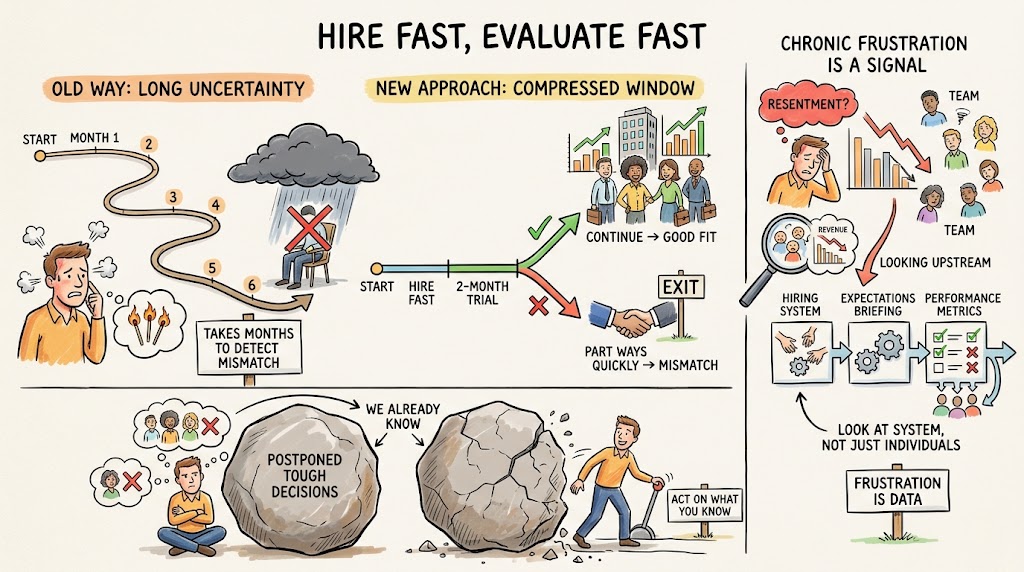
One thing this founder said in passing deserved its own topic. He had been burned three times by hires where it took six months to figure out the person wasn't going to work. His new approach, prompted by the sales resignation, is to bring people on with a two-month trial on a performance basis: if they're good, continue, and if not, part ways quickly. Nobody on the call argued with him.
A related observation from another member cut deeper. Listening to the founder describe his frustrations, he suggested the real pattern might be that the wrong people were being hired in the first place. When you find yourself resenting a whole team, asking why they want raises while customers are churning, that frustration is data. Either the expectations were never made clear, or the people in those seats were never right for them, and both of those trace back to the hiring and management system rather than to any individual.
- Compress the evaluation window. A structured two-month trial beats discovering a mismatch at month six, especially for revenue roles.
- Treat chronic frustration as a signal. If a team consistently disappoints you, look upstream at how they were hired, briefed, and measured.
- Act on what you already know. This founder admitted he had tough decisions he'd been postponing. Most of us know which ones those are long before we make them.
Train the team to bring answers, not fires
The most practical system shared on the call was a four-question framework one member uses across his entire company to stop escalations from landing raw on his desk. Before anyone brings him a problem, whether it's an employee issue, a vendor mess, or an angry client, they have to answer four questions. What happened, meaning just the facts, as if a video camera had recorded it, with no story layered on top. What did we want to have happen. What's missing between those two. And what's next, meaning the one thing we can do about it.
- Facts before story. Separating what happened from the emotion around it defuses most of the drama before it reaches you.
- The gap defines the fix. Naming what's missing turns a complaint into a solvable problem.
- Repeated failure is a seat problem. If someone can't learn to bring answers after coaching, they're probably in the wrong seat.
Alongside the framework, a couple of members made the harder, more emotional point: sometimes you have to let the fire burn. One founder described how difficult that was for him as a technical person, because engineers are wired to believe every bug is theirs to fix and every ticket deserves an instant response. Learning that a fire can burn a little longer, that a customer can wait sometimes, and that everything can still land well in the end, was the biggest mindset shift in getting his time back. Another member quoted a line that stuck with the group: more companies die of indigestion than starvation. The danger at this stage usually isn't doing too little. It's trying to swallow everything at once.
For documenting how things should work in the first place, one member pointed to an AI-powered tool called Playbook Builder that many EOS practitioners use. You record a video of yourself doing or explaining a process, and it transcribes it and drafts the SOP as you go, which lowers the activation energy of getting what's in your head into a form someone else can follow.
Start with one distraction-free hour
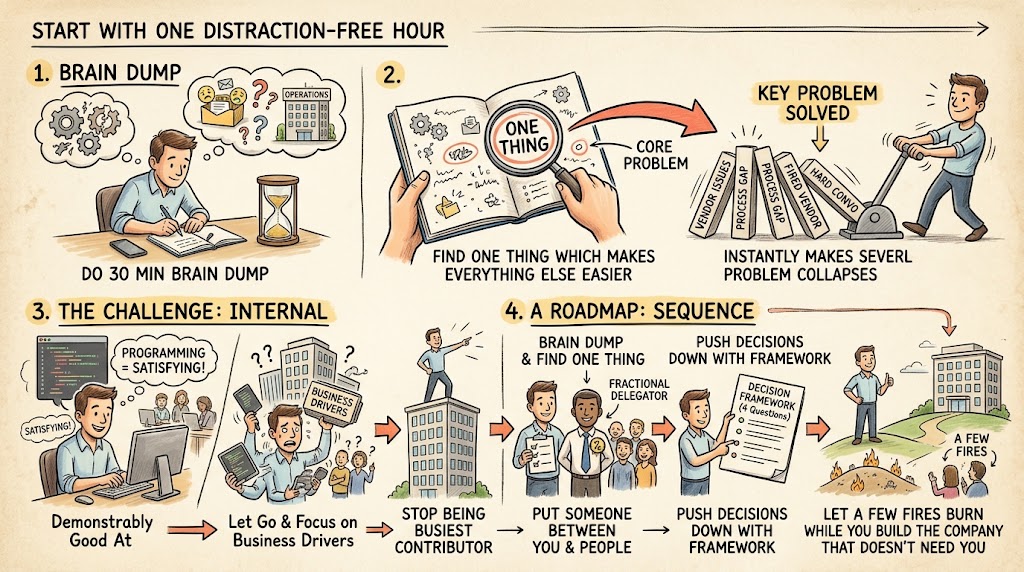
The advice that seemed to land hardest was also the simplest. One member told the founder to sit down for 30 minutes with a notebook and a pen, no phone, no screens, and write down everything that's bothering him. Then look at the list and ask one question: if I could get rid of exactly one thing, which one would make everything else easier? That's the thing to solve first, whether the solution is a hire, a fired vendor, a process, or a hard conversation you've been avoiding.
It pairs with the other recurring theme for technical founders: the hardest operational challenge is often internal. Programming is a creative outlet, it's satisfying, and it's the thing you're demonstrably good at, which is exactly why it's so hard to put down. But as one member said, figuring out how to let go of that and focus on what actually drives the business is the number one thing. The operational challenges get much more manageable once the person at the top stops being the busiest individual contributor in the company.
If you're in the catch-all seat right now, the sequence from the call is a pretty good roadmap. Do the brain dump and find your one thing. Put someone between you and the people, fractional if you need to start small. Push decisions down with a framework like the four questions. And give yourself permission to let a few fires burn while you build the company that doesn't need you in every room.