
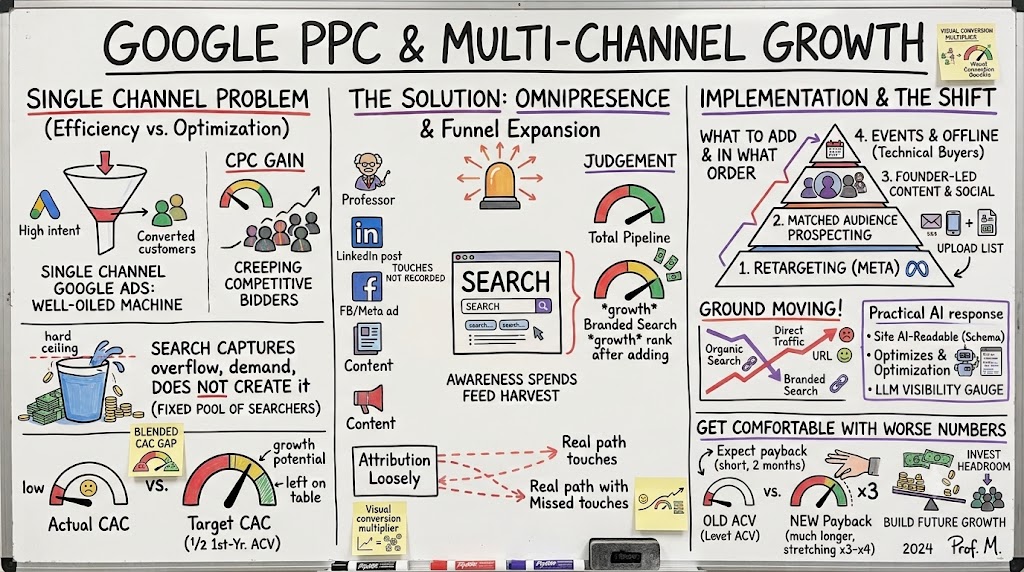
Google PPC and Multi-Channel Growth
What to do when a high-intent search channel taps out: the omnipresence effect that lifts branded search, the shift from organic to AI-driven research, and getting comfortable with worse payback numbers as you add awareness channels.

There is a particular kind of problem that only shows up when something is working. A founder in our community has built a Google Ads program that he describes, accurately, as a well-oiled machine. High-intent searchers type in exactly what they need, they land on his product, and they convert. His payback period is under two months. His actual customer acquisition cost is roughly a quarter of what his unit economics could comfortably support. By any normal reading, this is a company doing paid acquisition right.
And he is stuck. There is only so much search volume for the terms he wins. He is already capturing most of the people who go to Google on their own and type in the thing he sells, and there simply are not enough of them to grow the business at the rate he wants. He tried Bing and decided the juice wasn't worth the squeeze. So he sits on a channel with beautiful economics and a hard ceiling, spending far less than his model says he should, because he cannot find anywhere to put the money.
The ceiling is real, and it moves against you
If you are in this position, two things are happening at once, and neither is in your favor. The first is that Google gets more expensive over time. The longer a set of keywords stays profitable, the more competitors discover them and bid, and costs creep up year over year. You may be running the same campaign with the same conversion rate and watching your cost per click climb for reasons that have nothing to do with you.
The second constraint is the bigger one. Without external effort to make more people aware of the problem you solve and the fact that you exist, the pool of people who will independently go to Google and search for you is fixed. Search captures existing demand. It does not create it. If you have already gobbled up the available search volume on your terms, the only way to grow that channel is to grow the number of people who want to search in the first place, and that work happens somewhere else entirely.
Before you accept that ceiling, check whether it is really a ceiling or a budgeting failure. Two questions worth answering honestly:
- What should your CAC actually be? A reasonable target for many SaaS businesses is a customer acquisition cost around half of first-year contract value. Compare that to what you are actually paying.
- Are you underspending because you are out of room, or because you are comfortable? Being wildly under your target CAC is not a trophy. It usually means you left growth on the table.
That distinction matters, because founders in this spot frequently mistake efficiency for optimization. If your target CAC is several thousand dollars and your actual is a fraction of that, you are not winning. You are underinvesting, and the fix is to find places to spend that will still clear your payback threshold even if they are less efficient than search.
The omnipresence effect nobody puts in a dashboard
Here is the thing that surprises most founders when they finally expand beyond search. We work with a company that had been around for well over a decade, had strong brand equity, and was getting almost all of its paid media sales from Google. Same story: tapped out, no room to expand, buying every available impression on their core terms. When they went omnipresent across other channels, the thing that actually moved was Google search volume itself. It went up.
That effect is easy to explain and hard to measure. Someone sees a LinkedIn post from your founder. They do not click. A week later, a Facebook ad shows up in their feed. They do not book a demo. Then they read something you published, and one day they hit a problem in their business and go to Google and type your company name, or start searching for the category. The channel that gets credit for the conversion is search. The channels that created the conversion are all the ones the attribution model ignored.
So the goal of your second and third channel is often not to directly acquire customers from those channels. Sometimes you can draw a straight line from a Meta ad to a buyer, and that is nice when it happens. But for higher-ACV products that have maxed out search, the honest framing is that awareness spend feeds the high-intent channel that is already converting. You are not trying to replace Google. You are trying to widen the top of the funnel that Google is harvesting from.
- Judge the system, not the channel. Ask whether total pipeline moved when you turned the new channel on, not whether that channel closed deals by itself.
- Watch branded search. If people start typing your company name into Google, your awareness spend is working even when the ad platform gets no credit.
- Hold attribution loosely. Whatever your model tells you, the real path a buyer took almost certainly involved touches you never recorded.
Attribution is getting harder every year, and you have to make peace with that. Whatever you think you are seeing in your data probably is not exactly what is happening. That is not an argument for flying blind, it is an argument for holding your attribution model loosely and paying more attention to whether total pipeline and branded search are growing when you turn a new channel on.
What to add, and in what order
Retargeting comes first, always. It is the cheapest thing you can do and it applies to every persona you sell to, so it never needs to be re-decided as your buyer mix changes. If you have search traffic already, you have an audience worth re-reaching, and running retargeting on Meta gives you broad coverage of those people at a cost per impression roughly an order of magnitude below LinkedIn.
After that, the order depends on who you sell to and what they are worth. A rough sequence that works for most B2B SaaS companies coming off a search-only program:
- Always-on retargeting. Meta first, at whatever budget you can sustain, with a mix of image, video, and founder content.
- Matched audience prospecting. Build the account list, enrich it for personal email and mobile, upload it, and let the platform expand from there.
- Founder-led content and social. Organic posts from a real person, with paid budget behind the ones that land.
- Events and offline. For high-ACV technical buyers, a niche event or a physical package to a target account often beats another digital impression.
One member made a point about events that I think is underrated. Almost every founder who commits to going to industry events reports that they work, and almost every one of them is bandwidth-constrained rather than budget-constrained on that channel. If your buyer is a technical person with a high contract value, the in-person stuff still works, and the fact that it does not scale cleanly is precisely why fewer of your competitors are doing it.
The ground under search is moving anyway
There is a second reason not to leave all your weight on one search channel, and it came up in a different conversation on the same call. A founder with an enormous organic footprint, built over more than a decade, has watched his organic clicks start to decline over the last month in a way that looks like more than seasonality. What he is seeing in the data is that conversions are shifting away from organic search and toward direct traffic, people simply typing his company name into the browser.
His read on it, which I think is right, is that people are doing their research in ChatGPT and other AI tools, forming an opinion there, and then going straight to the company they decided on. The organic traffic is falling faster than the direct traffic is rising, so the two do not net out. If your growth model depends on being the top blue link, that is a shift worth taking seriously now rather than in a year.
The practical response is to make sure you show up in the places those models are reading from, and to widen your presence beyond the search box:
- Get your site AI-readable. Keep your schema current and follow answer engine optimization basics so the models can parse and cite you.
- Show up where models source. Reddit and community content play an outsized role in what AI tools surface, so post where your buyers actually discuss the problem.
- Track your LLM visibility. Tools exist to monitor how you rank inside AI answers, and it is worth knowing your position before it becomes a crisis.
Get comfortable with worse numbers
This is the part founders resist, and it is the most important thing in this article. Search works because it catches people at the exact moment they are looking. That is the highest-intent traffic that exists, which is why your payback period is so good. When you start reaching people who do not yet know they have the problem, your CAC payback period will get considerably worse. Expect it to lengthen by a factor of three or four.
That worse number is simply what buying attention from an unaware audience costs, and it is the price of growing past the ceiling that search put on you. The reason you can afford it is precisely the number that has been frustrating you: your blended CAC has been sitting far below target for years, which means you have headroom that most companies would trade a limb for. Spend it on purpose.
- Expect payback to stretch three to four times. That is the normal cost of reaching people who are not yet looking for you.
- Keep the efficient channel untouched. Do not raid the search budget to fund awareness. Fund awareness on top of it.
- Set a payback ceiling in advance. Decide what length of payback you can live with before you start spending, so a worse number does not panic you into shutting it off.
One founder said it well on a recent call. He knows his current numbers are not sustainable at larger volume, and he does not need vanity metrics anymore. He just needs more people through the door. Once you get to that mindset, the decision gets a lot simpler. Keep the efficient channel running exactly as it is, and start deliberately buying awareness in the places your future buyers already spend their attention, knowing full well that those channels will look worse in a spreadsheet and better in your revenue.