From One Video a Week to Six a Day: What AI-Produced Social Content Looks Like After Four Weeks
Real numbers from a four-week experiment in publishing six AI-assisted videos a day across seven platforms, how the production system works, and what founders should expect before it pays off.

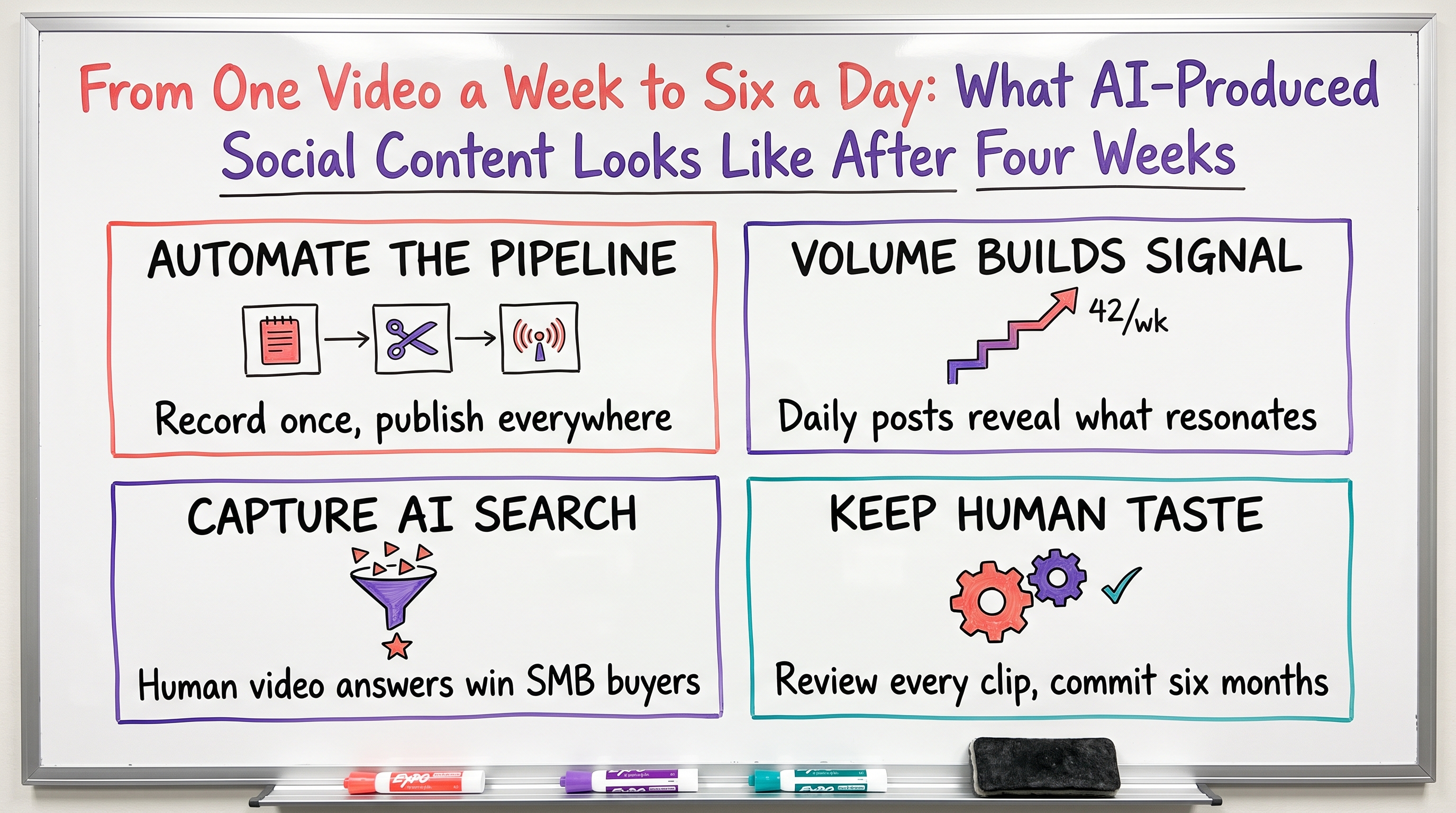
Before the end of October, I published about one video a week. It was a respectable pace for a founder with a day job, and it produced a respectable amount of nothing. Then on October 30th I started running a system that writes scripts, edits footage, and posts to seven platforms at once, and I went from one video a week to six a day. That is 42 a week, from one person. Four weeks in, I have enough data to show you what it produces and what I'd tell any founder who is thinking about trying the same thing.
I want to be careful about how I frame this. The numbers are small by creator standards, the account is new, and nothing has gone viral yet. But two other founders in our mastermind are running similar experiments with their own twists, and comparing notes made me more convinced that the shape of the system matters more than any single video.
The Numbers After Four Weeks
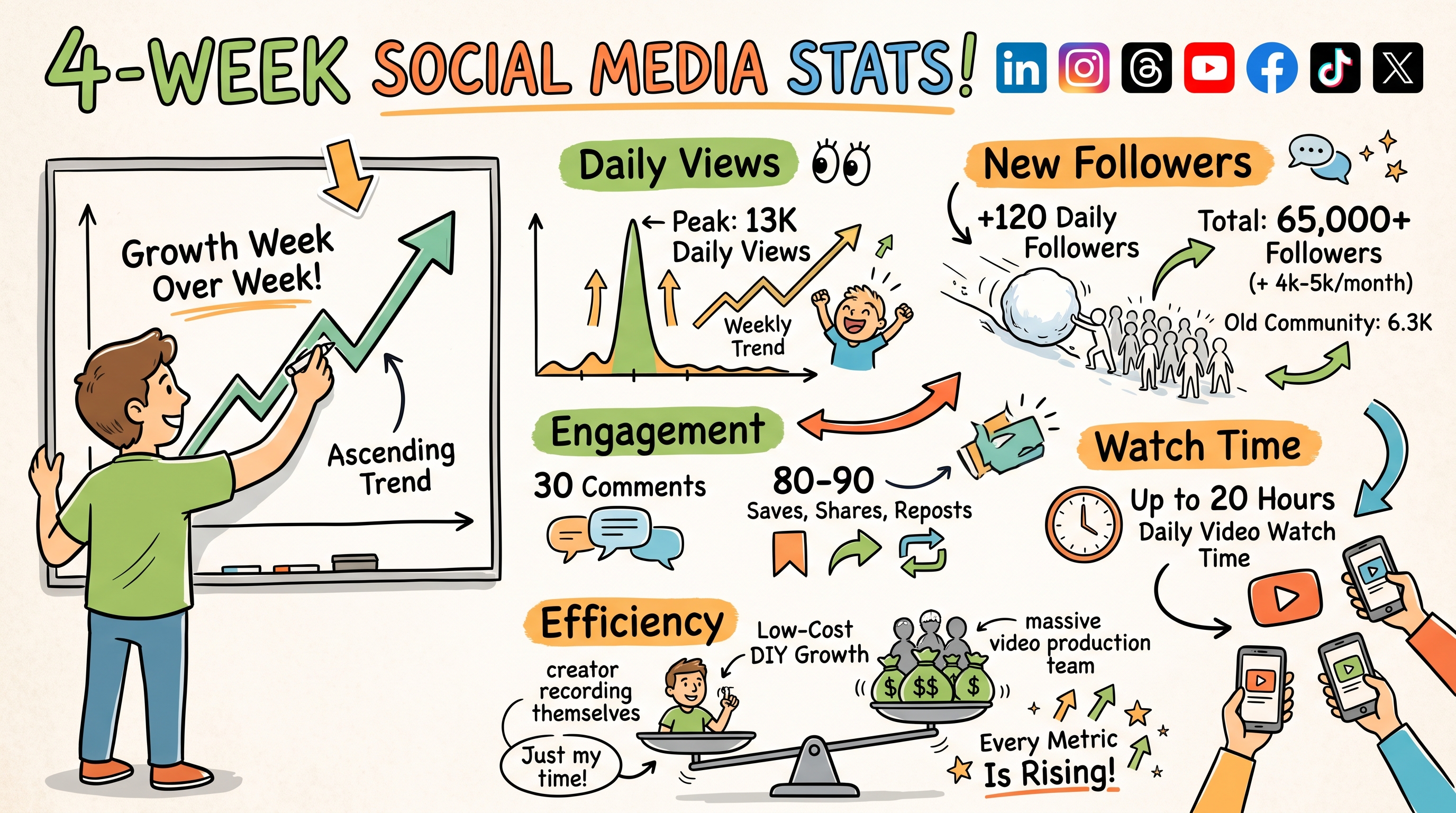
I post to LinkedIn, Instagram, Threads, YouTube, Facebook, TikTok, and X, and I track the combined results daily. Our best day so far reached about 13,000 views, and the trend is growing week over week. We're now adding roughly 120 followers a day and getting about 30 comments a day. Saves, shares, and reposts together run around 80 to 90 a day. Across all platforms, people are watching as much as 20 hours of video per day. Total followers across our channels are around 65,000, growing by four to five thousand a month, and that is on top of a community of about 6,300 members that existed before I started.
- Views. Our peak is about 13,000 a day, and the weekly average keeps climbing.
- Follower growth. About 120 new followers per day across all channels.
- Engagement. Roughly 30 comments and 80 to 90 saves, shares, and reposts per day.
- Watch time. As much as 20 hours of video watched per day across the platforms.
None of those numbers would impress a professional creator. What matters is the direction. Every metric is rising on a weekly basis, and I'm producing the content at roughly the cost of my time to record and approve it, which is a small fraction of what a video team would cost.
How the System Works
The setup is a recording studio built with Claude that writes my scripts for me. I get a script, I record it, and I click submit. In the background, Claude edits the video, cuts it into the right formats, and sends it out to each platform. I make two types of videos this way. The first is a video where I'm on camera and the system handles all of the editing. The second is an explainer video, where a professionally cloned version of my voice from ElevenLabs reads a script over visuals.
A typical explainer is about 15 seconds long and summarizes a single news item. Short videos work better than horizontal ones for us, so most of what we publish goes out as Reels and Shorts, with horizontal versions created for YouTube. The research is automated too. Claude controls my browser, watches YouTube videos in the background, and figures out which topics are working before it writes the next script.
- Script generation. A studio tool drafts scripts based on what's performing and what's in the news.
- Recorded videos. I record the script once, and the editing happens automatically after I submit.
- Explainer videos. A cloned voice reads short scripts over visuals, so no recording is needed.
- Distribution. The same piece goes to seven platforms in the right format for each one.
- Research. The system watches videos in a browser to decide which topics to cover next.
The part I like most is how little of my day it takes. My job is to record and to review. Everything else, writing, editing, formatting, and scheduling, happens without me.
Why Volume Is the Point
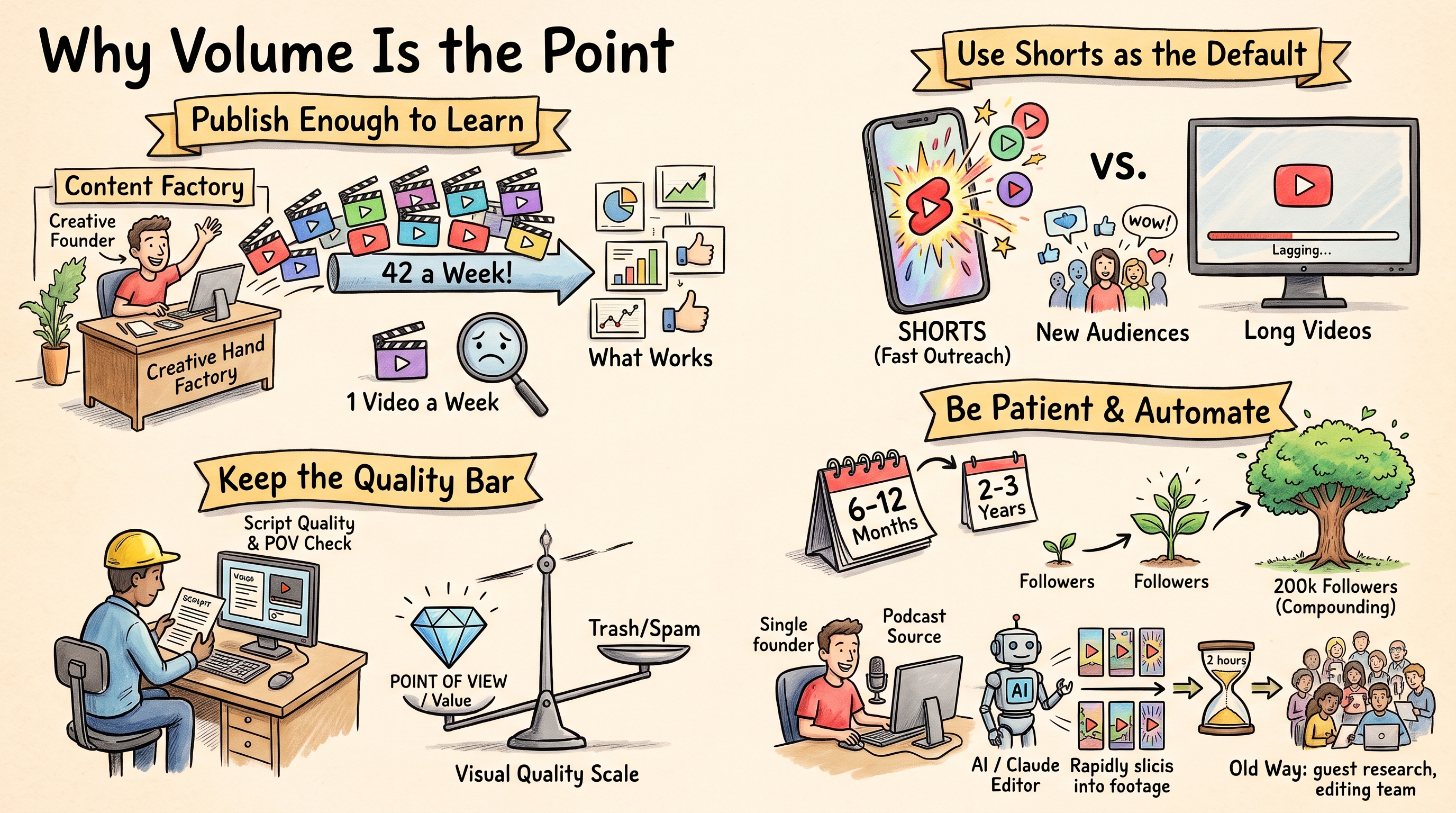
Consistency is what makes the math work. A new account has no audience and no algorithmic trust, so the only way to find out which topics resonate is to publish a lot of content and watch what happens. Some of our shorts reach 1,000 views quickly, and the goal is to keep producing about six quality videos a day per account until a few of them break out. In my experience it generally takes six to twelve months of high-quality posting in one niche before you start going viral, and if the trend holds, I expect to be around 200,000 followers in two to three years.
- Publish enough to learn. Forty-two pieces a week gives you far more data about what works than one video a week ever could.
- Keep the quality bar. Volume only helps if each piece is useful, so the scripts still need a point of view.
- Use shorts as the default. They get through to new audiences faster than long horizontal videos in our testing.
- Be patient with a new account. Expect six to twelve months before the compounding starts.
Another founder in our group shared an even more aggressive version. He told us he takes a podcast, runs it through an editing tool connected to Claude, and uses an agent to post everything. He's now publishing around 16 videos a day, from really high-quality source material, as a single person. He mentioned that years ago, when he ran podcasts the old way, he needed a full-time person to research guests and do the edits. The work that took a full-time employee now takes him a couple of hours.
Is Social Video Worth It for B2B?
It is unusual in B2B to talk about social media this much, and I understand the skepticism. If you sell a six-figure enterprise product, a short-form video probably won't close a deal. But both of the founders I compared notes with sell products to small and midsize businesses, where customers pay anywhere from $50 to $500 a month. In that range, buyers do discover vendors through content, and the overlap with consumer-style marketing is real.
There is also a second payoff that I didn't expect: AI search. One founder reported that his YouTube answers are starting to show up in AI-generated responses. These tools keep looking for new sources, and a short video where a real person answers a specific question in two or three minutes is exactly the kind of human content they pick up. I'd rather have my answers show up there than compete with another thousand generic blog posts.
- Good fit. Products priced between roughly $50 and $500 a month, where individuals or small teams buy.
- Weaker fit. Large enterprise sales with long cycles and committees.
- AI search benefit. Specific, human answers on YouTube can be picked up and cited in AI responses.
- Ad fuel. Once you know which videos land organically, you can run the winners as paid ads to a targeted audience.
One more founder said he'd considered starting a podcast but dropped it because of the time it requires. Seeing this approach made him reconsider, and he plans to bring the idea to his team during budget planning. That is probably the most useful reaction, because the tools have changed the cost of entry so much that an idea you dismissed two years ago deserves another look.
One thing worth saying plainly is that the tooling only removes the production work. It does not remove the need for taste. Some of my scripts land and some fall flat, and the only way I know which is which comes from watching the numbers each week and adjusting the next batch of topics. That feedback loop is the real skill, and it is one a founder can learn quickly if the system is publishing enough content to give clear signals.
What I'd Tell a Founder Starting This Month
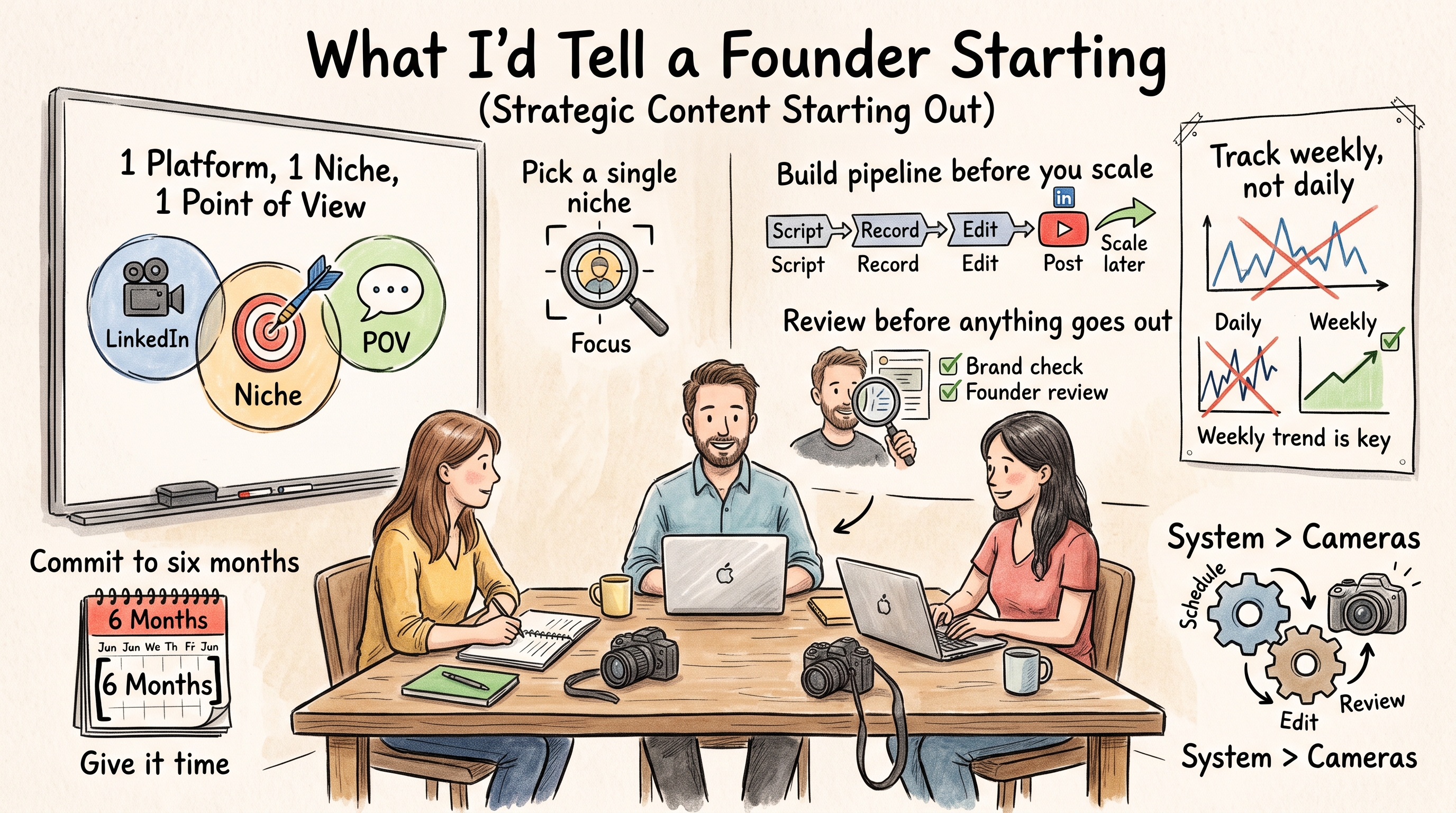
If you're thinking about trying this, I'd start with one platform, one niche, and one clear point of view. You can add platforms once the pipeline works. The part to protect is your own judgment. The system can write and edit, but it can't decide what your company stands for, so that part of the work stays with you.
- Pick a single niche. Pick the topic where you have real credibility and stay on it for months.
- Build the pipeline before you scale it. Get script, record, edit, and post working for one platform first.
- Review before anything goes out. A quick check on every piece protects your brand.
- Track weekly, not daily. Daily numbers bounce around, and the weekly trend is the one that tells you something.
- Commit to six months. Decide up front how long you'll run it before judging the results.
The founders I know who are getting ahead with content aren't the ones with the best cameras. They're the ones who treat production as a system, publish constantly, and wait long enough for the results to arrive. Four weeks isn't long enough to prove anything, but it was long enough to convince me that the system is worth continuing.