
Freemium: When It Works (and When It Wastes Ad Spend)
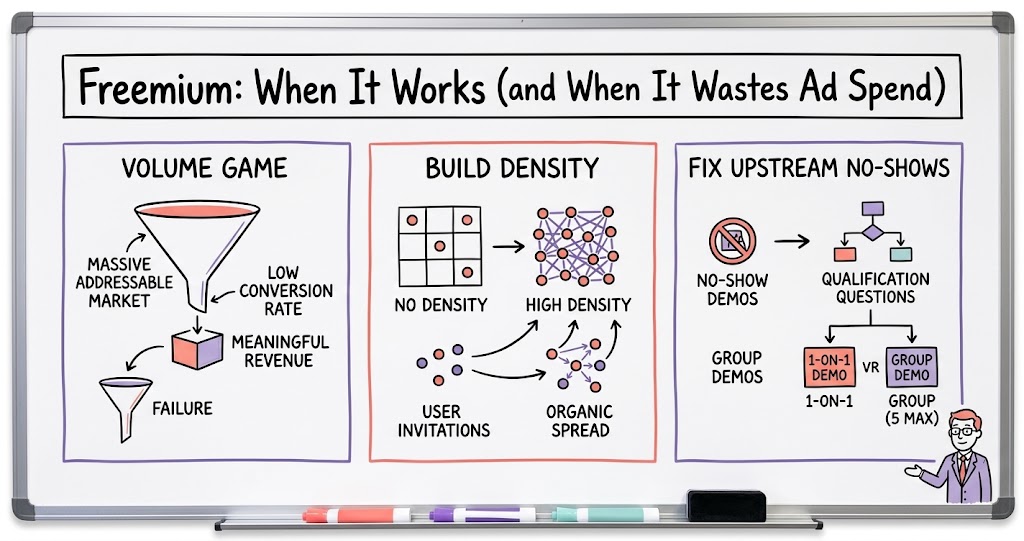
Two founders in the same mastermind tried freemium for opposite reasons, one to fix low conversion and one to fix low show-up rates, and their outcomes diverged sharply based on a rule that's easy to state and easy to ignore: freemium only works at real scale.

A founder building a community platform for churches asked the mastermind for feedback on a freemium pivot he'd just made. His funnel was full of small churches booking demo calls and then not showing up, despite doing everything he could think of to get them there. His fix was to offer a free plan for smaller churches and try to upsell the bigger ones that came in through it. He'd just launched it and wanted to know what the group thought. What came back was some of the most specific, hard-won advice on freemium you'll hear in a room full of SaaS founders.
Freemium needs a massive market to work
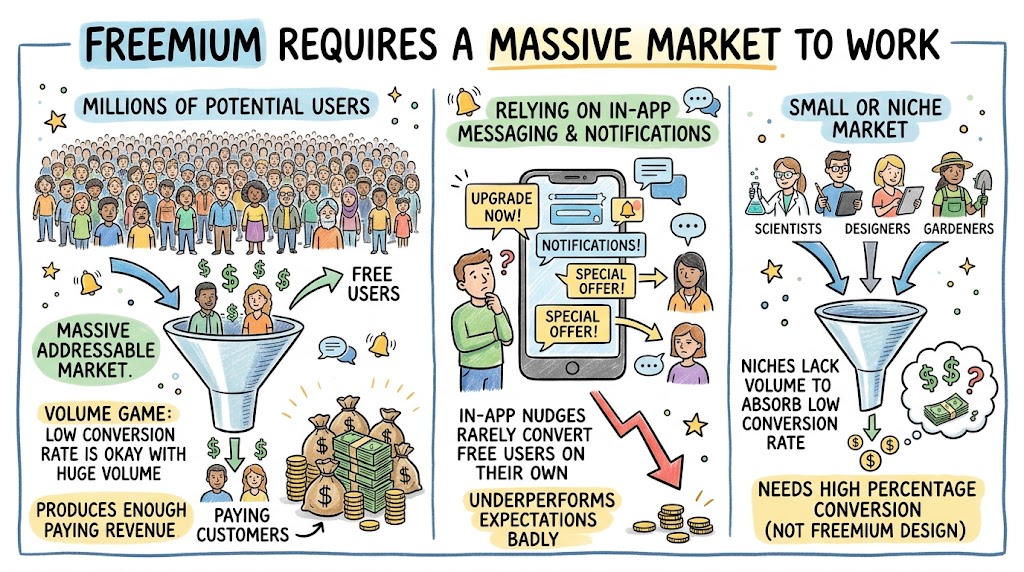
The clearest answer came from a founder who had recently run the exact experiment himself. His take was direct: freemium really works when you're operating in an enormous market, one with millions of potential users, where you can accept a low conversion rate because the sheer volume of free users still produces enough paying customers to matter. Outside of that scale, he warned, founders often assume they can convert free users through in-app messaging and notifications alone, and in his experience, that assumption is very hard to make work in practice.
- Freemium is a volume game. It works when the addressable market is large enough that even a low conversion rate produces meaningful paying revenue.
- In-app nudges rarely convert free users on their own. Relying on notifications and messaging to push free users toward paid plans tends to underperform expectations badly.
- Smaller or niche markets don't have the volume to absorb a low conversion rate. A niche audience needs a much higher percentage of free users to convert, which freemium isn't usually designed to deliver.
The cautionary tale: a lower-priced tier that backfired
The founder sharing this advice had tried something adjacent to freemium earlier in the year: a lower-priced product tier meant to compete with cheaper competitors in his market. It brought in a flood of sign-ups, exactly what a lower price point is supposed to do. But the trial-to-paid conversion rate on that tier was low, and the churn on the customers who did convert was high. He eventually killed the tier entirely. The volume of interest was real. The economics behind it weren't.
That experience is the practical version of the market-size warning above. A lower price point, whether it's a discounted paid tier or a fully free plan, will almost always generate more top-of-funnel activity. The question that actually determines whether it's worth doing is what happens after that activity arrives: do enough of those users convert, and do the ones who convert stick around long enough to be worth the cost of serving them for free or near-free in the meantime.
- More sign-ups isn't the same as more revenue. A cheaper or free tier reliably increases volume. It doesn't reliably increase the number of customers who end up paying full price.
- Watch churn on discounted or free tiers closely. Customers who arrive at a low price point can also be the customers least committed to sticking around.
- Be willing to kill a tier that isn't converting. A lower-priced or free plan that produces volume without proportional paid conversion is worth cutting, even after real investment building it.
Why the church-focused founder's situation is different, and possibly better suited to freemium
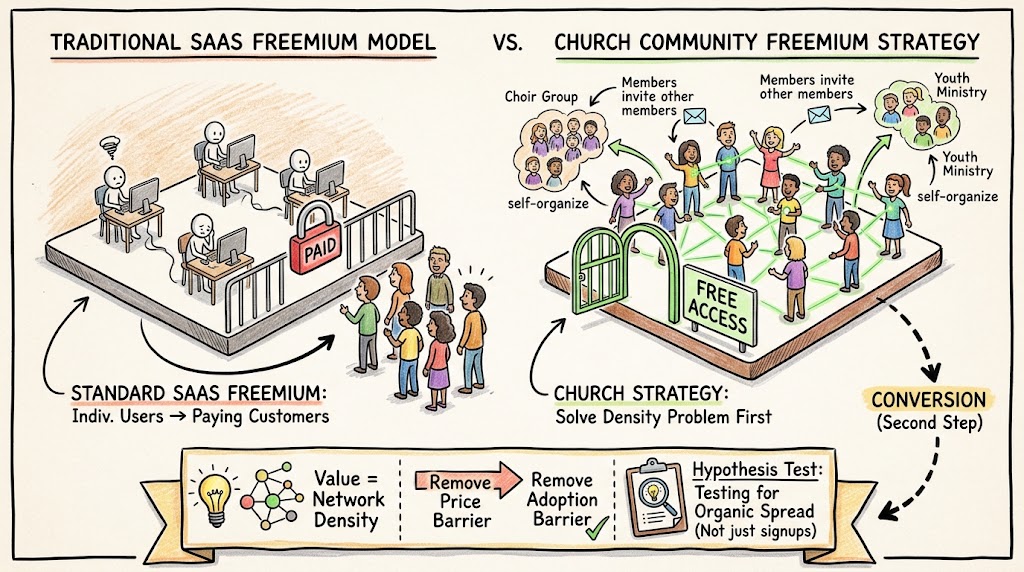
Despite the warning, there's a real argument that freemium could work in this specific case, and it's worth understanding why. The founder's product is a community-building tool, and its value increases with the number of people using it inside a given church. A handful of paying users doesn't create enough density for an online community to feel alive, but free access removes the barrier that was keeping smaller churches from ever reaching that density in the first place. The founder's own instinct was that if he can get enough people from a church using the platform for free, it can reach a kind of gravity that starts spreading on its own, church members inviting other members, ministries within the church using it for their own purposes, and so on.
That's a genuinely different mechanism than a typical SaaS freemium play. Most freemium products are trying to convert individual free users into individual paying customers. This one is trying to use free access to solve a network-density problem first, and treat conversion of the larger, more engaged churches as a second, later step. Whether that works depends on whether the free tier actually reaches the density needed to create that self-sustaining spread, which is a real open question the founder is now testing in practice.
- Match the free tier's purpose to your product's actual value driver. If your product gets more valuable as more people in a group use it, free access can solve a density problem that paid access never would.
- Be honest about which problem you're actually solving with free. Removing a price barrier and removing an adoption barrier are different goals, and they call for different measures of success.
- Treat this as a real experiment with a real hypothesis to test. The value of a free tier used this way depends on whether it actually reaches the density needed for organic spread, not just whether sign-ups go up.
A simpler fix for the no-show problem that has nothing to do with pricing
It's worth noting that the original problem driving this decision, prospects booking demo calls and not showing up, wasn't actually a pricing problem at all, and other founders in the conversation picked up on that. One suggested that the real issue might be a lack of qualification earlier in the funnel: if ads are optimized purely for volume of sign-ups rather than for a defined qualified lead, the funnel fills up with people who were never seriously evaluating the product in the first place, and no pricing change fixes that. Adding a qualifying question or two before someone can book a call tends to shrink the top of the funnel while dramatically improving how many of those calls actually happen and convert.
That distinction matters for anyone considering freemium as a fix for a conversion or engagement problem. Before assuming a pricing change will solve it, it's worth asking whether the real issue is upstream, in who's entering the funnel in the first place, rather than downstream, in what they're asked to pay once they're in it. Freemium can be the right call, but it's a strategy for markets with real scale or products with genuine network effects, not a patch for a lead-qualification problem that a simpler filter earlier in the funnel would fix for free.
The demos also matter, not just the pricing tier
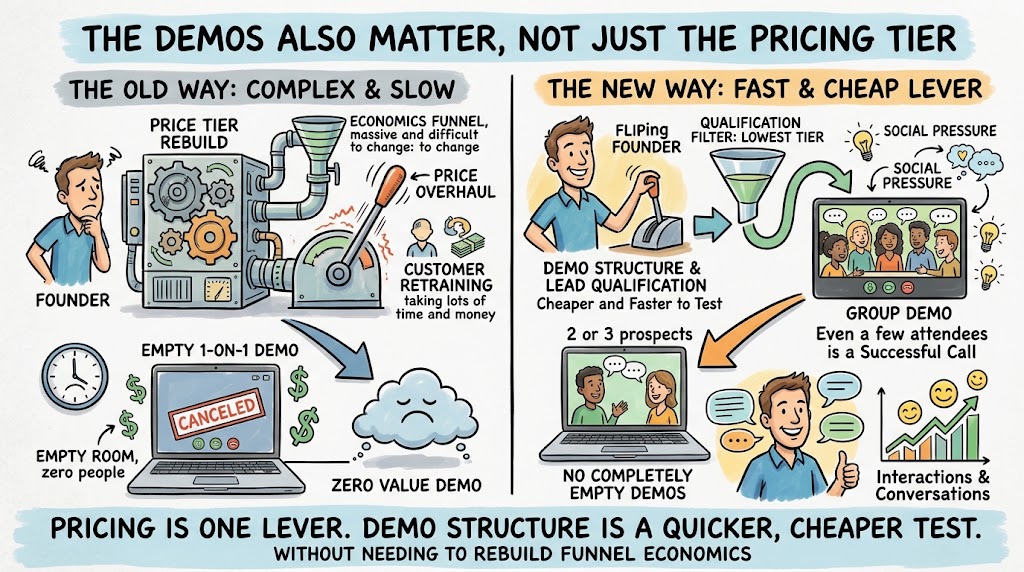
A related fix came up from a different founder in the group who had faced the same no-show problem with booked demo calls, and solved it without touching pricing at all. His team started routing prospects on the lowest-priced plan into group demos rather than one-on-one calls, capping each session at five attendees. The logic was simple: a group setting creates a bit of social pressure to actually show up, and even if only a couple of the five registrants attend, that's still a successful call, compared to a one-on-one demo where a no-show means zero people in the room. He said his team hadn't had a completely empty demo since making the switch.
That's a useful reminder that a no-show problem has more than one lever available to fix it. Pricing changes, freemium included, are one lever. Demo structure and lead qualification are others, and they're often cheaper and faster to test than a full pricing overhaul, since they don't require rebuilding your funnel's economics or retraining customers on a new price.
Set a clear bar for what success looks like before you launch
Whichever path you take, freemium, a discounted tier, or a qualification fix, the founders in this conversation agreed on one thing implicitly even when their approaches differed: decide in advance what number would tell you the experiment worked, and what number would tell you to kill it. The founder who cut his lower-priced tier earlier in the year did so because he had a clear enough view of trial-to-paid conversion and churn to see the tier wasn't working, and he acted on that data instead of hoping the numbers would improve. Freemium in particular is easy to keep running indefinitely on faith, because the sign-up numbers alone will almost always look encouraging even when the underlying economics don't support the plan. Track conversion from free to paid separately from raw sign-ups, track how long free users stick around before either converting or going dormant, and give the experiment a real deadline rather than letting it run forever on the strength of a growing but unmonetized user base.