
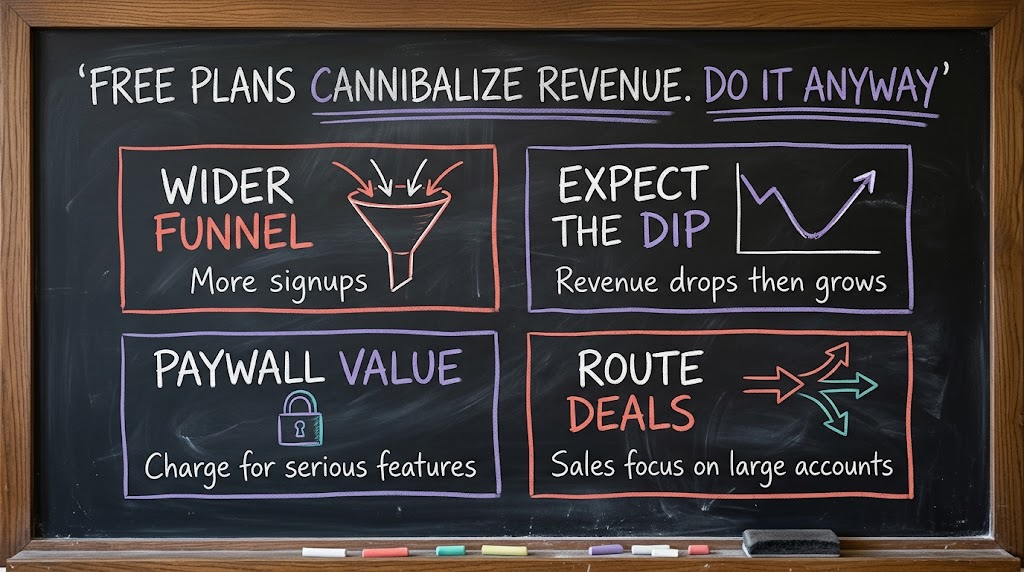
Free Plans Cannibalize Revenue. Do It Anyway
A free plan will eat into your lower tiers, and it can still be the right call. Here is the math from iContact's free-plan launch, the quarter that nearly sank it, and how to design the free tier.

A founder in our mastermind recently brought a question I hear every year or two. She is about to put a light, free version of her product in front of a much larger market, and she is afraid that everyone will grab the free tier and never pay for anything. Her product already sells well through a high-touch, sales-led process, but that process can't scale, so she wants customers to sign up and install the product themselves. The worry makes sense. My answer is that some of them will take the free plan and stay there, and you should probably launch it anyway, as long as you do the math before you do.
Cannibalization is guaranteed, so budget for it
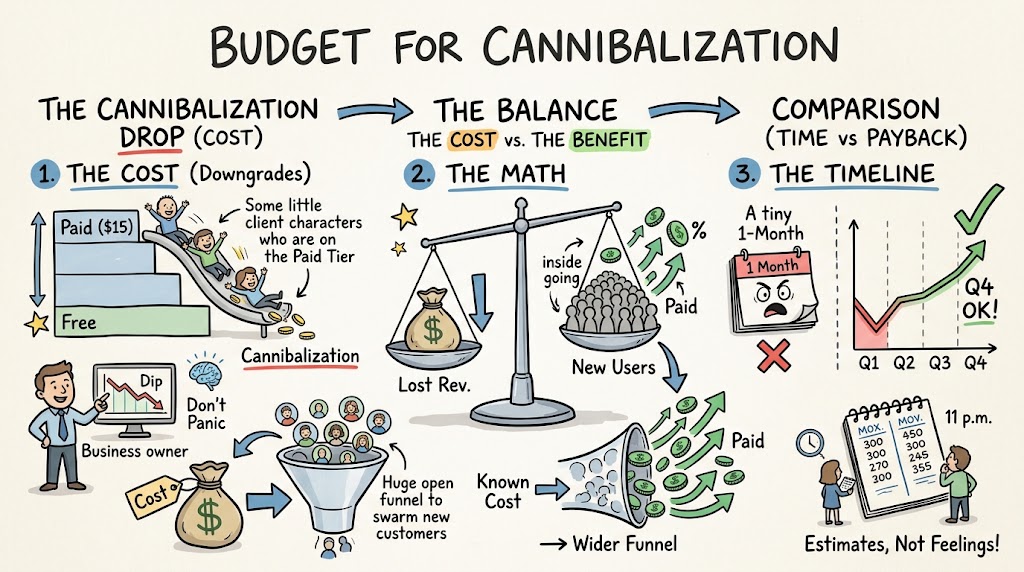
When I shared my own experience with her, the first thing I said was that there is always cannibalization of your lower tiers, and it is almost impossible to avoid. Some customers who would have paid you $15 a month will happily take the free version instead. Pretending otherwise leads to a launch plan that falls apart the first time the revenue chart dips.
The better question is whether that lost revenue buys you something worth more. I treat the cannibalization as a marketing expense, and I judge the free plan the way you would judge any other acquisition channel. You are paying a known cost, in revenue you would have otherwise collected, to get a much wider top of the funnel.
- Put a number on the cost. Estimate how much revenue sits on the plan the free tier will compete with, and what share of those customers could plausibly downgrade.
- Put a number on the benefit. Estimate how many more registrations the free plan will bring in, and what share of them will eventually pay.
- Compare over quarters, not weeks. The cost shows up immediately and the benefit arrives later, so a one-month view will always make the free plan look like a mistake.
- Decide the payback window up front. If you agree now that you will judge the plan after, say, four quarters, you are less likely to panic at the end of the first one.
Once you have those numbers written down, the decision stops being an argument about feelings and becomes a comparison of two estimates. That is a much easier conversation to have with a team, a board, or yourself at 11 p.m.
What actually happened at iContact
In 2011, we had about 60,000 paying customers at iContact, and roughly 20,000 of them were on our $15 a month entry plan. Mailchimp had changed the category in 2009 by making their product free for 500 subscribers, and in 2010 they raised that to 1,000. We were charging $15 a month for 1,000 subscribers, which was exactly what they were now giving away. We felt we had no choice but to copy them if we wanted to stay competitive, so we launched a free plan of our own.
The effect on the top of the funnel was immediate. New registrations went up about four times. Free-to-paid conversion fell by about half, from roughly 16% to roughly 8%, which is what you would expect when the pool of people signing up gets that much bigger and less committed. The part that mattered is what happened when you multiplied the two.
- A funnel four times as large. Many more people were trying the product every month, including plenty who would never have started a paid trial.
- A conversion rate half as high. Fewer of each cohort paid, which is the number that tends to scare people the most.
- Twice the paying customers. We went from adding roughly 2,500 to 3,000 new paying customers a month to adding roughly 4,000 to 5,000.
- Real cannibalization underneath. Some of the people who would have paid $15 a month were now on the free plan, and that cost was real even while total paying customers climbed.
A bigger aperture and a lower conversion rate beat a smaller aperture and a higher one, as long as the funnel grows by more than the conversion rate shrinks. When you run that test on your own numbers, check it quarter by quarter, because the second half of the story is where we got into trouble.
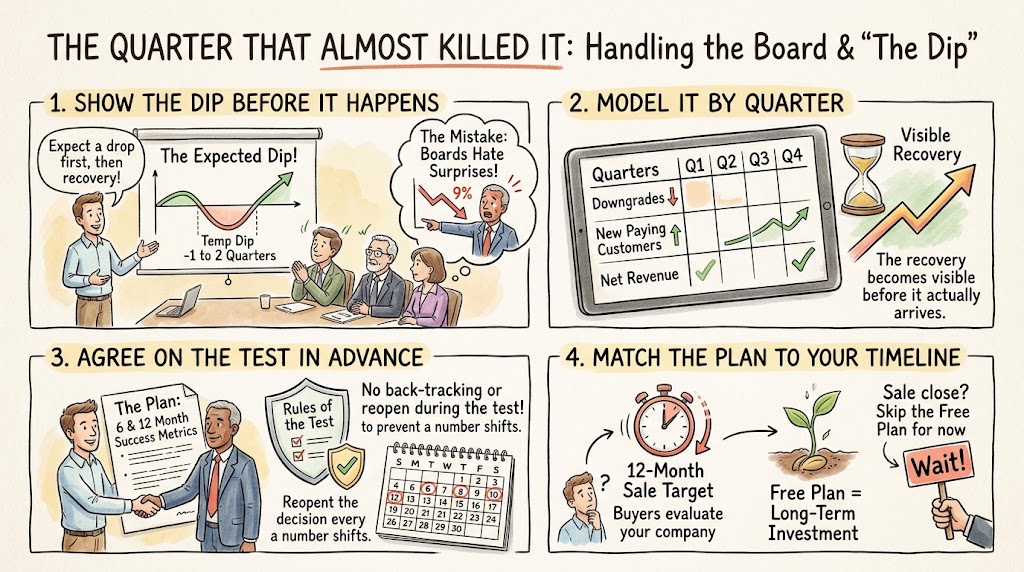
The quarter that almost killed it
About three months after launch, our board looked at the results and did not like what they saw. Our lowest plan represented roughly 20% of revenue, and about half of those customers had moved down to the free account. In that first quarter we lost a net of about 9% of total company revenue, even though we were adding more paying customers than before.
The board was focused on selling the company within the next 12 months, and they did not want to show a buyer two down quarters in a row. They voted three to two to remove the free plan, which outvoted me and my cofounder. We pulled it, and over the following decade Mailchimp pulled well ahead of us. I don't think the free plan was the mistake. Failing to prepare the people holding the vote for the dip was.
- Show the dip before it happens. Put a slide in front of your board or investors that says revenue will fall for a quarter or two, and by roughly how much.
- Model it by quarter. A simple table with the downgrades, the new paying customers, and the net revenue each quarter makes the recovery visible before it arrives.
- Agree on the test in advance. Write down what a successful free plan looks like at six and twelve months so the decision isn't reopened every time a number moves.
- Match the plan to your timeline. If a sale is 12 months away and your buyers will pay for trailing revenue, a free plan may be the wrong move for that window.
That last point is worth taking seriously. A free plan is a long-term investment, and if your plans for the next year don't have room for a long-term investment, it may be better to wait.
Design the free tier to create accounts, then meet a paywall
The shape of the free plan decides how much cannibalization you take on. My rule is that the free version has to be valuable enough that someone is willing to create an account, and then the moment they try to do something meaningful, they hit the paywall. A free plan that does everything gets you users and no revenue. A free plan that does nothing gets you neither.
The founder who asked the question described her free tier as a lighter version of the real product. It works, but it has no automations and none of the extras. That is a sound starting point, because the people who care about those extras are the ones most likely to pay for them later.
- Give enough to be useful. A person should be able to set up the free version and see a result, otherwise they will never reach the point where they would consider paying.
- Reserve the features that signal serious use. Automations, integrations, higher volumes and in-person or hands-on services are natural lines to draw.
- Make the paywall appear at the moment of value. The best time to ask for money is right when the customer is trying to do the thing they signed up for.
- Count the data as an asset. Another member pointed out that a large free base builds a data set that competitors can't copy, and that can raise what a buyer will pay for the company later.
That last idea is easy to miss, but it changes the math. If each free user adds to a proprietary data set or makes your network more valuable, then the free plan is doing two jobs at once, and the case for it gets stronger. The same founder also described a competitor that won a market by moving faster on a land grab, which is the sort of situation where a free tier pays for itself in speed alone.
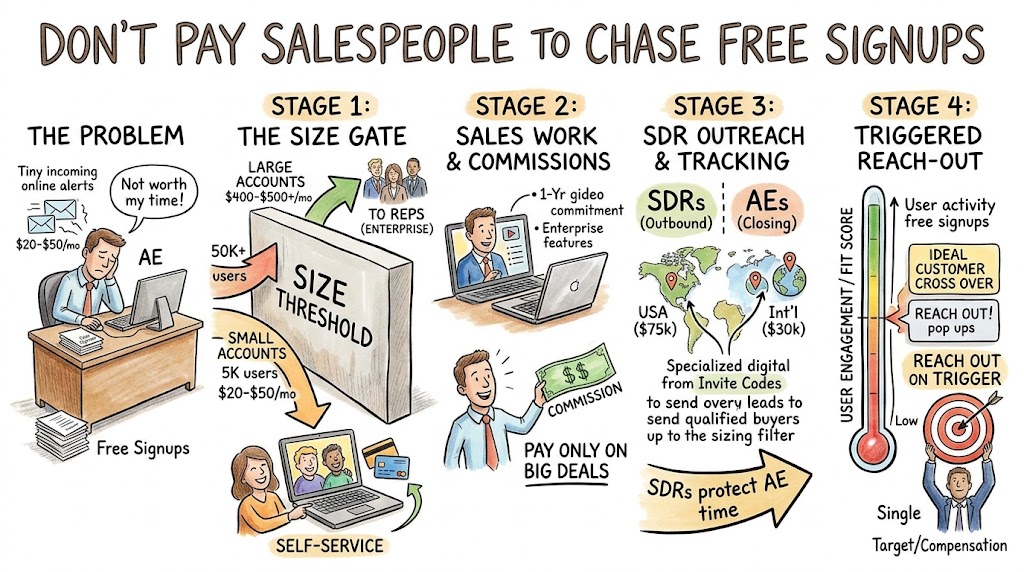
Don't pay your salespeople to chase free signups
Her second question was about sales compensation. Once customers can install the product themselves, a rep might talk to someone in March who then signs up on their own in May, and it is not obvious who should be paid. This is the problem that makes sales leaders nervous about free plans, and it has a clean answer.
At iContact we set a minimum size for a lead to be worth a salesperson's time. For us, the number was around 50,000 subscribers. Anyone coming in with 5,000 or 10,000 was going to be a $20 to $50 a month account, which isn't worth an account executive's time, so those customers went through self-service and upgraded with a credit card. Anyone above the line, who would be a $500 a month account or bigger, got a demo and an enterprise package with a few more features, a shared account manager, a quarterly business review and a one-year commitment. Reps were paid on the second group and never touched the first.
- Pick a size threshold. Find the metric that separates a $30 a month account from a $400 a month account and route only the larger ones to your reps.
- Pay commission on the big deals. Reps who focus on accounts worth several thousand dollars a year can be paid well without making the economics worse.
- Separate outbound from inbound. An outbound SDR can cost around $30,000 a year in South Africa or $75,000 in the United States, and they don't need big commissions. It is the AE's time you are trying to protect.
- Track what you need to. If SDRs are doing outreach, give each one a unique invite code or UTM link so you can see which signups they brought in.
One member added a useful variation, which was to score free signups on how closely they match your ideal customer and how they use the product, and have sales reach out only when someone crosses a threshold. His reps are paid on a single number, because he doesn't want to penalize them for working leads that start as self-serve.
A quick test before you launch
Here is illustrative math you can adapt. Say 20% of your revenue sits on your entry plan, and half of those customers downgrade to the free tier. In the first quarter you lose about 10% of revenue. Now say the free plan quadruples your signups and your conversion rate drops by half. You are adding twice as many paying customers each month, and within a few quarters the gap closes and then reverses. The exact figures will be different for your business, but the structure of the calculation is the same.
If that calculation works for you, launch the free plan, brief your board on the dip, draw the paywall in the right place, and keep your reps focused on the accounts that justify them. If it doesn't, you have saved yourself a painful quarter. In both cases you will have made the decision with real numbers, which is more than most founders do.