Fixing the No-Show Demo Problem
A founder whose funnel was full of booked calls nobody attended got three fixes from the mastermind that had nothing to do with chasing harder, and everything to do with who gets into the funnel and how the call itself is structured.

A founder running a community platform for churches described a familiar and frustrating pattern to the mastermind: a funnel that was working, in the sense that plenty of people were coming through it and booking calls, but falling apart at the exact moment that was supposed to matter most. People booked demos and simply didn't show up, despite everything his team tried to get them there. It's one of the more demoralizing problems in SaaS, because the top of the funnel looks healthy right up until the point where it isn't, and it's easy to misdiagnose as a sales problem when it's usually something upstream.
The fix that worked without touching pricing or messaging at all
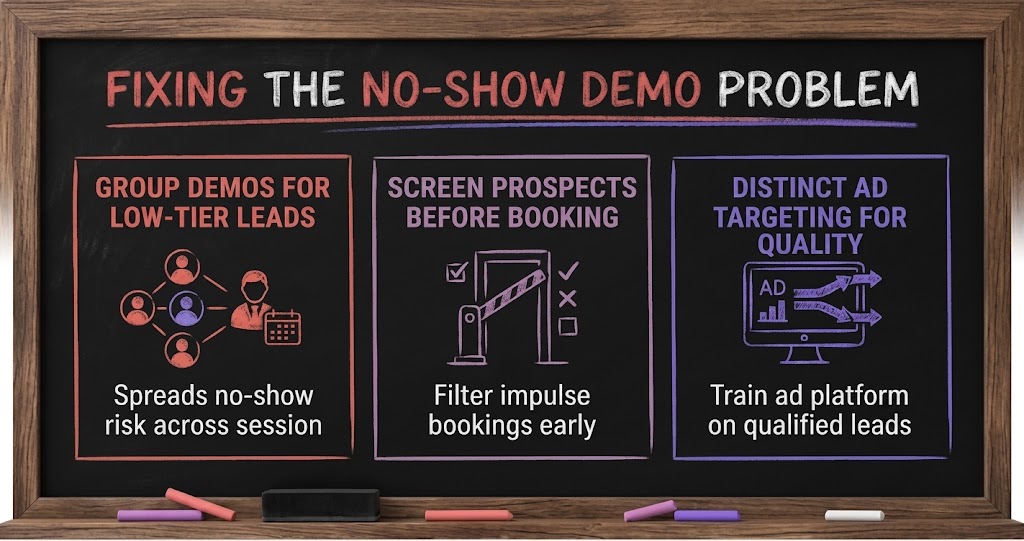
The most concrete solution in the conversation came from a founder who'd faced the identical problem and solved it with a change to how demos themselves were structured, not to who he was targeting or what he was charging. His team started routing anyone signing up for the lowest-priced plan into a group demo instead of a one-on-one call, capping attendance at five people per session. He said his sales rep hadn't had a single completely empty demo since making the switch. Even on a slow day, two out of five registrants tend to show, and some days all five do.
The mechanism behind why this works is worth understanding, because it explains when the tactic will and won't transfer to your own funnel. A one-on-one demo puts the entire outcome on a single person's willingness to show up, and a no-show means the call simply doesn't happen. A group demo spreads that risk across five people, so even a poor turnout rate still usually produces an audience. There's also a mild social effect at work: people are somewhat more likely to follow through on a commitment when they know others were invited too, even if they never interact with those other attendees directly.
- Route lower-intent or lower-tier prospects into group demos. Spreading a demo across several registrants means a no-show doesn't leave you with an empty call.
- Cap group size to keep it useful. A cap of around five attendees keeps the session small enough to still feel personal while providing real insurance against no-shows.
- Reserve one-on-one calls for higher-intent or higher-value prospects. Group demos work best as the entry point for lower-commitment leads, not as a replacement for every kind of sales conversation.
Check whether your funnel is actually delivering qualified people
A second founder in the group, who runs a marketing agency alongside his own SaaS product, pushed the diagnosis further upstream. His view was that if a meaningful share of booked calls are going unattended despite genuine effort to get people there, the more likely root cause is that the ads feeding the funnel aren't targeting qualified prospects tightly enough. When unqualified people are entering the funnel easily, some will book a call on impulse and never seriously intend to show up, because they were never a real prospect to begin with. His suggested fix was to add a qualifying step, a short set of questions or a light barrier, between ad click and booked call, so that every call landing on the calendar represents someone who's actually cleared a bar of seriousness.
This matters because it reframes the goal. The instinct when demos go unattended is often to try harder to get people to show, more reminder emails, more follow-up texts, a better calendar tool. Those tactics can help at the margins, but they're fighting the wrong battle if the underlying problem is that too many people booking calls were never qualified enough to want to be there in the first place. Fixing the front of the funnel, who's allowed to book a call, tends to be more durable than trying to chase down people at the back of it who were never going to convert.
- Add a qualifying step before someone can book a call. A short screening question or two filters out impulse bookings from people who were never a real fit.
- Fix the front of the funnel before optimizing reminders and follow-ups. No-show reduction tactics applied to an unqualified funnel treat a symptom instead of the cause.
- Fewer, better-qualified calls usually beat more, weaker ones. A smaller number of demos that actually convert is more valuable than a larger number that mostly go unattended.
Separate your ad tracking so the platform learns the right lesson
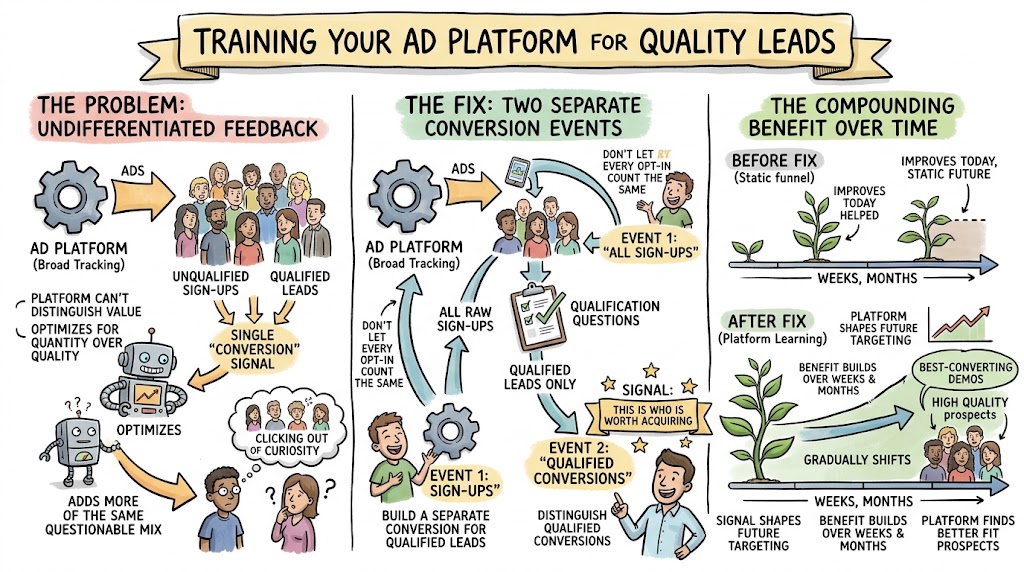
A related fix, raised by another founder in the group who focuses on paid digital growth, goes one layer deeper into the ad platform itself. If every opt-in feeds back into your advertising platform as a single, undifferentiated conversion event, the platform can't distinguish a qualified lead who actually wants to talk from someone who clicked out of curiosity and will never show. It just sees conversions and optimizes to find more people who resemble whoever converted, unqualified bookings included. His recommendation was to build at least two separate conversion events, one for every lead, and a second, distinct one specifically for leads that clear your qualification bar, so the signal going back to the ad platform reflects who's actually worth acquiring more of.
This is a technical fix, but it compounds over time in a way the other fixes don't. A better qualification question at the point of booking helps today's funnel. Feeding qualified-lead data back into your ad platform changes who the platform finds for you tomorrow, gradually shifting your traffic mix toward people who look like your best-converting demos rather than people who look like anyone who's ever clicked a button.
- Build a separate conversion event for qualified leads. Don't let every opt-in count the same in your ad platform's eyes. Distinguish qualified conversions from raw sign-ups.
- Let the qualified-lead signal shape future ad targeting. Over time, this trains the platform to find more people who resemble your actual best-fit prospects, not just anyone who converts easily.
- Treat this as a compounding fix, not a one-time patch. The benefit of better ad-level tracking builds over weeks and months as the platform's targeting improves, unlike a funnel change that helps immediately but doesn't improve further on its own.
Put the three fixes together
None of these three fixes, group demos, upstream qualification, and separated ad tracking, requires a pricing change or a new tool most founders don't already have access to. They work at different points in the funnel and reinforce each other rather than compete. Qualification and ad-tracking changes reduce how many unqualified people ever reach the booking stage. Group demos protect whatever calls do get booked from turning into a wasted, empty slot. A founder dealing with chronic no-shows doesn't need to pick one of these. Running all three together tends to compound: fewer unqualified bookings, and the ones that still slip through are far less likely to leave a sales rep staring at an empty call.
Don't overlook the mechanics of the booking flow itself
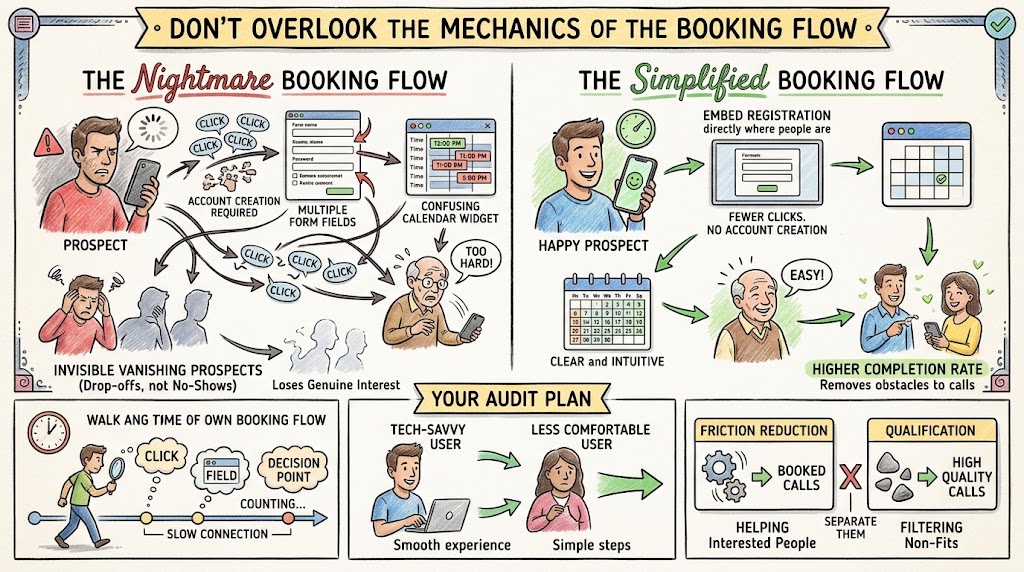
There's a simpler layer to this problem that's easy to skip past when the conversation moves straight to qualification and ad tracking: the actual friction of getting from interested prospect to booked call. A founder targeting a very specific niche audience in the same broader conversation made a point about accessibility that applies just as well here. He described how his own organization had reduced friction everywhere it could, embedding registration directly where people already were rather than routing them through extra steps, and noted that even a small reduction in friction produced a noticeably higher completion rate, particularly among prospects who aren't naturally comfortable with technology. A booking flow that requires several clicks, an account creation step, or a confusing calendar widget will lose people who were genuinely interested but gave up partway through, and those people never show up as a clean no-show statistic. They just vanish before the booking ever completes.
Reducing that friction is a smaller, cheaper fix than any of the three above, and it's worth auditing first simply because it's fast to check. Walk through your own booking flow as a new prospect would, on a phone, on a slow connection, without any special familiarity with your product, and count the number of steps and decisions required before a call actually lands on the calendar. Every unnecessary step is a place someone with real intent can quietly drop off, and unlike qualification, tightening this doesn't reduce the volume of people considering your product. It just removes the obstacles between genuine interest and an actual booked call.
- Walk your own booking flow as a first-time prospect would. Count every click, form field, and decision point required before a call is actually on the calendar.
- Reduce friction especially for less tech-comfortable audiences. A confusing or multi-step booking process disproportionately loses prospects who aren't naturally at ease with software.
- Treat friction reduction as separate from qualification. Cutting friction helps genuinely interested people complete a booking. It shouldn't be used as a substitute for filtering out people who were never a fit.