
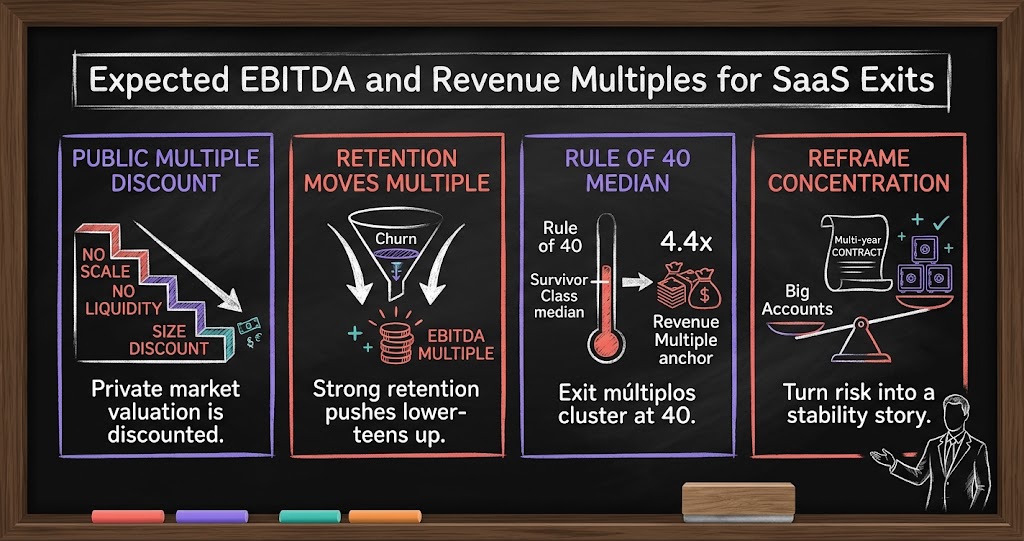
Expected EBITDA and Revenue Multiples for SaaS Exits
What actually moves your multiple when a PE firm or strategic buyer looks at your SaaS company: rough EBITDA and revenue benchmarks, the rule of 40, and why customer concentration can matter more than growth rate.

A founder in one of our enterprise mastermind sessions was heading into conversations with four or five private equity firms and wanted a straight answer to a question that comes up constantly: do you optimize for revenue growth or for EBITDA heading into a sale? His ARR growth was going to be flat this year, maybe five percent, with a bigger jump projected for next year, and he already had positive EBITDA. The problem is that PE firms almost never tell you their actual formula. They talk in generalities about valuing recurring revenue and de-risking the deal, and you're left guessing at the math behind the number they eventually offer.
I don't have a magic formula either, but after looking at a lot of these deals, some rough patterns hold up well enough to plan around. None of this is meant to be statistically rigorous. It's practitioner's advice, the kind of rule of thumb you pick up from being in the room for enough of these conversations, not an MBA case study.
Start with the public market baseline, then discount hard
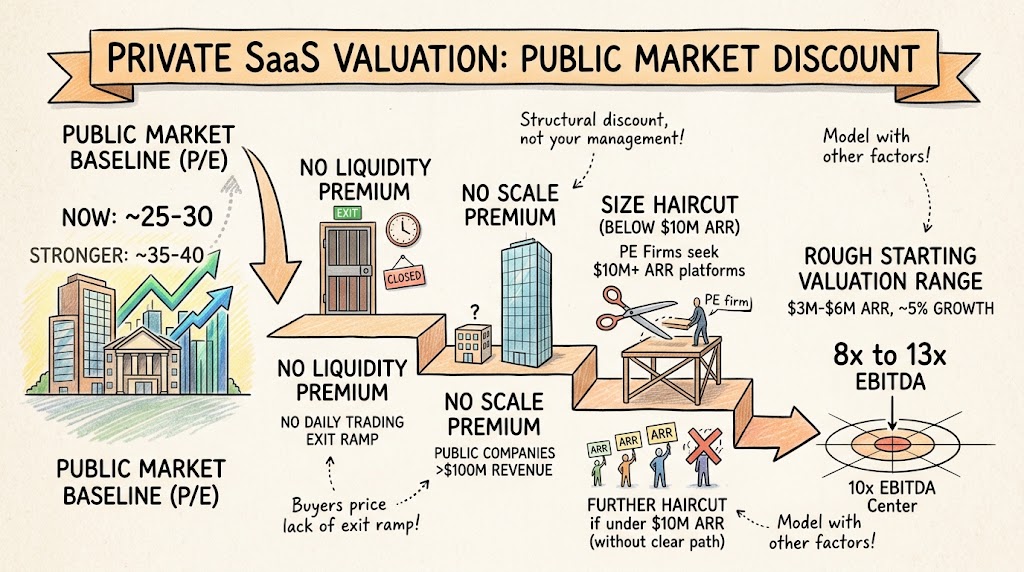
Publicly traded SaaS companies are currently trading at a price to earnings ratio right around 25 to 30. That number has been as high as 35 to 40 in stronger markets, so where it sits today matters for timing your expectations. Private companies get a real discount off that public number, and the reasons are structural rather than a reflection on how well you're running the business.
- No liquidity premium. A public company's stock trades every day. Your equity doesn't, and buyers price that lack of an exit ramp into what they'll pay.
- No scale premium. Public SaaS companies are mostly well past $100 million in revenue. A buyer isn't paying you the multiple they'd pay a company ten times your size.
- Size drives a second, separate discount. PE firms tend to get seriously interested once you cross about $10 million in ARR, because that's roughly the size where you can become a platform they build a portfolio around. Below $10 million, and without a credible path to it in the next 12 to 18 months, expect a further haircut.
Put those together and a rough range starts to form. A company doing $3 to $6 million in ARR and growing revenue around five percent a year tends to land somewhere between 8x and 13x EBITDA, with 10x being a reasonable center point. That's not a promise, it's a starting point for your own modeling, and the two factors below will move you up or down from it.
Retention moves the multiple more than most founders expect
Buyers are ultimately underwriting whether the revenue and profit you're showing them today are still going to be there in three years. That's why retention numbers carry so much weight in the multiple conversation, sometimes more than the headline growth rate does.
- Net revenue retention above 115 to 120 percent can push your EBITDA multiple into the higher teens instead of the lower teens, because it signals the existing base is expanding on its own.
- Gross revenue retention above 85 percent which is considered good for enterprise SaaS, has a similar effect. It tells a buyer the base itself is sticky even before expansion revenue is counted.
- Weak retention compresses everything else. Strong growth on a leaky base reads as unproven, and buyers will discount for the churn they expect to eventually catch up with you.
If your retention numbers are genuinely strong, don't bury them in an appendix. Lead with them. They do more to justify a higher multiple than almost any other single metric you can show a buyer.
The rule of 40 and what it implies about your revenue multiple
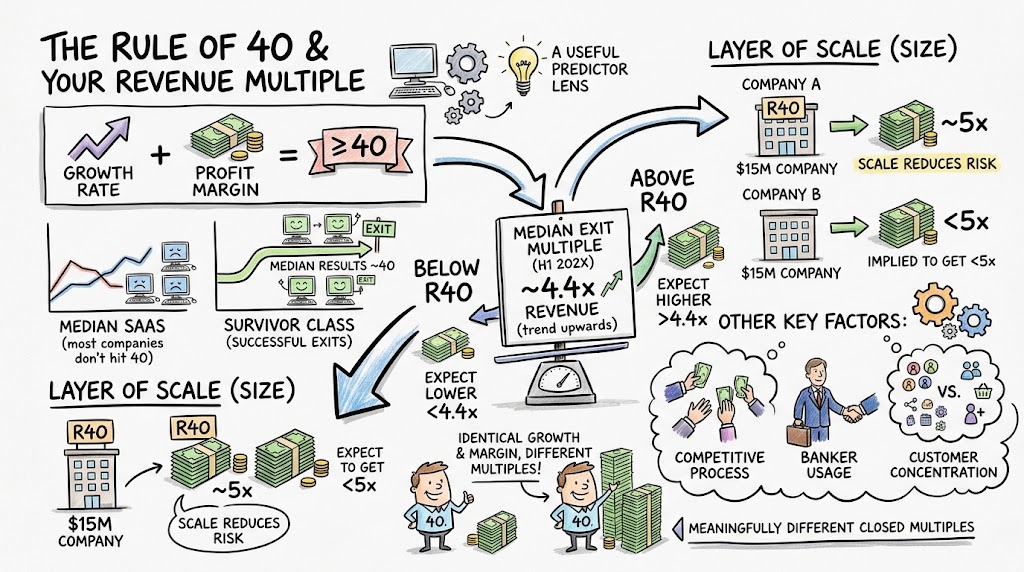
The rule of 40 says a healthy SaaS company's growth rate plus its profit margin should add up to at least 40. It's worth being honest about what that number actually represents. The median SaaS company overall is not hitting the rule of 40. Most aren't. But among the subset of companies that actually reach a successful exit, the survivor class, the median result clusters right around it. That's a useful lens because it means you can use the rule of 40 as a rough predictor of where you'll land on a revenue multiple, not just a vanity benchmark.
The median exit multiple across SaaS deals in the first half of this year was about 4.4 times revenue, and it's been trending slightly upward. If you're sitting right at the rule of 40, that 4.4x is a fair anchor for what you might expect. If you're below it, expect lower. If you're above it, expect higher, and size matters on top of that. A $15 million company hitting the rule of 40 might command something closer to 5x, because scale itself reduces perceived risk. Layer in things like whether you run a competitive process, whether you use a banker, and your customer concentration, and you start to see why two companies with identical growth and margin can close at meaningfully different multiples.
Customer concentration can quietly cap your multiple
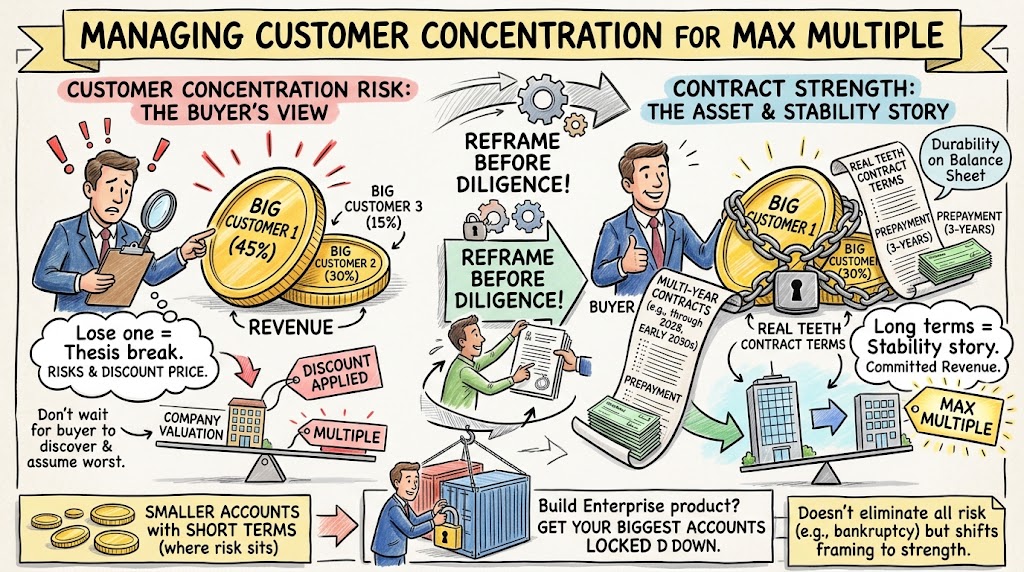
One of the sharpest exchanges in this conversation came from a founder whose retention numbers were genuinely excellent, but whose revenue was concentrated in a small number of large accounts. Buyers kept flagging it as a risk, even though nothing had actually gone wrong. The logic from the buy side is simple: if you lose one of your two or three biggest customers, you don't just lose revenue, you lose the thesis the deal was built on. That risk gets priced in as a discount regardless of how happy those customers currently are.
Another founder in the room had run into the identical objection and found a way to flip it. His company also had a handful of customers making up around half of revenue, and prospective buyers were losing sleep over it during diligence. The fix wasn't to shrink the concentration, it was to change what the concentration actually meant. Every one of those big accounts was locked into a contract running through at least 2028, with one stretching into the early 2030s, and those contracts had real teeth. Once he started leading with that instead of waiting for buyers to dig it up, the framing flipped from a risk into an asset.
- Reframe the story before diligence finds it. Don't wait for a buyer to discover concentration and assume the worst. Lead with the contract terms that make it a strength.
- Lock your biggest accounts into multi-year terms. Long-dated, well-structured contracts turn a scary concentration number into a stability story.
- Prepayment is even better. One customer had prepaid three years of the contract, which showed up as unearned revenue on the balance sheet and made the relationship look even more durable to a buyer.
- It won't eliminate the risk entirely. A locked-in customer can still go bankrupt or dispute a contract. But the framing shifts the conversation from a company with concentration risk to a company with the majority of its revenue already committed, and the risk sitting instead with the smaller accounts that have shorter terms.
As one founder put it after living through this exact dynamic, the real second-best strategy, after having twenty thousand customers instead of a handful, is getting your biggest accounts locked down for as long as you can. You won't always have the luxury of a broad customer base, especially if you're building an enterprise product where a small number of large accounts naturally drives most of the revenue. What you can control is how committed those relationships look on paper by the time a buyer sits down with your numbers.
Putting it together before you go to market
None of these levers work in isolation, and none of them replace simply growing the business. But if you're planning a raise or a sale in the next year or two, there's a concrete set of things worth doing now rather than scrambling to fix during diligence.
- Model your likely range now, not during the process. Use the rough 8x to 13x EBITDA and roughly 4.4x revenue benchmarks as a starting point, adjusted for your size and growth rate, so you're not anchoring on hope.
- Push retention as high as you realistically can before you go out. The gap between mediocre and strong retention is often the single biggest lever on your final multiple.
- Get ahead of concentration risk with contract structure. Multi-year terms and prepayment where possible do more for your story than almost any other pre-sale prep.
- Get to, or credibly demonstrate a path to, $10 million in ARR. That threshold changes which buyers are seriously interested and how much of a size discount you'll absorb.
The honest answer to the original question, revenue growth or EBITDA, is that buyers are looking at both together, filtered through how sticky your revenue actually is and how much risk sits in your customer base. Get those fundamentals right, and the multiple conversation gets a lot easier to walk into with confidence instead of guesswork.