Does Mobile Cold Calling Work for Enterprise SaaS?
Founders scaling into six-figure ACV deals compare notes on cold calling: what it's actually good for, why AI phone screening is changing the game, and why a narrow ICP matters more than call volume.

A founder pushing further into enterprise deals, now regularly closing contracts well above six figures in annual value, brought a question that a lot of SaaS companies hit right around the time their average deal size crosses into serious enterprise territory: does cold calling actually work? He'd heard about a company going after the same buyer persona that had scaled to several million in annual recurring revenue almost entirely through dialing, and wanted to know whether it was worth building out, along with which tools were best for enriching phone numbers before making the calls.
The answers from founders who'd actually built and run these motions were more nuanced than a simple yes or no, and the nuance is where the useful advice lives.
What cold calling is actually good for
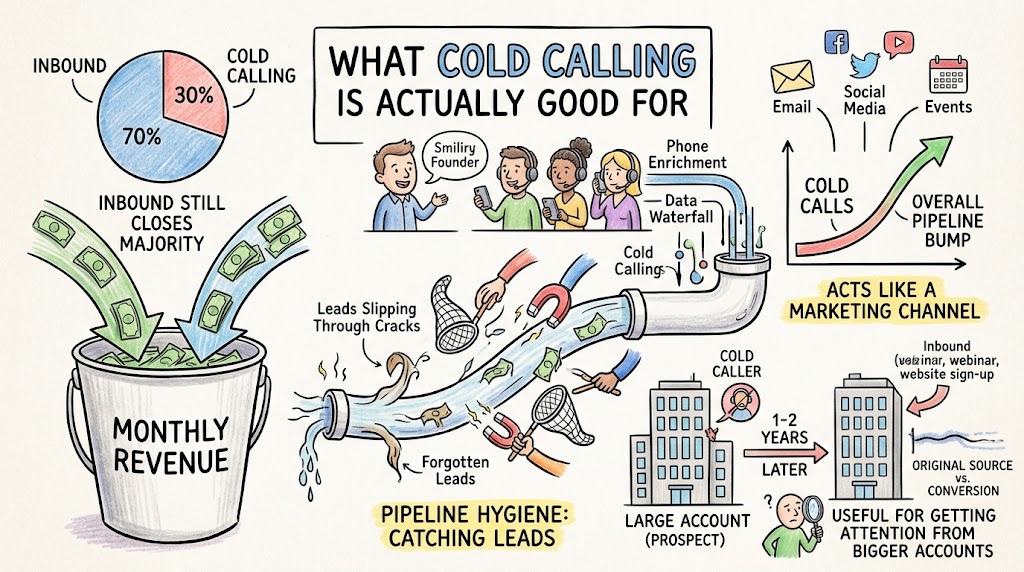
One founder running a three-person business development team that does substantial cold calling volume gave the most detailed breakdown. His team also uses a phone number enrichment tool with a waterfall approach across multiple data sources, so the tactical setup was similar to what the founder asking the question was planning. But the actual impact on revenue was more subtle than either of them expected going in.
- Inbound still closes the majority of revenue. Roughly 70 percent of the revenue closing month over month comes from inbound, even with an active outbound calling team running in parallel.
- Cold calling's real value is preventing leads from going cold. A lot of what the calling team does is more like pipeline hygiene than net-new demand generation, catching leads that would otherwise slip through the cracks and get forgotten.
- It functions closer to a marketing channel than a standalone sales engine. It doesn't produce a clean, direct line from more dials to more closed revenue, but adding the team did produce a real, measurable bump in overall pipeline.
- It's genuinely useful for getting attention from larger accounts. Even when a call doesn't convert immediately, it can be the thing that gets a bigger prospect to eventually engage, sometimes as an inbound lead a year or two later.
That last point matters more than it might seem at first. The distinction between a lead's original source and what actually converts it gets blurry over time, since someone who first came in cold might convert eighteen months later through an inbound channel, and vice versa. If you're judging cold calling purely by a simple source-to-close attribution model, you'll likely undervalue what it's actually contributing.
Phone versus email, and why AI is complicating both
On raw conversion, the group was fairly aligned: getting a real person on the phone converts far better than email outreach. One founder put the gap at roughly half a percent conversion from cold email outbound versus a meaningfully higher rate once you get someone live on a call, describing the difference as not even close. His view is blunt: email is where you make sure information is available if someone wants to find it, but a real conversation on the phone is what actually moves a deal.
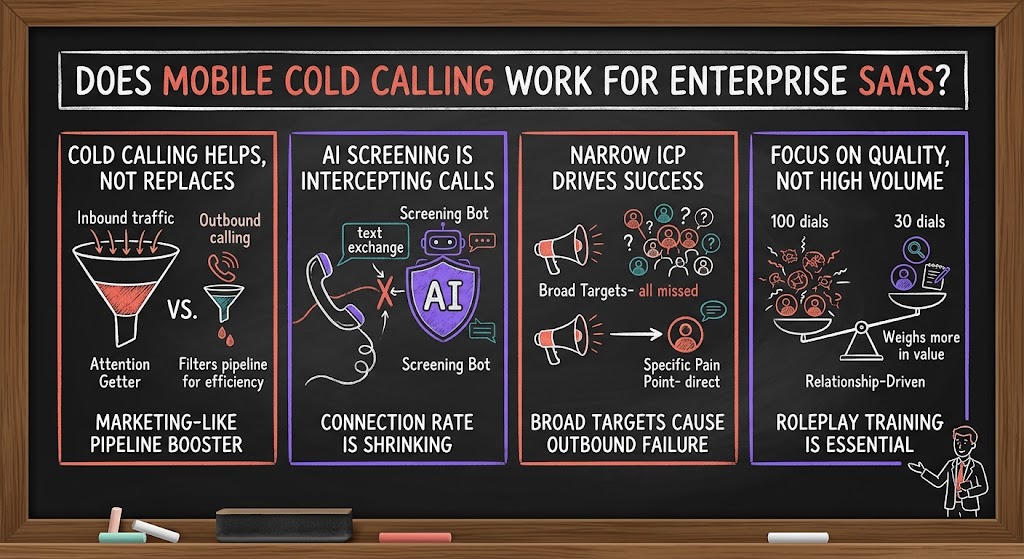
The complication is that phones themselves are getting harder to use for this. AI-powered phone screening, now built directly into modern phones with a single tap, is intercepting a growing share of cold calls before they ever reach a person.
- A meaningful share of calls now hit an AI screen, not a human. One team estimated only about 30 to 40 percent of their dials currently connect with a real person, with the rest hitting an automated phone tree.
- That effectively turns a phone call into a text message. Reps have to figure out how to make an opening pitch work as a short written exchange with a screening system, which is a different skill than a live conversation.
- Teams are still figuring out the right approach. How much information to include in that screened message, and how vague versus specific to be, is an open, actively evolving question rather than a solved playbook.
This is worth planning for explicitly if you're building a calling function now. The playbook that worked two or three years ago, where a dial reliably reached a human being who could be worked through objections live, doesn't fully hold anymore, and a team that hasn't adapted its opening approach for AI screening is going to see its effective reach quietly shrink.
The real variable is ICP clarity, not call volume
The most useful pattern in the whole conversation came from two founders who'd run outbound calling against genuinely complex products, with very different results, and the difference wasn't effort or budget. It was how narrow and well-defined the target buyer actually was.
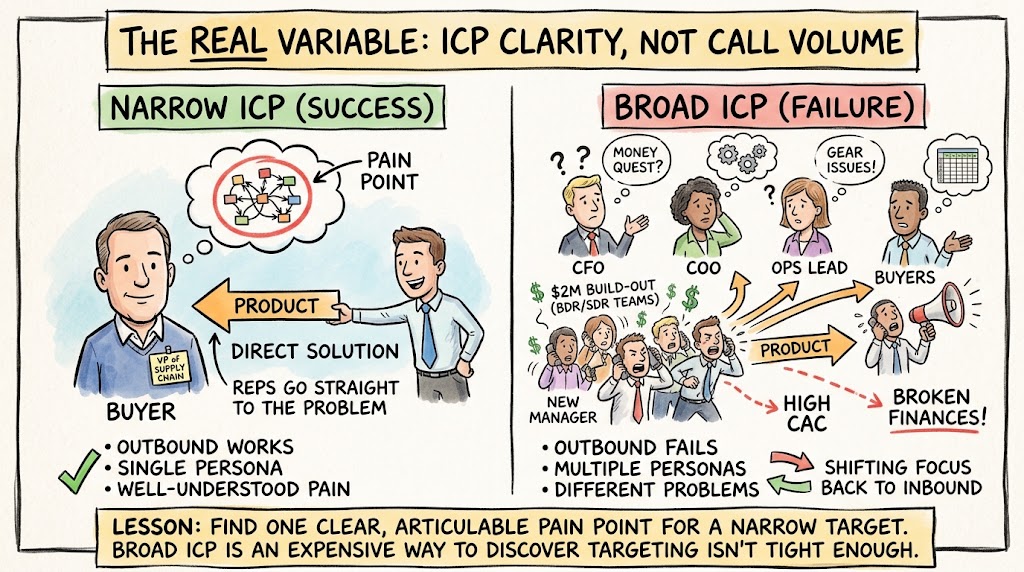
- A narrow, well-understood ICP made outbound work. One founder had success in a segment where there was a single, clear buyer with a specific, well-understood pain point. When the product spoke directly to that pain, reps could get someone on the phone and go straight to the problem.
- A broad, universal ICP made outbound fail, regardless of investment. The same founder had a version of the product sold into a more regulated, complex vertical where the buyer could be a CFO, a COO, or an operations lead, each with a different problem. Outbound simply didn't work there, no matter how much money, time, or training went into it.
- A second founder's experience backs this up at a larger scale. With a broad ICP and a complicated product sold to thousands of customers, an outbound build-out costing roughly two million dollars, including a new sales manager and a BDR and SDR team, did generate pipeline, but the resulting cost of customer acquisition nearly broke the company financially, and the team has since shifted its focus back toward inbound.
The lesson isn't that outbound calling doesn't work for complex, enterprise-grade products. It's that it depends entirely on whether you can hand a rep a genuinely narrow target with one clear, articulable pain point. If your ICP still spans multiple buyer personas with different problems, outbound calling becomes an expensive way to discover that your targeting isn't tight enough yet, rather than a reliable growth channel.
How call volume fits into a broader outbound motion
The founder with the successful narrow-ICP experience also gave a useful reference point on call volume itself, since the founder asking the original question wanted to know whether reps should hit a specific dial target. His team runs around 30 calls a day per rep, which he described as enough for what they need, deliberately well below the 100-plus daily dials some organizations push for. The reasoning ties directly back to the ICP point above: his market is small and the approach is relationship-driven and personalized rather than a volume play, so maximizing dial count isn't the goal. A spray-and-pray approach at high volume makes sense for a broad market with low-touch deals. It makes much less sense once your average deal size is in six figures and each conversation needs real context and preparation behind it.
- Volume targets should scale with deal complexity, not the other way around. A team selling a six-figure ACV product to a narrow buyer persona doesn't need the same dial count as a team selling a low-touch product to a broad market.
- Fewer, better-prepared calls tend to outperform more, shallower ones at this deal size. The founder's team leans on personalization and relationship-building to get a conversation started, rather than treating volume as the primary lever.
- Set your target based on what your ICP and product complexity actually require. Not on a generic benchmark borrowed from a different kind of sales motion.
List quality and rep training matter more than most people assume
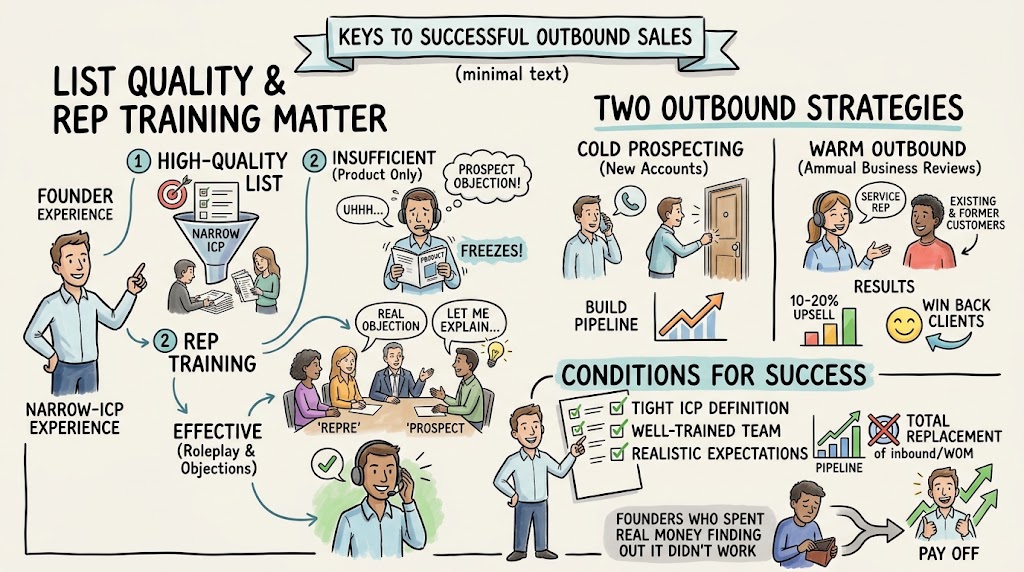
The founder with the successful narrow-ICP experience was direct that outcomes came down to two things above everything else: the quality of the list and the quality of the training. On training specifically, his advice was to sit reps down and have them actually roleplay conversations with your ideal prospect, including the real objections you know come up, rather than assuming that product training alone prepares someone to handle a live call. A rep who knows the product cold can still freeze or fumble the first time a prospect pushes back with an objection they've never rehearsed against.
There's also a version of outbound calling that isn't cold at all, and it's worth considering alongside pure prospecting. One founder's company uses a call service not to reach new prospects but to run annual business reviews with existing and former customers, a warm outbound motion that reliably upsells current accounts by 10 to 20 percent of their existing recurring revenue, and occasionally wins back prospects who chose a competitor's solution and later found it didn't meet their needs.
For a founder deciding whether to build a cold calling function, the honest answer from this group is that it can absolutely work for enterprise deals, but the conditions matter more than the tactic itself. A tightly defined ICP, a well-trained team that's adapted to AI phone screening, and realistic expectations that it will amplify pipeline rather than replace inbound and word of mouth are what separate the founders who saw it pay off from the ones who spent real money finding out it didn't.