
Do Channel Partners Work for SaaS? What Founders Learned the Hard Way
Channel partners promise sales capacity, but most founders who tried them say the partners did little to create demand. Here is when partnerships work, what to offer, and three lower-risk alternatives.

A founder on our enterprise call is rethinking his go-to-market plan. His company started out being sold by the sales forces of several large ERP vendors, as a third-party endorsed add-on. Over time one of those vendors built a competing product, and their reps stopped caring about his. So he asked the group a practical question: has anyone built a successful channel with independent partners or sales organizations, or is in-house selling the only answer?
The answers came from people who had tried it, and they were more cautious than the usual conference-stage advice. I think they are worth sharing because the lessons are specific, and a few of them point to better ways to get distribution.
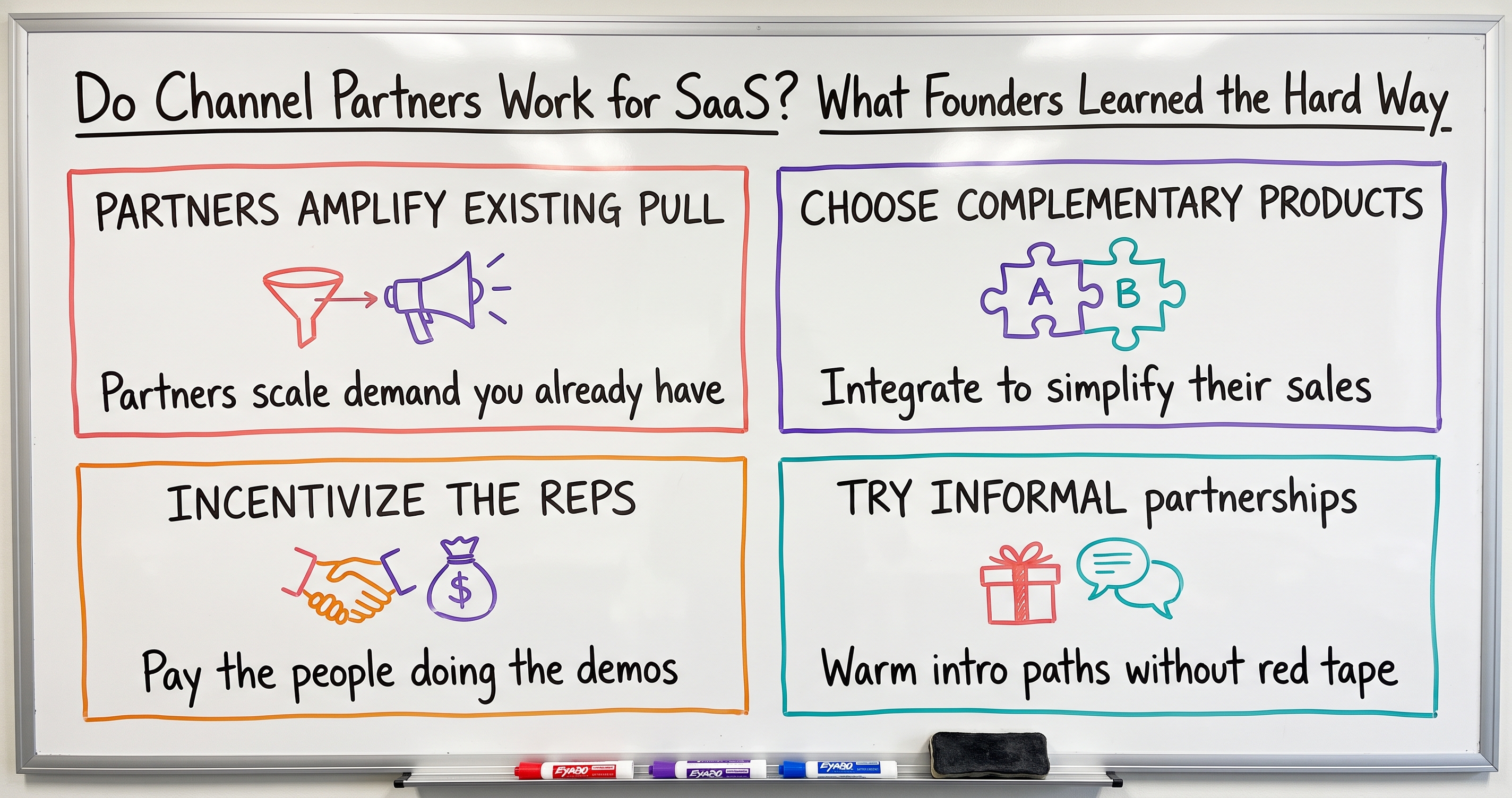
Partners scale demand you already have
The most useful reply came from a founder who called himself a skeptic. In his experience, channel partners are a good way to add capacity if you already have pull. If your product has the phones ringing and you need more people to implement, price, and manage relationships, a partner can help. If you expect partners to create the demand, he has not seen it work for anyone, except for companies that already had momentum. He also described how partners behave when a deal gets complicated: they come back to you for product expertise and training, they expect you to manage the sale, and they still want their share.
He told a story that made the economics concrete. A local partner claimed to have a team that would take his product into government agencies. They did land one customer, but the customer found the company through the partner listing on his own website and already had a relationship with the partner. He had put real effort into training the partner, and in the end he got a customer he would have won anyway, at a smaller share. Others in the room agreed, and one said unless you can offer a partner real volume, they will not invest the time to learn your solution, which leaves you doing both the selling and the professional services.
- Pull comes first. Partners amplify demand. They rarely create it from scratch.
- Expect to carry the load. You will probably train them, support them, and run the complex deals yourself.
- Watch the economics. If the partner only owns a relationship and adds no value, you give up margin for revenue you would have received anyway.
- Beware of partners who sell into pre-wired deals. Cold-calling organizations that already issued a formal request often means the winner is already chosen.
- Expect turnover. Partner companies get sold, leaders change, and enthusiasm fades. Local reps and individual influencers tend to bring less drama.
None of that means you should rule partnerships out. It means you should treat them as an accelerator for something that already works and design the deal with that in mind.

The partnership that does work: complementary products
One founder offered a much more optimistic example, and it involved a complementary product and not a generic reseller. Years ago, his team built an application for a vendor in the medical space. That vendor connected it to a practice management system, built a light integration, and gave that system's salespeople preferential licensing so they could demo the combined product live. They also ran training. It took almost a year to see any business. Twenty years later, the company still earns about 80 percent of its business from that one relationship.
The lesson he drew was that the salespeople at the partner company are the ones who drive results. Executives sign the agreement, but the rep decides whether to mention your product in a demo. So the incentive has to be personal. If a rep is about to earn $15,000 for closing an ERP sale and can earn another $5,000 by getting the customer to look at your product too, that is where things start to happen. It takes a long time and a lot of work, and you need to leave real money on the table for the partner's team.
- Choose a partner who completes their universe. Your product should be complementary, with no risk of them copying your technology.
- Build the integration. A working integration lets their reps demo the combined solution in production.
- Pay the people who sell. A meaningful spiff for each rep gets your product into conversations.
- Train relentlessly. Run training sessions until the product is easy for their reps to explain.
- Plan for a long runway. The first real results may take close to a year.
The founder asking the question had already done much of this homework. He has identified several niche ERPs in his space that offer no document management of their own, and he has attended trade shows for three years running. The obstacle is getting the vendors to talk to him at all, since he needs access to their APIs. One of those vendors is owned by a software consolidator, which makes it harder to find the right person. That is a normal frustration, and the group's advice was to keep trying, find a champion inside the partner, and consider an approach that does not depend on a formal agreement.
Informal partnerships often beat formal ones
One member runs a company in the affiliate world, and they said something I found refreshing. Their team has no formal affiliate or partner program, even though the industry is their home turf. Their best results come from informal relationships with complementary companies. A rep over there knows them, likes the product, and passes along warm introductions. Nothing is signed. Sometimes they send a gift. They called it the lowest-hanging fruit, because you skip corporate approvals and legal documents, and the introductions you get are often the best leads those companies have.
For founders who do want a more structured program, that member pointed out that partner management platforms handle both traditional partner sales and basic affiliate programs. A simple affiliate program can be inexpensive to set up and, if you run it conservatively, may produce a win here and there. The line between affiliate and channel sales is blurry, so you can start light and add structure as you learn.
- Find the friendly rep. One person who likes your product can do more than a signed agreement.
- Make it easy to refer you. Give them a short pitch, a simple intro template, and quick follow-up.
- Say thank you. A gift or a public thank-you goes a long way.
- Try a light program first. A basic affiliate or partner program is cheap to test before you invest in a large one.
I also suggested the member talk to a founder in our community who built software for tracking channel partnerships and sold the company, because someone who has watched hundreds of programs knows the patterns.

Another approach: be the host for a local leader
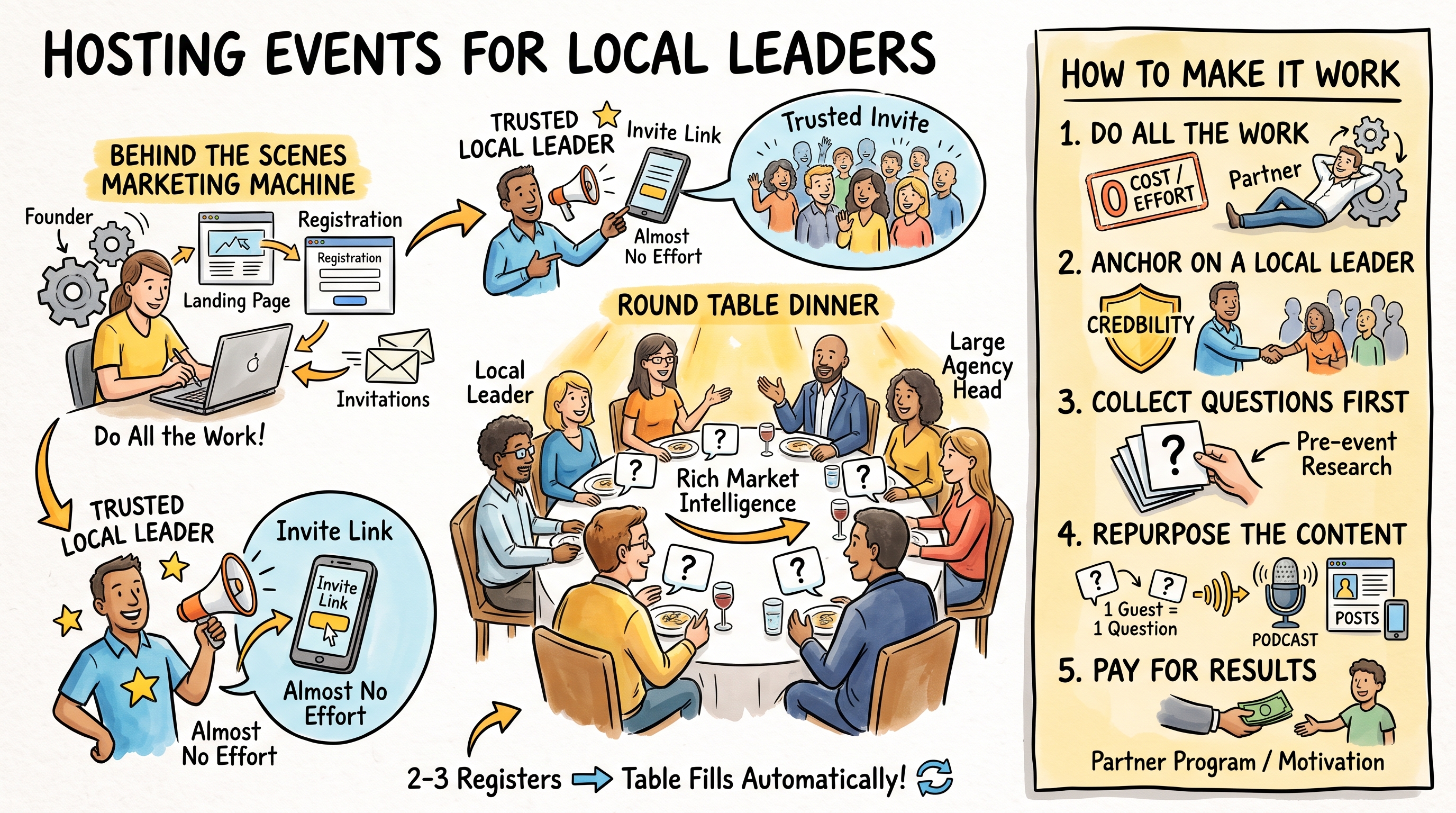
The most creative idea of the day came from a founder with a high-ticket product. He partners with a well-known local leader in each market, someone in the industry whom people already trust, and then runs the entire marketing machine for that person's event. The format is a small dinner or round table. He pays for the dinner, builds the landing page, handles registration, and sends the invitations. The local leader only has to bring their people and accept the invitation link.
Each guest brings one question to the table, and he shares the questions in advance so everyone knows what will be discussed. The next day, his team turns those questions into a podcast. He gets market intelligence from the questions, and the partner gets a fresh reason to invite their network to something interesting. The format also reached people he might never have contacted otherwise: one of the attendees was the head of a large marketing agency, who came because of the local leader's invitation. Once two or three people register, the rest of the table tends to fill, and the whole process is automated. He pays his partners through a defined partner program, so the incentive is clear.
- Do all the work. Partners are far more likely to participate when it costs them nothing and takes almost no effort.
- Anchor on a trusted local figure. Their invitation carries credibility that cold outreach cannot match.
- Collect questions before the event. It draws people in and gives you ready-made market research.
- Repurpose the content. Podcasts or posts built from the questions extend the reach of each dinner.
- Pay for results. A clear payment structure keeps partners motivated.
How I would decide
If your product already has pull, a partner network can add capacity, and it is worth testing with two or three carefully chosen partners. If you are still searching for demand, put your energy into outbound, content, and a few informal relationships with complementary companies. And if you can make a partner's life easy by hosting, training, and paying their sellers well, you give yourself the best chance of becoming the product they mention first. Whatever you choose, keep the experiment small, measure the leads that come in, and be willing to stop if the partners are not producing.