
Digital Marketing & Demand Generation
Two founders in a recent mastermind compared notes on what's actually working in digital marketing right now, and the pattern underneath both stories was the same: separate generating demand from capturing it, and be patient enough to let the flywheel spin up.

Someone asked a question in a recent mastermind call that comes up in some form almost every week: is email still successful as a marketing channel? The honest answer that came back was it depends, and the two founders who answered it in detail ended up telling a much richer story than a yes or no. One runs a niche, vertical SaaS product with a tight, well-defined audience. The other runs a broader horizontal product competing for a wider, noisier market. Both are generating real pipeline right now. Neither is doing it the same way, and the differences are worth breaking down.
When email still works: know your audience cold
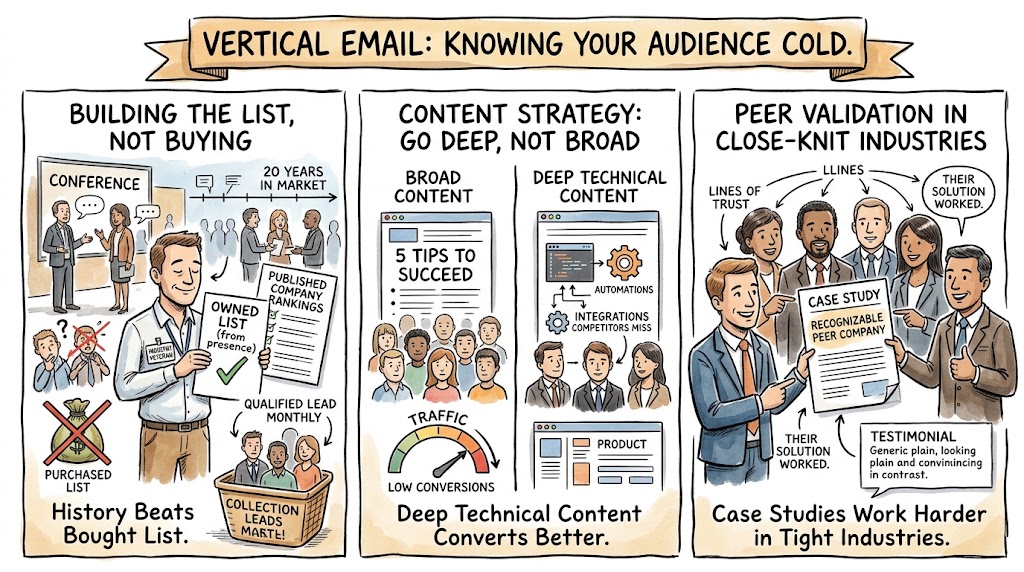
The founder in the vertical niche made a case for email that's easy to dismiss as old-fashioned until you hear the specifics behind it. He's been marketing to the same industry for two decades, long before he started his current company, through an earlier business that also served the same customer base. That history means he already knows exactly who his buyers are: he pulls attendee lists from industry conferences and cross-references published rankings of the top companies in his space. His email list, built from years of direct industry presence rather than purchased data, converts at a strong open rate and consistently produces several qualified leads every month.
The content strategy behind that list is deliberately narrow. He publishes deep, technical blog posts, the kind that go into specific automations and integrations his product handles that competitors don't, alongside case studies about recognizable companies in his close-knit industry. That specificity is the whole point. A broad, general-interest post might get more traffic, but it wouldn't convert the way content written for people who already understand the technical problem does.
- A history in the industry beats a purchased list. Years spent actually operating in a market builds a contact base that outperforms any list you could buy.
- Go deep on content, not broad. Technical posts about specific automations and integrations convert better with a niche audience than general interest pieces ever will.
- Case studies work harder in close-knit industries. When your buyers all know each other, a case study about a recognizable peer carries more weight than a generic testimonial.
When email is a minority contributor, and something else has to carry the weight
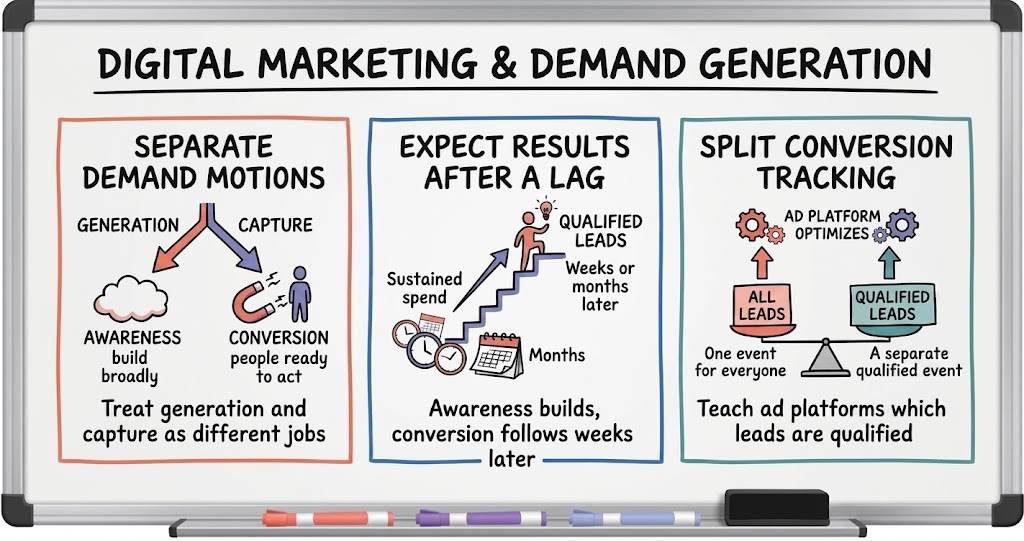
The second founder's experience was almost the opposite. Email has been a minor contributor to his pipeline, and instead his team built what he described as splitting demand generation from demand capture into two distinct, deliberately managed motions. Demand generation runs on Facebook and Instagram, building broad awareness with a large lookalike audience. Demand capture happens mostly on LinkedIn and Bing, where people who've already been exposed to the brand actually convert when they're ready.
That split matters because it changes what you're measuring and when. He doesn't expect the Facebook and Instagram spend to convert directly. Its job is to get the brand in front of people enough times that, weeks or months later, when they're actively looking for a solution, they already recognize the name. Committing roughly twenty thousand dollars a month to this since the spring, with someone dedicated full time to optimizing it daily, his team went from a handful of qualified leads a month at the end of last year to more than forty in a single recent month.
- Separate awareness spend from conversion spend. Generation and capture are different jobs with different channels and different success metrics. Treating them as one budget muddies both.
- Expect a lag between spend and results. Awareness spend doesn't convert on contact. It shows up later, when a prospect who's seen you repeatedly starts actively searching and recognizes the name.
- Don't judge a channel by direct conversions alone. A channel that never converts directly can still be doing the most important work in the funnel, building the familiarity that makes the converting channel work.
Not every channel deserves your budget, even the popular ones
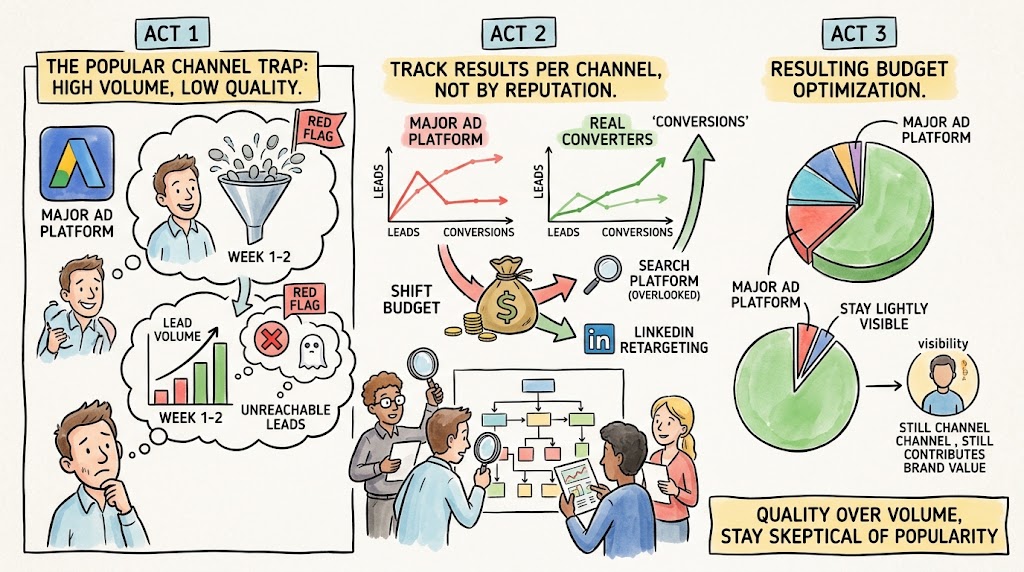
One detail from this founder's experience is worth calling out on its own: he described one major ad platform as producing strong results for a week or two, then flooding the account with what looked like leads but turned out to be unreachable. His team has mostly cut spend there, keeping just enough active to stay visible, while shifting real budget toward the channels that were actually producing conversions, primarily a search platform other founders often overlook and LinkedIn retargeting.
This is a useful reminder that channel performance isn't fixed, and reputation isn't the same as current performance. The platform that worked great for other founders in the group wasn't working for him, and the one that's often treated as an afterthought was carrying real weight. The only way to know which is which for your own product is to track it directly rather than assume based on what's popular.
- Track results per channel, not by reputation. The platform everyone assumes is the default winner may not be the one converting for your specific product or audience.
- Watch for lead quality, not just lead volume. A sudden spike in leads from a channel that previously performed well can be a red flag rather than a win, if those leads turn out to be unreachable.
- Stay lightly visible even on underperforming channels. Cutting a channel to zero can mean losing whatever residual brand presence it was still contributing, even if direct conversions have dropped.
Fix the feedback loop between ads and sales, or the whole system lies to you
A separate thread in the conversation, sparked by a founder running a freemium community product, surfaced a mistake that's easy to make and expensive to leave uncorrected: sending every opt-in back to your ad platform as a single undifferentiated conversion event. If your ads are optimizing for "lead" broadly, and a growing share of those leads are unqualified, the ad platform doesn't know the difference. It just sees conversions and keeps finding you more people who look like the ones who already converted, unqualified or not.
The fix that came out of that discussion is to build at least two distinct conversion events: one for all leads, and a separate one specifically for leads that clear whatever qualification bar matters to your business. Once that second event is feeding data back into your ad platform, your spend starts optimizing toward the leads that actually convert to revenue instead of the leads that are merely easy to acquire. This is a small technical change with a large downstream effect, and it's one of those things every founder running paid ads should have in place, whether or not they're currently struggling with lead quality.
- Split your conversion tracking into at least two tiers. One event for all leads, a separate event for qualified leads, so your ad platform learns to find more of the right kind.
- Add a qualification step before the conversion fires. A short set of questions before someone counts as a qualified lead keeps the signal going back to your ads clean.
- Revisit this even if things seem to be working. A single-tier conversion setup can look fine for a while before the unqualified-lead problem compounds.
The flywheel takes longer to spin up than founders expect
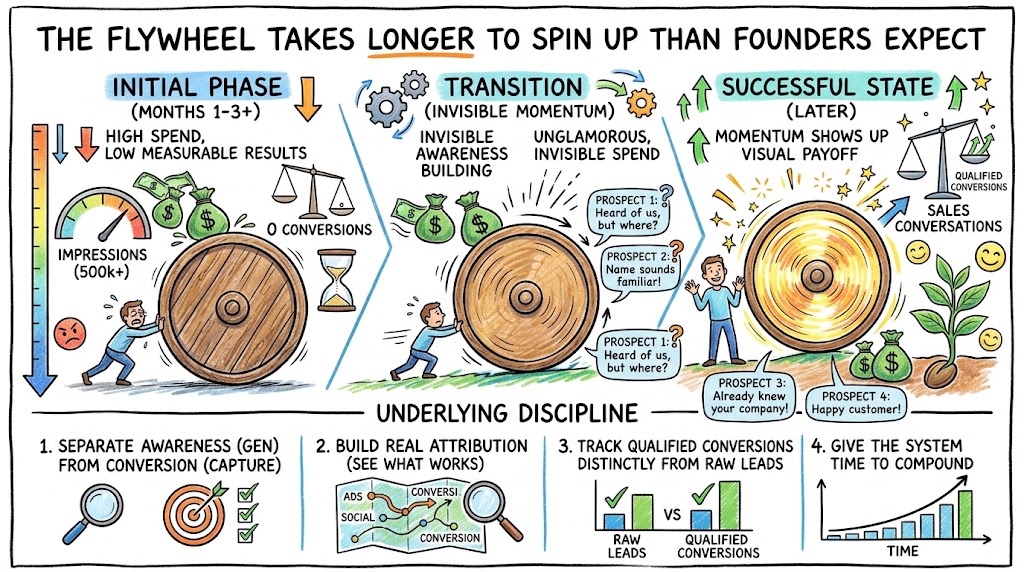
The most candid moment in the whole exchange was an admission that things looked bleak for months before they worked. The founder running the demand generation and capture split described real concern setting in a few months into the campaign, spending consistently with very little to show for it, watching impression counts climb into the hundreds of thousands with nothing converting. He described it as a flywheel that had to keep spinning before the momentum showed up anywhere measurable, and that the eventual results, sales conversations where prospects said they'd already heard of the company without being able to say where, only became visible after that sustained period of unglamorous, invisible spend.
He was careful to frame this without overconfidence. What worked for his product and market may not transfer directly to another. But the underlying discipline, separating generation from capture, building real attribution so you can see what's actually working, tracking qualified conversions distinctly from raw leads, and giving the system enough time to compound before judging it, is a framework that applies well beyond his specific channels. Whether your version of demand generation runs on social ads or two decades of industry relationships, the discipline of separating awareness from conversion, and measuring both honestly, is what turns marketing spend into a repeatable system instead of a hopeful bet.
It's also worth naming what both approaches have in common, because it's easy to read a niche founder's twenty-year head start and a broad founder's paid social flywheel as unrelated stories. They're not. Both are built on the same underlying insight: you cannot skip the awareness phase, whether you build it through years of direct industry presence or months of consistent ad spend, and you cannot treat every inbound signal as equally valuable. One founder earned his audience's attention slowly, through relationships built over two decades. The other bought it deliberately, channel by channel, and tracked it obsessively enough to know which dollars were actually working. Neither shortcut exists. What exists is a choice about which kind of patience you're willing to invest, relational or financial, and then the discipline to measure honestly once you've made it.