
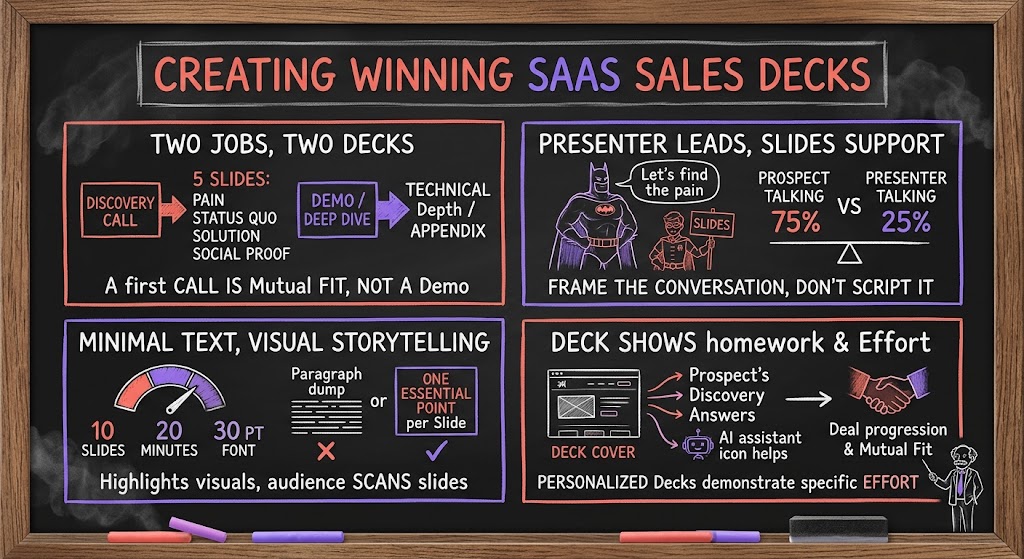
Creating Winning SaaS Sales Decks
A founder-to-founder look at what actually makes a SaaS sales deck work, from separating discovery decks from demo decks to personalizing at scale with AI, drawn from a recent SaaSRise mastermind conversation.

On a recent SaaSRise mastermind call, one of our founders brought up a problem I think every SaaS CEO has lived through. He had just come out of a big meeting with a channel manager at a major platform partner, and he was second-guessing his slide deck. Some people tell him it's too detailed and he should stay high level. Others tell him he stayed too high level and they never saw the substance. The feedback is completely contradictory, and he wanted to know what the rest of the group actually does.
What followed was one of the better conversations on sales decks I've heard, because it wasn't theoretical. Everyone in the room is actively selling B2B SaaS somewhere between $1M and $100M ARR, and the advice converged on a few principles that I want to walk through here.
Stop building one deck for two different jobs
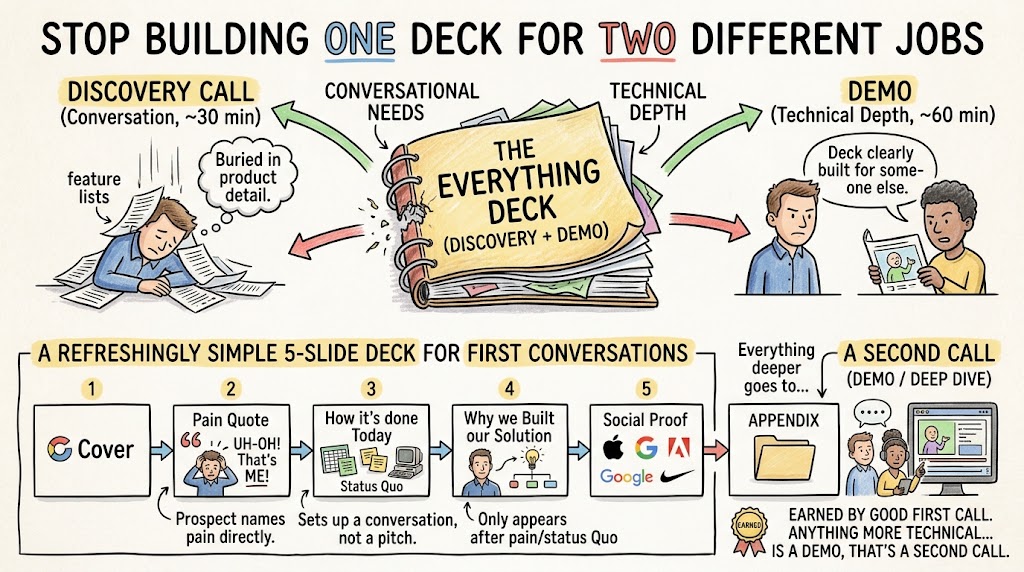
The first insight is that most founders are trying to make a single deck do two jobs that pull in opposite directions. A discovery call and a demo are different meetings with different goals, and when you cram both into one deck you get the exact contradictory feedback our member was describing. The people who wanted a conversation got buried in product detail, and the people who wanted depth got a deck that was clearly built for someone else.
One founder in the group showed us his answer to this, and it was refreshingly simple: a five-slide deck he uses only for first sales conversations.
- A cover, then a pain quote. The first real slide is a customer quote that names the pain directly. The goal is to give the prospect that uh-oh feeling, the moment where they think, that's me, or I can see how that would become a problem.
- How it's done today. A slide walking through the ways people currently solve the problem, which sets up a conversation rather than a pitch.
- Why we built our solution. Only after the pain and the status quo are on the table does the product show up at all.
- Social proof. A quick look at customers they'd recognize, and that's the whole deck.
Everything deeper than that goes into an appendix or, better, a second call. That second meeting is the demo or the deep dive, and it's earned by a good first conversation. As he put it, anything more technical "is less of a discovery and more of a demo, and that's a second call."
You're Batman, the deck is Robin
My favorite line from the call was the analogy this founder uses with his team: you are Batman, and the slides are Robin. You're the one telling the story, asking the right questions, and pulling the pain front and center so the prospect starts wondering what happens if they don't fix this in the next six months. The slides are the trusty sidekick that visually supports the point you're making. The moment the slides become the main character, you've lost the room.
In practice, that changes how you run the first call in a few concrete ways.
- Aim for the prospect talking 60 to 75 percent of the time. If you're doing most of the talking on a discovery call, the deck has taken over.
- Keep the slides in your back pocket. Use them to frame the conversation, not to script it.
- Be willing to disqualify. This founder sometimes ends a first call by telling the prospect they don't need his product at all, and pointing them to a simpler fix. That honesty is exactly what makes the deals that do move forward feel different.
That last point matters more than it looks. When you treat the first call as a mutual fit conversation instead of a pitch, you stop feature-dumping by default, and the deck naturally gets lighter.
Design for scanners, not readers
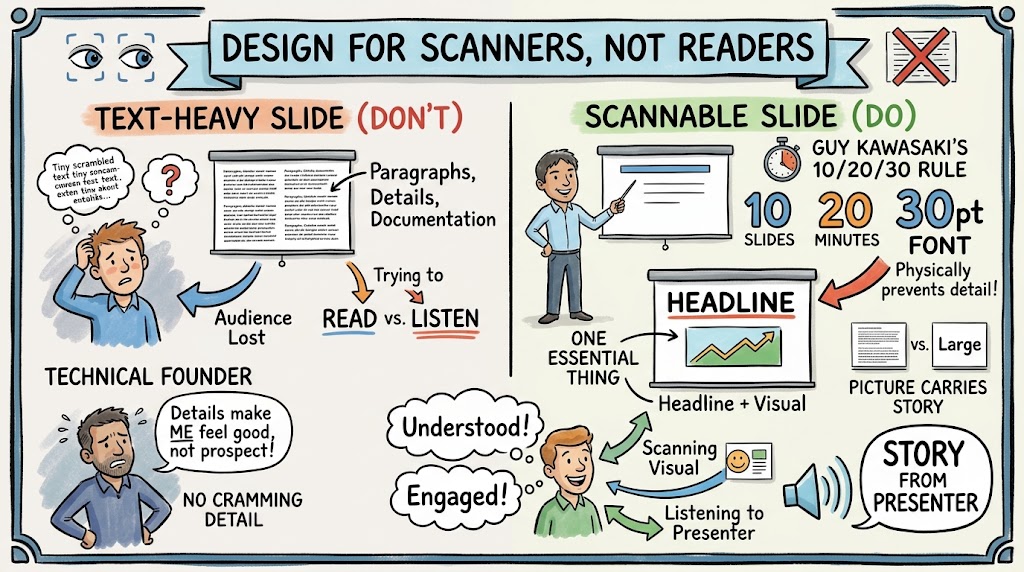
Several members pushed hard on the design side of this. One was blunt with our presenting founder: the deck he showed had way too much text, and as an audience member he was lost. People scan now, more than ever. Nobody on a sales call is reading your paragraphs, so a slide's job is to highlight the one essential thing and remind you what to talk about. If the audience has to choose between reading your slide and listening to you, you've built the slide wrong.
Another member brought up Guy Kawasaki's classic 10/20/30 rule, which he learned from watching Kawasaki present and has used as a discipline ever since: ten slides, presentable in twenty minutes, with no font smaller than 30 point. The font rule is the sneaky one, because it physically prevents you from cramming detail onto a slide. He also admitted something I suspect most technical founders would recognize in themselves: he's a details guy, and the detail is his nemesis. Providing all that information makes us feel good, but it doesn't make the prospect feel good.
- Ten slides, twenty minutes, 30-point font. The Kawasaki constraint that forces visual storytelling over text.
- One essential point per slide. The slide is a headline and a visual, not documentation.
- Let the picture carry the story. The most compelling decks in the conversation were built on visuals, with the words coming from the presenter.
The deck is proof of effort, not an explanation
The most contrarian take on the call reframed the whole question. One of our members argued that people don't believe what you say, they believe what you do, and the deck is your chance to demonstrate effort rather than explain features. His decks are very little about his company and almost entirely about the prospect.
- Put their website on the cover. A screenshot of the prospect's own site on the front page, instead of your logo, immediately signals this was built for them.
- Reflect their discovery answers in writing. Whatever they said on the booking call shows up in the deck, in their words.
- Accept that nobody will ever reread it. The deck's only lasting effect is the impression that you did more homework than every competitor they're evaluating.
Someone reasonably objected that this is a lot of work if you're running dozens of calls a week. His answer had two parts. First, the work is the point, because effort your competition won't match is exactly what stands out. Second, the economics support it once you look at the funnel honestly. By the time a prospect reaches a one-on-one demo, you've often spent a few thousand dollars in marketing and sales time getting them there, so a few hundred dollars of deck preparation on top of that is trivial. And with AI tools like Claude, you can now hand over your standard deck, point it at the prospect's website and intake form, and generate a personalized version at scale, which removes most of the manual cost anyway.
One more story from the call drove the effort principle home. A member had been chasing a high-value affiliate partner who ignored every call, text, and email. His team found out the guy was into wrestling, had a personalized championship belt made naming him their future number one affiliate, and shipped it to him with an oversized novelty check. Total cost was around five or six hundred dollars. The partner responded immediately and is now one of their top affiliates. That's not a slide tactic, but it's the same underlying move: visible, specific effort beats another generic touchpoint every time.
Make the deck work after the call ends
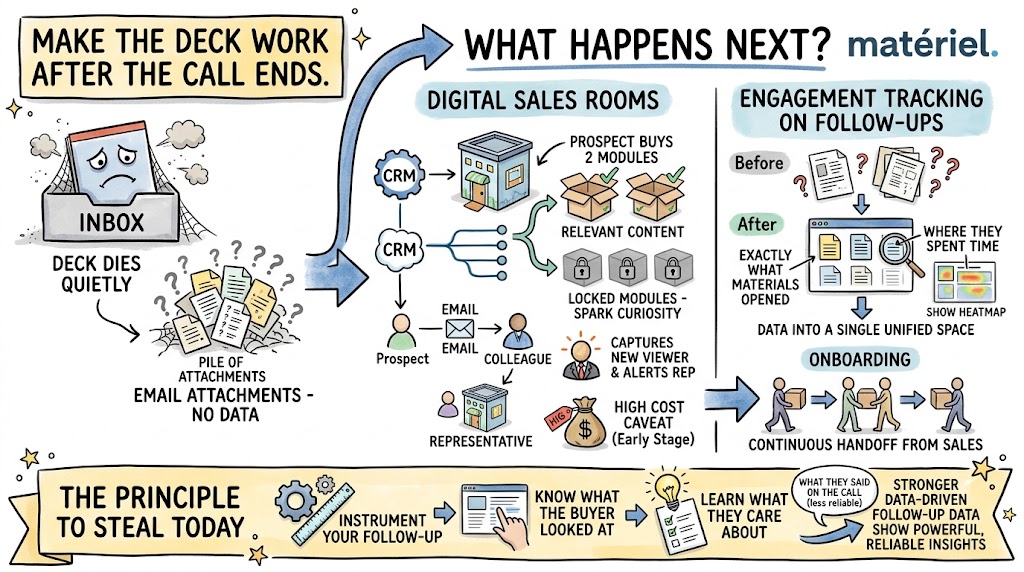
The last thread of the conversation was about what happens to your materials once the call is over, which is where most decks quietly die in someone's inbox. Two tool categories came up from members who use them.
- Digital sales rooms. One member built per-customer rooms with branching logic tied to his CRM, so a prospect buying two of five modules only sees the relevant content, with the rest shown as locked to spark curiosity. When the prospect forwards the room to a colleague, the tool captures the new viewer and alerts the rep to reach out. His caveat was cost, since the tool ran too expensive for his stage, but the mechanics impressed him.
- Engagement tracking on follow-ups. Another member moved from emailing a pile of attachments, with no idea what happened next, to a tool called Dock that shows exactly which materials the prospect opened and where they spent time. He's now moving onboarding into the same space so the handoff from sales feels continuous.
You don't need either tool to start, but the principle behind them is worth stealing today: instrument your follow-up so you know what the buyer actually looked at, because that tells you what they care about far more reliably than what they said on the call.
Where our founder landed
By the end of the discussion, the member who asked the question summarized his takeaway, and I think it's the right one for most of us. Build one lightweight discovery deck for first B2B conversations, ask questions, and get the prospect talking 70 or 80 percent of the time. Save the detail for a second call that goes deep for the people who want depth. Then layer on personalization as proof of effort, starting with your biggest opportunities where the economics are obvious.
The pattern underneath all of it is that a winning sales deck works less like a document and more like a conversation plan with visual support, plus a signal of how much work you're willing to do for this specific buyer. Get those two things right and the slide count almost takes care of itself.