
Copy These Tactics, New Customers Will Flood to Your SaaS
A tactical breakdown of the 10 customer acquisition strategies driving real pipeline for B2B SaaS in 2026, from retargeting and matched audiences to LinkedIn outreach, cold email at scale, and content-driven lead warming, and how they work together to create true market omnipresence.

If you’re running a B2B SaaS company in 2026 and you’re still relying on one acquisition channel, you are leaving an insane amount of growth on the table.
I’ve seen this pattern over and over again. A company finds something that works. Maybe it’s outbound. Maybe it’s Google Ads. Maybe it’s referrals. And then they ride that one horse as far as it will go.
That worked in 2018. It does not work now.
As I said in the training, “B2B SaaS marketing in 2026 is not about finding one magic bullet channel. It’s about building a portfolio of channels that reinforce each other and create brand omnipresence.”
At SaaS Rise, we manage over $12 million per year in digital ad spend for B2B SaaS companies and work with 500+ SaaS founders and CEOs in our community. We see what’s working week in and week out.
What’s working right now isn’t complicated. It’s disciplined. And it’s layered.
Below are the 10 tactics that are generating qualified pipeline for B2B SaaS companies right now.
1. Retargeting Ads: The Non-Negotiable Foundation
Here’s what most companies get wrong.
Someone visits your website. They read a blog post. They check your pricing page. Maybe they even watch a demo. Then they leave.
And you let them go.
That’s the mistake.
Retargeting means you follow that visitor around the internet and show them ads on Facebook, Instagram, LinkedIn, Google, and across display networks. You stay visible. You remind them you exist.
Why does this work?
Because 99% of B2B buying decisions don’t happen on the first touch. They require 10–20 touches or more. Frequency creates familiarity. Familiarity creates trust.
And here’s what most founders miss: retargeting doesn’t just convert on its own. It makes every other channel perform better. When someone sees you on G2 or gets your cold email, recognition kicks in.
Set up is simple:
- Install tracking pixels (Meta, LinkedIn, Google).
- Build retargeting audiences.
- Run ads that clearly state: who this is for and what the benefit is.
- Focus on clarity over cleverness.
If you’re not running retargeting, you’re operating with one hand tied behind your back.
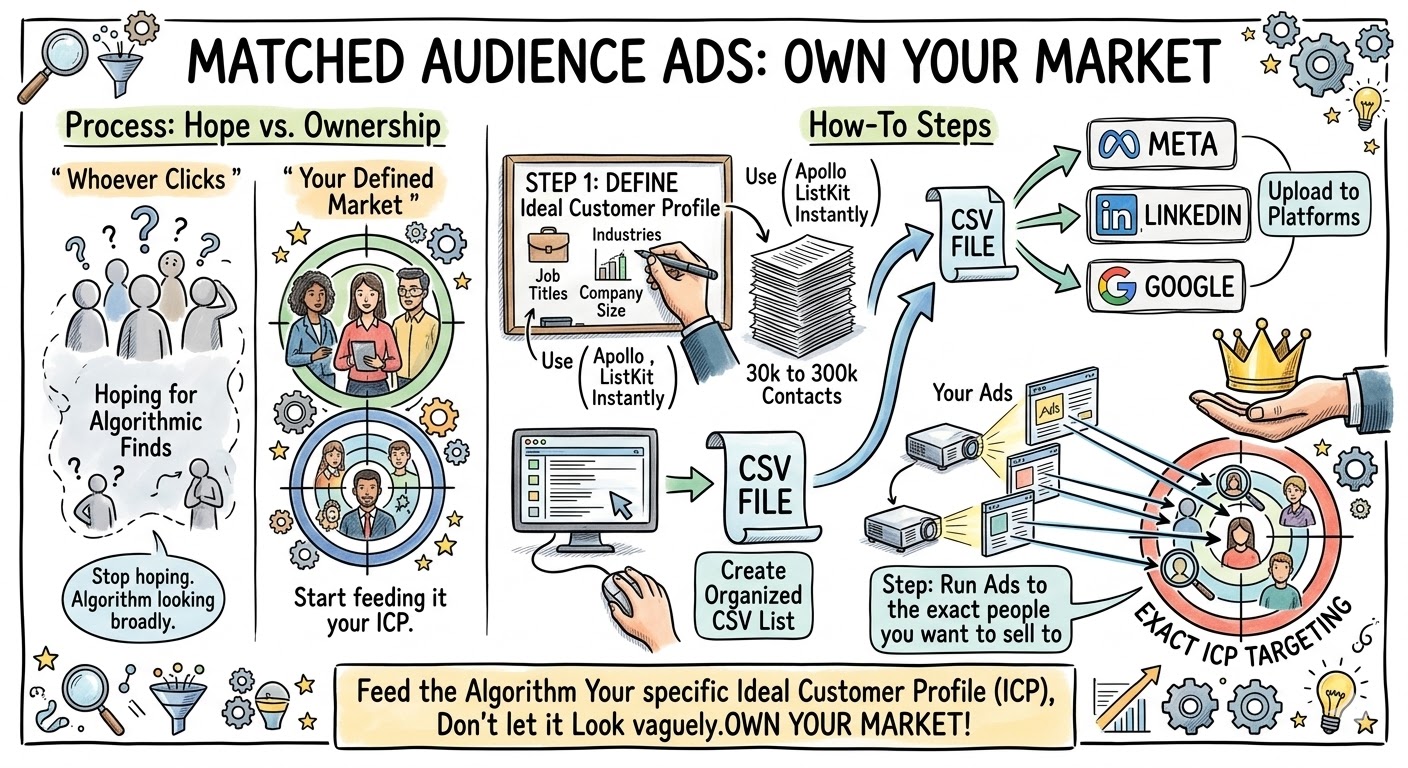
2. Matched Audience Ads: Own Your Market
Next layer: build your ABM list.
Use tools like Apollo, ListKit, or Instantly to build a CSV of your ideal customer profile. Aim for 30,000 to 300,000 contacts, depending on your market size.
Upload that list to Meta, LinkedIn, and Google as a custom (matched) audience. Now you’re running ads to the exact people you want to sell to.
This is the shift from “whoever clicks” to “my defined market.”
Once you do this, you stop hoping the algorithm finds your ICP. You feed it your ICP.
3. LinkedIn Sponsored Message Ads: Direct Inbox Access
For mid-market and enterprise SaaS with ACVs north of $10,000, this has been crushing.
Instead of feed ads, you send a message directly to someone’s LinkedIn inbox.
And here’s the kicker: LinkedIn inboxes are less crowded than email. Messages feel more personal. We’ve seen click-through rates 3–4x higher than regular LinkedIn ads.
Cost? Roughly $0.30–$0.50 per message.
The key is not being salesy. Start conversations. Offer value. Promote a report, a webinar, a useful asset.
You’re not closing deals. You’re opening loops.
4. LinkedIn Thought Leader Ads: Founder > Corporate
Most companies don’t even know this exists.
You can boost organic posts from a founder’s LinkedIn profile to your matched audience using LinkedIn’s Thought Leader Ads.
Here’s why it works:
Regular LinkedIn display ads often cost around $200 CPM. Thought Leader Ads are typically $30–$40 CPM, about 5–7x cheaper.
And they don’t feel like ads.
When someone sees a founder sharing insight, it feels real. Not corporate. Not polished to death.
We’ve scaled this to 1 million impressions per month inside a tightly defined SaaS CEO audience at a fraction of the cost of traditional ads.
Credibility compounds faster than creativity.
.jpg)
5. Meta Lookalike Ads: Find More of Your Best Customers
This is simple in concept and powerful in practice.
Upload your best customers to Meta. Build a 1% lookalike audience. Tell Meta: find more like this.
We’ve seen enterprise qualified leads in the $300–$400 range, often about 50% lower CAC than colder acquisition methods.
But here’s the rule: only build lookalikes from high-quality data.
Use:
- Closed-won customers
- High-intent opportunities
- Qualified demo leads
Garbage in, garbage out.
6. Google Paid Search: Capture Intent
There are three buckets that matter:
- Brand keywords (protect your turf).
- Competitor / alternative keywords (high intent, often 2–3x lower CAC).
- General intent keywords (category terms like “CRM software”).
If someone searches “Salesforce alternative,” they are in buying mode. That’s not awareness traffic. That’s comparison traffic.
Match your landing page headline to the search intent. Alignment between keyword and page is where conversion rates are won or lost.
7. Cold Email at Scale: Awareness, Not Just Replies
Cold email is not dead. It’s misunderstood.
When you shift from “book meetings” to “build awareness,” everything changes.
We’re talking real volume: 2,000+ emails per day, 40,000+ per month, covering your ABM list multiple times per year.
Well-executed campaigns are seeing:
- ~50% open rates
- ~3% click-through rates
Clicks matter as much as replies. When they click, your retargeting activates. The system reinforces itself.
8. LinkedIn Connection Outreach: Systematic Conversations
You can send up to 200 connection requests per week on LinkedIn.
When someone accepts, follow up with a thoughtful message. Tools like HeyReach or Kaki can help automate this.
We’ve seen LinkedIn response rates 2–3x higher than email in some cases because it feels like a professional conversation, not a cold pitch.
You don’t need to be clever. You need to be consistent.
9. Weekly Email Newsletters: Compound Trust
This one is massively underrated.
Your newsletter should go to:
- Customers
- Warm prospects
- In-process leads
- Repeat engagers from cold outreach
Weekly beats monthly. Enterprise buying cycles are often 6–12 months.
We’ve seen newsletters generate 30% of total pipeline because they compound trust over time.
Consistency builds authority. Authority builds preference.
.jpg)
10. Content-First Lead Warming: The Missing Layer
Most companies take cold leads and immediately hand them to SDRs.
That’s backwards.
Before outreach, warm the market with content. Let them see your:
- Blog posts
- Webinars
- Case studies
- Founder content
So when SDR outreach begins, it’s not truly cold. It’s contextual.
This is especially critical for companies with ACVs above $25,000.
Cold conversations become warmer. Conversion rates increase. Sales cycles shorten.
The Real Secret: They Work Together
The mistake is thinking any one of these tactics is the answer.
They’re not.
They are a system.
Cold email feeds retargeting. Retargeting improves search conversion. LinkedIn thought leadership boosts credibility for outbound. Lookalikes scale what’s already working.
Individually, each tactic helps.
Together, they create omnipresence.
And when your ICP sees you everywhere, across email, LinkedIn, Meta, Google, newsletters, and search, you stop feeling like a stranger in the market.
You start feeling inevitable.
Execute these with discipline, have a product that delivers, and growth becomes far more predictable than most founders realize.