
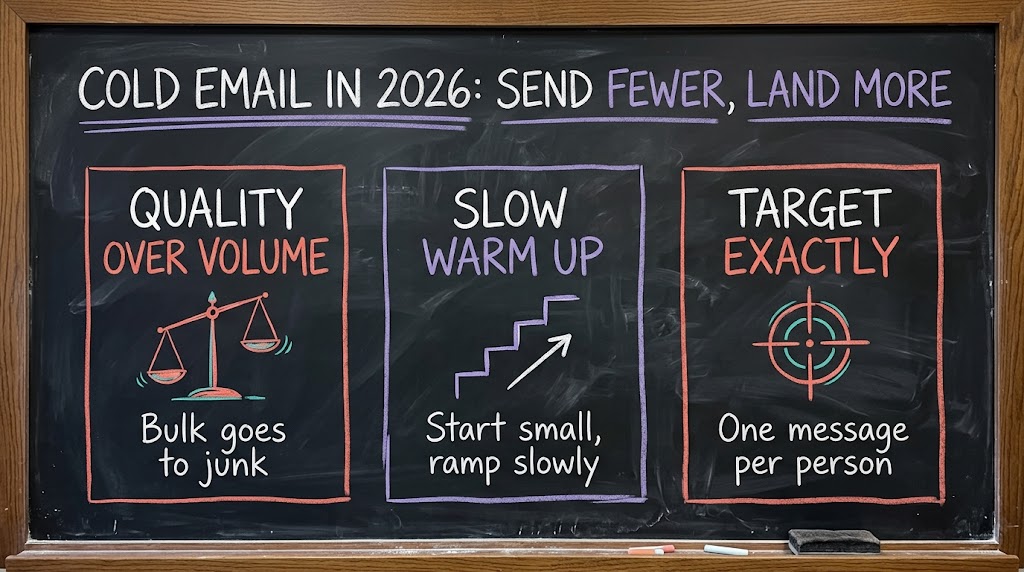
Cold Email in 2026: Send Fewer, Land More
Mass cold email stopped reaching inboxes this summer. Here is the lower-volume, highly personal setup I use now, from domains and warm-up to targeting, plus what to do if your campaign also needs a human on the phone.

About three months ago I stopped using the cold email platform I had relied on for years. Nothing was wrong with the tool itself. The problem was that no matter how carefully I set things up, every campaign started landing in the junk folder after two or three weeks. That pattern didn't exist a year ago, and it has been consistent since this summer. A founder in our mastermind told me the same thing this week: the platform he uses has been delivering his mail to junk, and his team has been trying to solve it with AI tools without much luck.
The old advice was to send three or four thousand emails a day and let the volume do the work. That advice is now out of date. What works in 2026 is sending far fewer messages, writing each one for a specific person, and treating deliverability as the thing you earn with quality rather than the thing you buy with more infrastructure.
Why volume stopped working
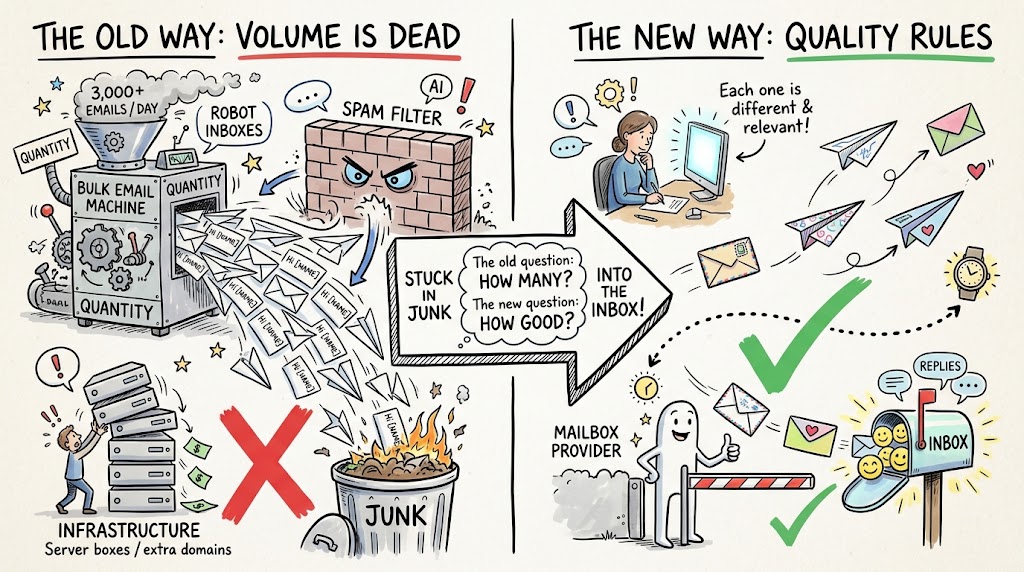
It used to be about quantity. You bought a list, loaded a sequence, rotated a pile of inboxes and accepted that a small percentage would reply. My read is that mailbox providers have gotten much better at spotting that shape of traffic, which is the same message with a swapped first name, sent in large batches. Whatever the exact mechanism, the result I see is consistent: the bulk approach that worked for years now ends up in junk, and piling on more sending accounts doesn't change that.
The only reliable way I have found to reach the inbox now is to send something that doesn't look like bulk mail, because it isn't. Every message is different, each one is relevant to the person receiving it, and they are sent at a pace that looks like a person working through a list.
- Bulk copy gets filtered. Near-identical messages sent in large batches are the pattern that now lands in junk after a couple of weeks.
- Volume used to be the lever. Three or four thousand emails a day was the old standard, and it no longer produces results.
- More infrastructure doesn't fix it. A big pool of domains is expensive to set up and maintain, and it doesn't change what the messages look like.
- Quality is the way in. Different messages, relevant to the reader, sent at a human pace, are what reach the inbox.
So the question to ask has changed. It used to be how many emails you could get out the door per day. Now it is how many good messages you can write and send per day, and the answer is a much smaller number than most teams are used to.
The setup I use now
The setup is simpler and cheaper than the old one. I connect Claude to a couple of Gmail inboxes on my sending domain, or to Resend, which is a transactional email service you can reach through an API for around $10 a month. Then I describe the customers I want to reach, and Claude builds the list and writes the messages. I send around 100 highly specific, short emails a day, each written for that particular account, and I let them trickle out about ten seconds apart rather than firing them in a block.
You don't need a large pool of domains either. One founder told me he had registered about 30 domains in the early days of an outbound program and was about to let them all expire. My advice was that he only needs about five, with a handful of inboxes on each, sending 50 to 100 emails a day in total. Everything else is overhead.
- Start with five domains at most. Pick a few that clearly relate to your brand, and let the rest lapse.
- Use five to ten inboxes per domain. Spreading the volume across inboxes keeps each one at a modest daily number.
- Send through Claude or an email API. Either option lets you write each message individually and control the timing.
- Keep each message short. A few sentences about who you are and why you are writing to that specific person is plenty.
This is also much easier than it was a year ago, which is part of why I recommend it. Checking that your email records are set up correctly used to be hard. Today you can ask Claude to check your SPF, DMARC and MX records, and to ramp up sending slowly while it watches the open and click rates for you.
Warm up slowly and watch the numbers
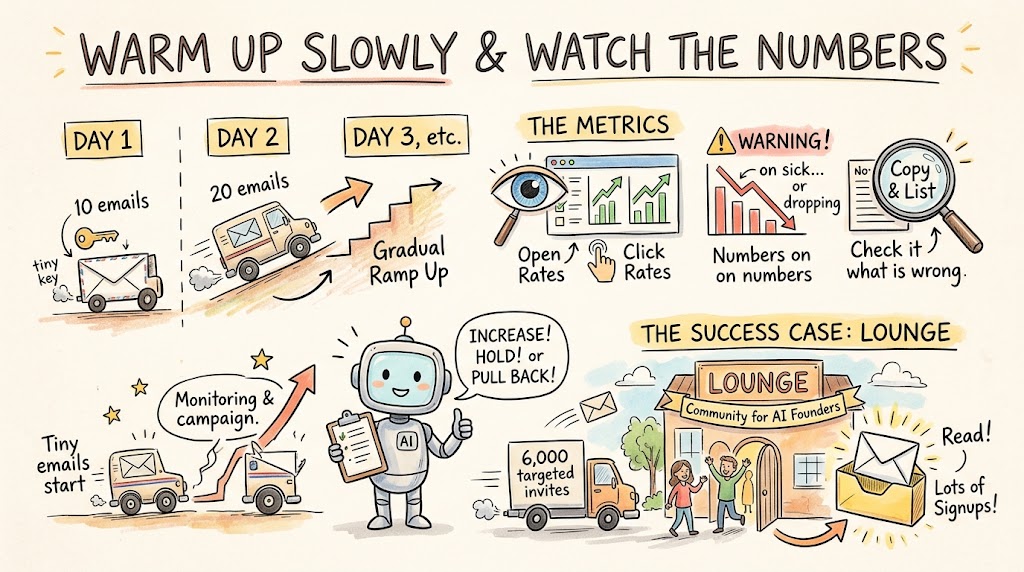
New sending accounts shouldn't go from zero to a hundred emails a day. I ramp them in small steps. On day one I send ten, on day two twenty, and I keep growing from there while checking open rates and click rates along the way. If those numbers are healthy, I keep climbing. If they drop, I stop, look at the copy and the list, and fix what is wrong before sending more.
- Day one, around ten messages. Start small enough that a problem is easy to diagnose.
- Add volume gradually. Double or increase in measured steps, and hold at any level where results get worse.
- Check opens and clicks. Falling numbers tell you something is wrong with the list, the copy or the infrastructure.
- Let the tool do the monitoring. You can ask Claude to review the data each day and tell you whether to increase, hold or pull back.
I used this approach for the launch of Lounge, our community for AI founders. Over about a week we sent roughly 6,000 invitations to venture-backed AI founders that we had identified as a good fit, and we got a lot of signups from it. That is a small number compared with the old standards of outbound, and it still produced more useful results because the messages arrived where people could read them.
Targeting is where the work moves
When you send fewer emails, the quality of each target matters a great deal more. My approach is to tell Claude what an ideal customer looks like, ask for around 200 accounts that match, and then ask for two or three people at each one with the right job titles. After that, each message gets written for the person and the company in front of it. It is a different kind of work from loading a spreadsheet into a sequencer, and it takes more thought per prospect.
The same logic applies when a founder is looking for an acquirer or a partner. Instead of sending thousands of messages, you build a list of the 30 or so companies that would benefit most from what you have, and you write to each of them one at a time. For that kind of list, sixty carefully written emails are far more effective than ten thousand generic ones.
- Define the ideal customer precisely. The more specific your description, the better the list Claude can build.
- Pick the right titles. Two or three relevant people per company gives you several chances without spamming anyone.
- Write one message per person. Mention something specific about their company and say plainly why you are writing.
- Send one at a time. Individual sends, spaced out, look like what they are, which is real outreach.
My own experience at iContact was almost the opposite. We never did outbound at all, and everything came from paid ads, affiliates, SEO, direct mail and trade shows. The results from Lounge make a strong case that fewer and better beats more and generic.
When the campaign needs a human on the phone
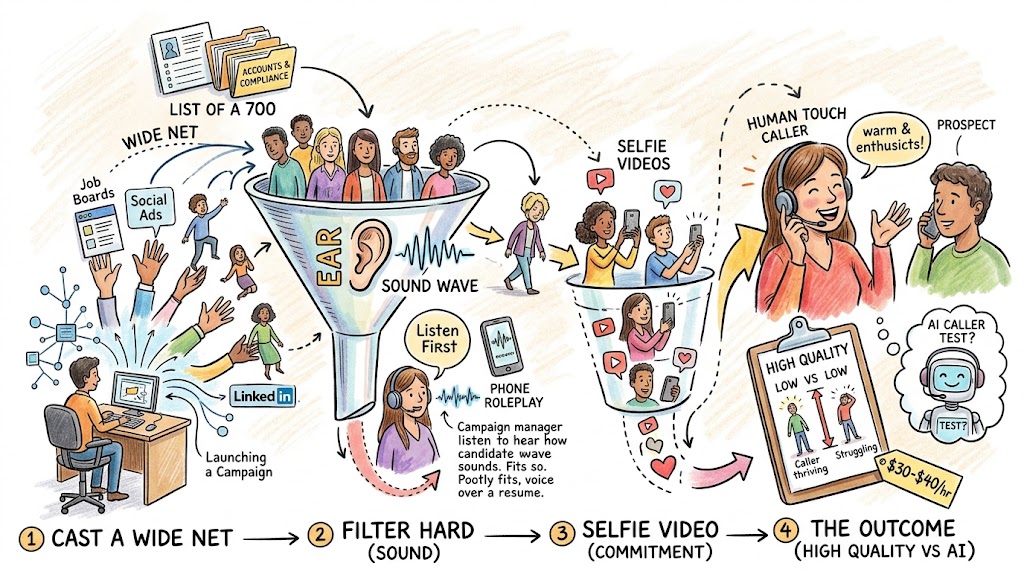
Some campaigns work best with a phone call attached to the email. A member who sells compliance software to organizations managing large amounts of federal money has a list of about 700 accounts, and he wants to hire contract cold callers to book appointments. The list is small and the campaign matters, so he cares more about quality than price.
The group had good advice for him. One person recommended posting the job for free on a major job board, targeting parts of the United States where hourly rates are lower, and expecting to pay somewhere between $30 and $40 an hour. Another member runs a large sales operation and shared a rule of thumb that most of the people who respond on those boards are looking because they weren't successful in their last role, so you need a hard filter. His filter is a wide net, then a recorded phone roleplay to hear how people actually sound, then a short selfie video explaining why they want the job.
- Cast a wide net. Job boards, social ads and LinkedIn posts all bring volume.
- Filter hard on how people sound. A short phone roleplay tells you more than a resume does.
- Ask for a quick video. People who record one are showing a bit more commitment.
- Expect a wide performance range. With the same leads and the same script, the gap between your best and worst caller can be very large, so pay for quality.
Another member suggested trying an AI caller first, particularly for a list this small, since the best ones are good enough to handle objections if you give them solid rebuttals. I think that is worth a test, and the same principle applies as with email: the better your preparation, the better the results.
What to do this week
If your outbound has been quietly getting worse, start with what is in front of you. Cut your domains down to a handful, check your DNS records with Claude's help, and rebuild your list around a tight definition of who should hear from you. Write a short message for each person, ramp up slowly, and watch your open and click rates every day. The goal is to send fewer emails that deserve to be in the inbox, and that is a much easier goal to hit than getting the old approach to work again.