
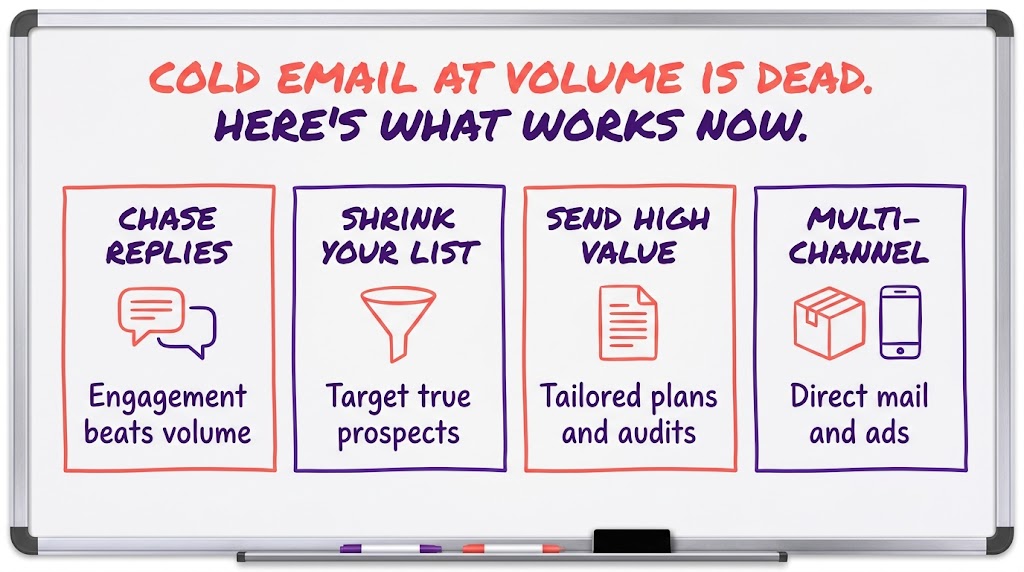
Cold Email at Volume Is Dead. Here's What Works Now.
Sending more cold email used to be the answer to every pipeline problem. Here is how enterprise SaaS founders are winning with small, researched lists, short messages, and real engagement instead.

In March of 2025, we were sending somewhere between 130,000 and 140,000 cold emails a month. We had hundreds of inboxes, a list of roughly 200,000 SaaS founders, and a playbook that said more volume meant more pipeline. For a while it did. Then, over the last 18 months, that strategy flipped on its head, and I now give founders almost the opposite advice.
The question I get most often from enterprise founders is how big their outbound list should be. A founder in our mastermind asked it this week. He sells to large manufacturers and retailers at a six-figure contract value, and he was wondering whether to load up a big list and run a generic five-step sequence. My answer surprised him, because it is a different answer than I would have given a year and a half ago.
Why more volume stopped working
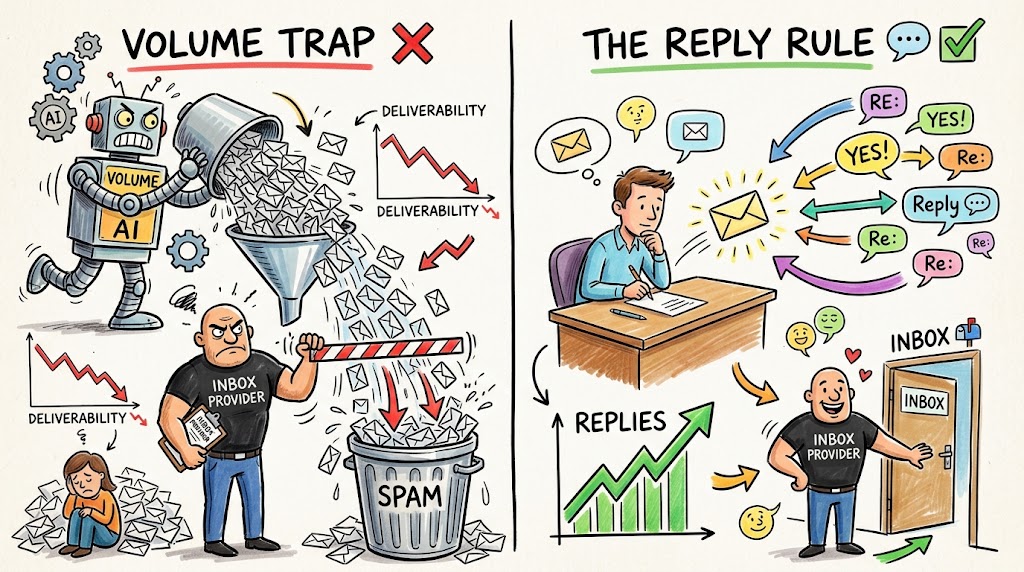
Once everyone got access to AI, everyone started sending more email. More volume with less engagement per message has an obvious result: the inbox providers noticed. We watched deliverability collapse more than once, to the point where close to none of our outbound was landing in the inbox. We hired deliverability consultants. We ramped brand new inboxes. None of it worked unless the engagement on the emails themselves was high.
What counts as engagement here is mostly replies. Clicks matter a little, but replies are the signal that tells the inbox providers your mail belongs in front of a human. That changed the whole logic of outbound, because the old levers (IP addresses, warm-up schedules, sending limits) matter far less than whether real people write back to you.
- Replies are the currency. A relevant, personal email gets answered often. A generic blast gets a reply roughly once in a thousand sends.
- A small reply rate is enough. If you reach half a percent to 1% replies, your future messages keep reaching the inbox. Ten replies per thousand is a good target.
- Infrastructure tricks have a ceiling. Fresh inboxes and warm-up tools help at the margins, but they cannot rescue a message nobody wants to answer.
- Volume now hurts you. Sending more of the same message with the same low engagement drags down every future send.
If you accept that replies drive deliverability, the strategy follows almost automatically. You stop asking how many people you can reach and start asking how many people you should reach.
Size your list by who actually has the problem
The better question is how many people in your target market have the problem you solve, and would be better off if you reached out. For many enterprise companies that number is 5,000. For others it is 20,000. It used to take a list of 50,000 to 100,000 people to close 20 or 30 new enterprise customers. Today a list of 5,000 or 10,000 highly targeted people can do the same job, as long as you treat each of them like a person instead of a row in a spreadsheet.
I like to work backward from revenue. For most SaaS companies in the 2 to 20 million ARR range, an extra 3 to 4 million in closed revenue per year is a win. If your contracts run $100,000 to $200,000, that is roughly 20 more closed customers a year. Getting to twenty customers takes a short list of the right accounts and a team willing to stay on them for as long as it takes, with no need for a million emails.
- Start from the revenue goal. Decide how many new customers would move the needle, then size the list to match.
- Define the real ICP. Include only accounts where your product would make a clear difference to the buyer's job.
- Score and rank the accounts. Work the best ones first. An AI-native CRM or Claude itself can build and score the list from your ICP document.
- Stay on them. Treat each account like an AE with a big bonus would. You keep going until the person moves or buys.
I do this myself now. This month, my CRM built a list of 277 target accounts from our ideal customer profile, scored them, and I am writing sequences specific to what we learned about each one. The math is simple: pick the thousand or so founders I want to reach this month, write something short and useful for them, and get 30 or 40 of them to engage. That beats the much lower rates I used to see at 100 times the volume.
Write like a smart AE writing one email at a time
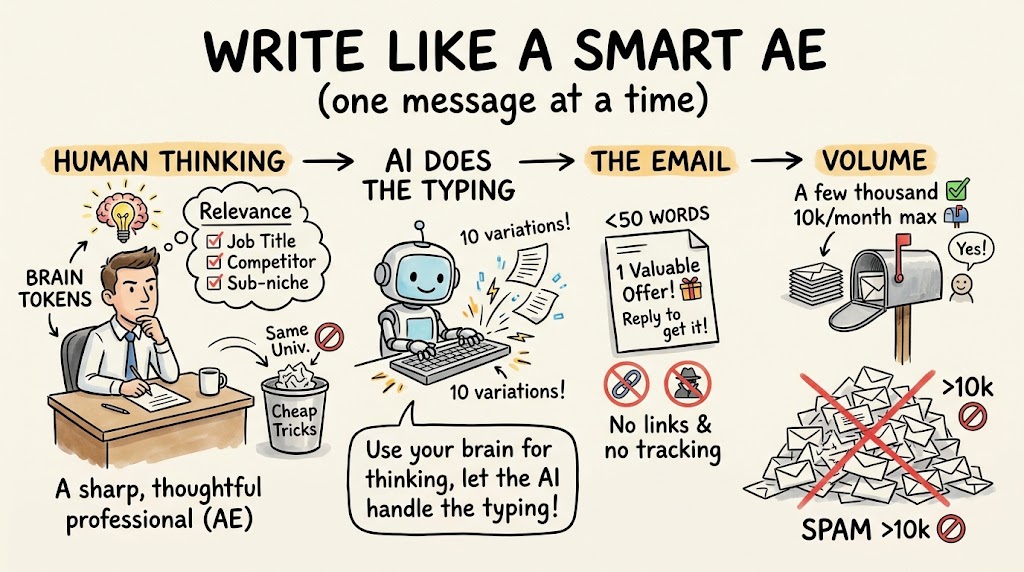
The mental model I give founders is this: pretend you are one sharp account executive writing every message by hand, and you care enough to make each one relevant. Then use AI to produce ten sample versions of that message. As I told the group, use your own brain tokens on the thinking, and let the model handle the typing.
Relevance has a specific meaning here. Mentioning that you saw the person went to the same university is a thin trick that people spot immediately. Real relevance means the email speaks to their job title, their company, their competitors, and their sub-niche, ideally with an example of how a similar company benefited from what you sell.
- Keep it under 50 words. Longer outbound loses attention fast.
- Make one valuable offer. It should be something they can only get by replying, such as a short case study, a benchmark, or a free consultation.
- Skip links and tracking. Leave out open tracking and click tracking. Cybersecurity bots trigger them anyway, so the data is mostly noise.
- Describe the offer in plain text. When they reply, send the real thing.
A small point on volume limits is worth knowing. If you send a couple thousand cold emails a month, you are fine. Even 10,000 a month is generally fine. The trouble begins when you go well beyond that, which most enterprise teams never need to do.
Use assets that carry the weight a link normally would
One of the sharper tips in our group came from a founder who runs a cold email agency. His team discovered that, for Google inboxes, a link to a Google Doc does not hurt deliverability the way an ordinary link does, because Google treats its own domain as trusted. So for qualified leads they generate a full, nicely designed plan in a Google Doc, including a custom email sequence, a target list, and a strategy across channels, and share that.
He also described building personalized websites and landing pages for each prospect, which costs around 50 cents per lead. That sounds expensive until you do the math on a list of fewer than 10,000 qualified accounts. At that size, spending a meaningful sum to produce audits and reports tailored to each account can pay for itself with a single closed deal. You still have to check the quality of what AI produces, but this approach is starting to work well for his team.
- Google Docs as a delivery vehicle. Share a tailored plan or report as a doc instead of linking to your website.
- Personalized pages for qualified accounts. Around 50 cents a lead is a small cost when each customer is worth six figures.
- Reports and audits made for one company. Give the prospect something they can use even if they never buy.
- Quality control stays human. Review the output before it goes out, especially at the start.
The common thread is that the asset itself earns the reply. The email is a short invitation, and the real value arrives in the form the prospect wants it.
Go beyond the inbox when each customer is worth six figures
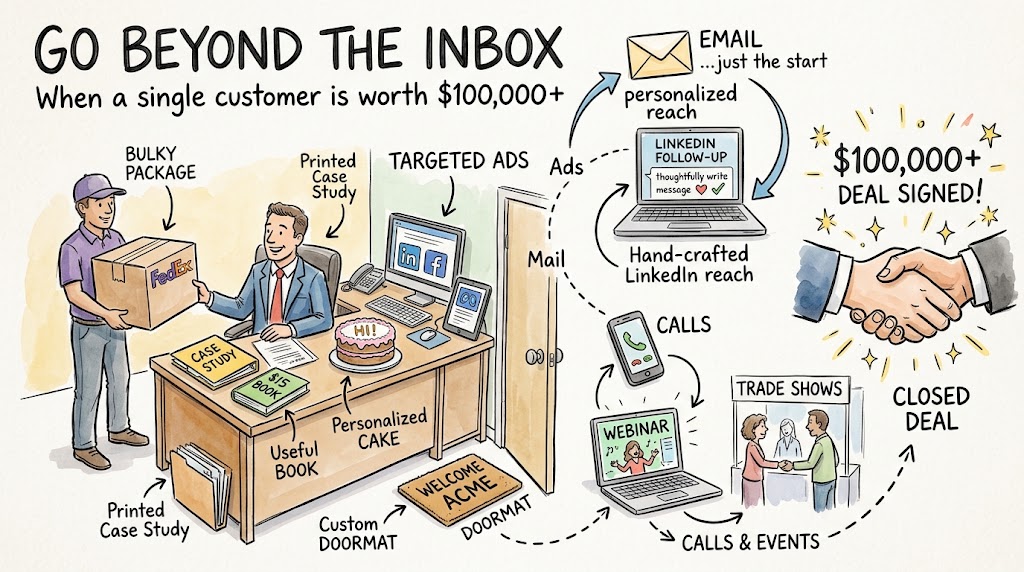
When a single customer is worth $100,000 or more, you have room to use channels that would be absurd at a $5,000 price point. A few of the ideas our members shared are worth stealing.
You can send a printed case study, or a $15 book by FedEx, so the executive gets something physical that makes them remember you. Some teams send something bulky on purpose, because a package on a desk is hard to ignore. One founder mentioned that a popular tactic in San Francisco is sending personalized cakes to target companies, and I have even seen personalized doormats. These sound silly until you realize the cost per account is trivial next to the contract value.
- Direct mail. Printed case studies, books, or bulky packages get attention that email cannot.
- Targeted ABM ads. Show the same people your ads on Meta and LinkedIn while your emails land in their inbox, so your name feels familiar.
- LinkedIn follow-up. Take the people who click or reply and move them into a LinkedIn campaign, ideally one you run with care rather than a spray-and-pray tool.
- Calls, webinars, and events. Webinar partnerships, trade shows, sponsorships, and in-person visits all become worth the effort at this deal size.
These channels work together. The email earns attention, the ad reinforces it, the package makes it physical, and the call finishes the job.
What to do this week
If you run outbound for an enterprise product, the practical shift is smaller than it sounds. Email stays in the mix. What changes is who you send it to, how much you send, and how much thought goes into each message. Start with your ideal customer profile, build the smallest list that could realistically deliver your revenue goal, and write to those people as if you had all the time in the world.
Then measure replies instead of opens. If you reach even half a percent, you have a message worth scaling slowly. If you do not, rewrite before you send more. In a market where everyone can generate a thousand emails in a minute, the founders who win are the ones willing to care about the dozens that actually matter.