
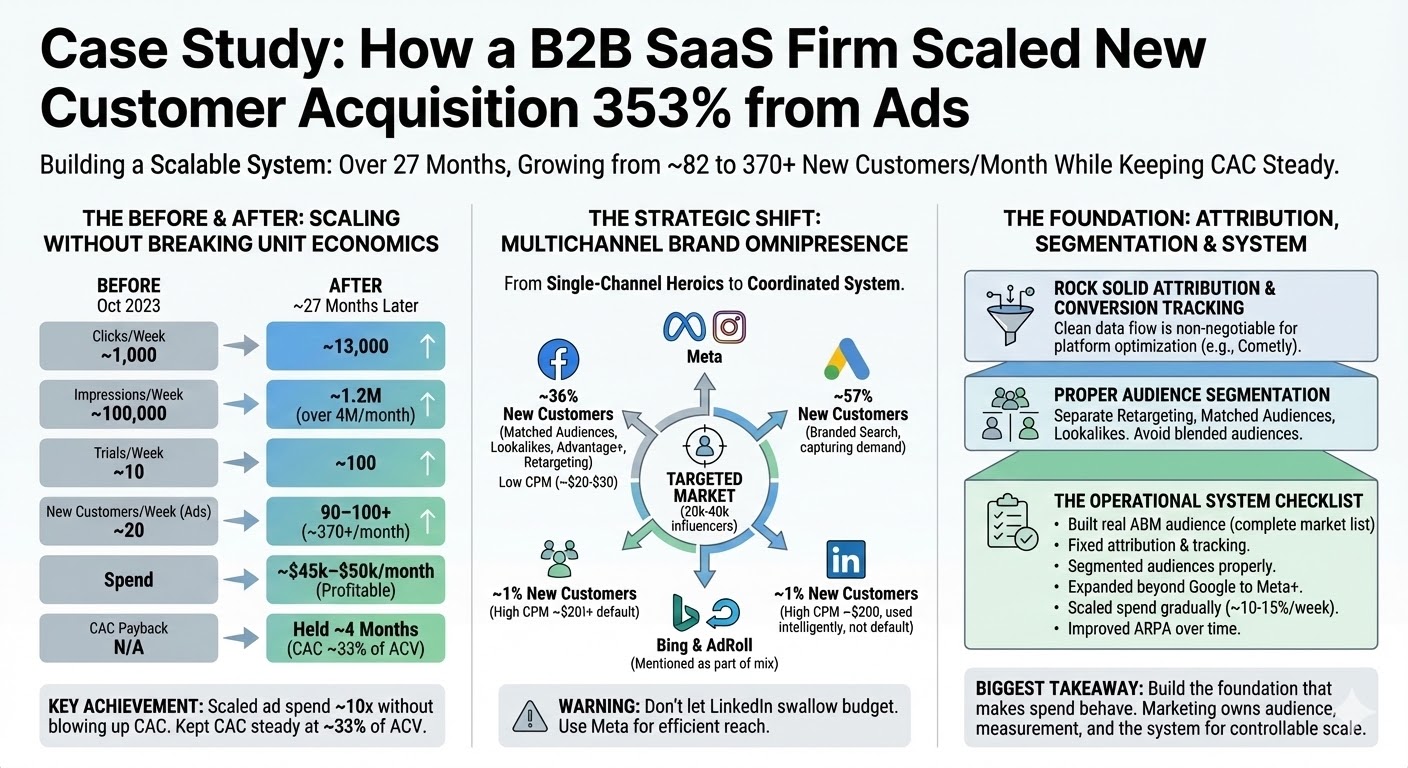
Case Study: How a B2B SaaS Firm Scaled New Customer Acquisition 353% from Ads
We break down how one B2B SaaS company scaled new customer acquisition by 353% using a disciplined paid advertising strategy — without blowing up their CAC. It walks through the exact shifts in messaging, targeting, landing page optimization, and unit economics that turned underperforming ad spend into a scalable growth engine, along with the mistakes and lessons learned along the way.

.jpg)
In this webinar, I walked through one of my favorite kinds of stories: not “we ran some ads,” but we built a system that kept working as spend scaled.
The company in this case study is a B2B SaaS business with a trial-driven motion (freemium / free trial). Over 27 months, they went from ~82 new customers per month directly sourced from ads to 370+ new customers per month from ads.
If you do the math literally on 82 → 370, that’s about ~351% growth (and the “353%” headline is basically a rounding / “370+” effect). The point isn’t the exact percent. The point is: they scaled hard without their unit economics falling apart.
And that’s the part most teams never figure out.
As I said in the session, “Usually, when you 10x ad spend, you at least 3x or 4x CAC. Here, we’ve been able to keep CAC steady at 33% of ACV.”
Let’s break down what happened, what they changed, and why it worked.

The before and after: what actually moved
When we started (October 2023), this company was largely Google-only. They were getting roughly ~1,000 clicks per week from ads, producing about ~10 new trials per week, and about ~20 new paying customers per week sourced from ads.
Fast forward ~27 months:
- Clicks: ~1,000/week → ~13,000/week
- Impressions: ~100,000/week → ~1.2M/week (over 4M/month)
- Trials: ~10/week → ~100/week
- New customers from ads: ~20/week → 90–100+ per week (he describes it as “over a hundred new customers a week” at the high end)
- Spend: roughly $45k–$50k/month at the current scale (profitable)
- CAC payback: held around ~4 months by keeping CAC around 33% of ACV and improving ARPA over time
That last bullet is the whole game. It’s easy to buy impressions. It’s hard to do it while staying profitable.
This is why I keep coming back to the same belief: “The difference between a three million ARR SaaS company and a thirty million ARR SaaS company is digital advertising and cracking the nut on unit economics.”
The “how”: multichannel brand omnipresence, not one-channel heroics
This wasn’t a magical new ad creative. It was a strategic shift: from a single-channel acquisition habit to what we call a multichannel brand omnipresence campaign.
In plain English: they stopped expecting one platform to do all the work.
Here’s the mental model I shared in the webinar: “The whole point of this system that we’ve invented is to make your brand omnipresent within a targeted market.”
And I mean targeted. Not “everyone on the internet.”
“You can’t make a B2B brand omnipresent like Coca-Cola in the whole world, but what you can do is find the twenty to forty thousand people that really influence the buying decision within your target market and make your brand as well known as Coca-Cola for those forty thousand people.”
The “omnipresence” part comes from coordinating multiple ad types and multiple networks, supported by a real ABM audience and solid measurement.
The foundation that made scaling possible: attribution + segmentation
When I brought David on, I asked him to summarize how we scaled from “Google-only” to multiple networks without blowing up CAC. His answer was exactly what most teams skip:
He said we came in and ensured “rock solid attribution,” then paired that with “proper audience segmentation,” because “everything about advertising is setting things up foundationally correct from the beginning.”
He also made the point that if you don’t have good data flowing into the ad platforms, “you’re kind of shooting yourself in the foot from the very beginning.”
That’s not theory. It’s practical:
- If your conversion tracking is wrong, Meta optimizes for the wrong thing.
- If your audiences are blended together, you don’t know what’s working.
- If you can’t separate retargeting from net-new, you over-credit the bottom of the funnel and starve demand generation.
That’s why we treat the measurement layer as non-negotiable, and why I called out installing a tracking tool like Cometly as part of the system.
What channels actually drove new customers (and a LinkedIn trap to avoid)
One of the most useful moments in the case study was looking at where customers really came from once the company went multichannel.
They ran across Meta, LinkedIn, Google, Bing, and AdRoll.
But the surprise was distribution:
- ~36% of new customers came from Facebook/Instagram (Meta) (matched audiences, lookalikes, Advantage+, retargeting).
- ~57% came from Google Ads (with the important caveat that Meta often creates the awareness that later turns into branded search).
- ~1% came from LinkedIn for this particular company (and I noted that many clients are more like 5–10%, but still).
This leads into a very specific warning I gave on the webinar, because I see founders and marketers make this mistake constantly:
“Most people say, ‘LinkedIn’s the B2B social network. I’m going to put 50% of my ad spend on LinkedIn.’ Do not do that. LinkedIn is way too expensive.”
The cost dynamics matter. I called out typical CPM ranges we see:
- LinkedIn: ~$200 CPM
- Meta: ~$20–$30 CPM
That’s often 80–90% lower CPM on Meta while still reaching many of the same humans via matched audiences.
So the play isn’t “avoid LinkedIn.” The play is: use LinkedIn intelligently, but don’t let it swallow your budget because it feels more B2B.
The system in one view: what they did differently
If you want the simplest explanation for why this company scaled, it’s that they stopped treating paid acquisition like a standalone channel and started treating it like an integrated growth system.
In the webinar I laid out the core tools and steps that make this work: ABM list building, outbound + content, conversion tracking, and then scaling ads across networks and ad types.
Here’s the operational checklist version of what changed (this is the one list I’d print out and put next to your desk):
- Built a real ABM audience (not “1,000 leads for an SDR,” but a complete list of the market they wanted).
- Fixed attribution and conversion tracking so optimization signals were clean.
- Segmented audiences properly (retargeting vs matched audiences vs lookalikes, and excluded overlaps).
- Expanded beyond Google into Meta + other networks to create awareness and lower blended costs.
- Scaled spend gradually (mathematical scaling, roughly 10–15% per week, instead of chaotic jumps).
- Improved ARPA over time, which helped keep CAC payback stable even as volume increased.
That’s the recipe. Notice what’s not on the list: “found a clever hack.”
Why the unit economics didn’t break
Holding CAC steady while scaling is mostly about two things:
- You scale what’s already profitable (and you actually know what’s profitable because tracking is right).
- You expand reach without paying premium prices for every impression (matched audiences on Meta are a huge piece of that).
On the payback metric specifically, the company held around ~4 months. That’s fast. It gives you room to reinvest and compound.
And it’s worth repeating the underlying definition I used live, because founders sometimes hear “33% of ACV” and don’t internalize it. In this framing, ACV is basically ARPA x 12, and CAC at ~33% of ACV implies you’re buying customers for about four months of revenue, which is why the payback shows up around four months.
The biggest takeaway (and how to apply it in your company)
.jpg)
If you’re sitting at $3M–$10M ARR and want to scale to $30M+, the lesson from this case study is not “spend more.” It’s build the foundation that makes more spend behave.
I said it in the webinar and I’ll say it again here: “We like centralized scalable models… lead acquisition is the role of marketing, not the role of sales. The role of sales is to close leads. The role of marketing is to create the leads.”
When marketing owns the audience (ABM list), owns the measurement (attribution), and owns the system (multi-network), then paid acquisition becomes a controllable lever. Not a gamble.
If you want a simple first step, do this: stop asking “what channel should we try next?” and start asking “do we have clean attribution and a segmented audience structure that would allow scaling if we found something that works?”
That’s how you get from 82 customers/month from ads to 370+ without destroying your CAC.

.jpg)
.jpg)
.jpg)
.jpg)
.jpg)