
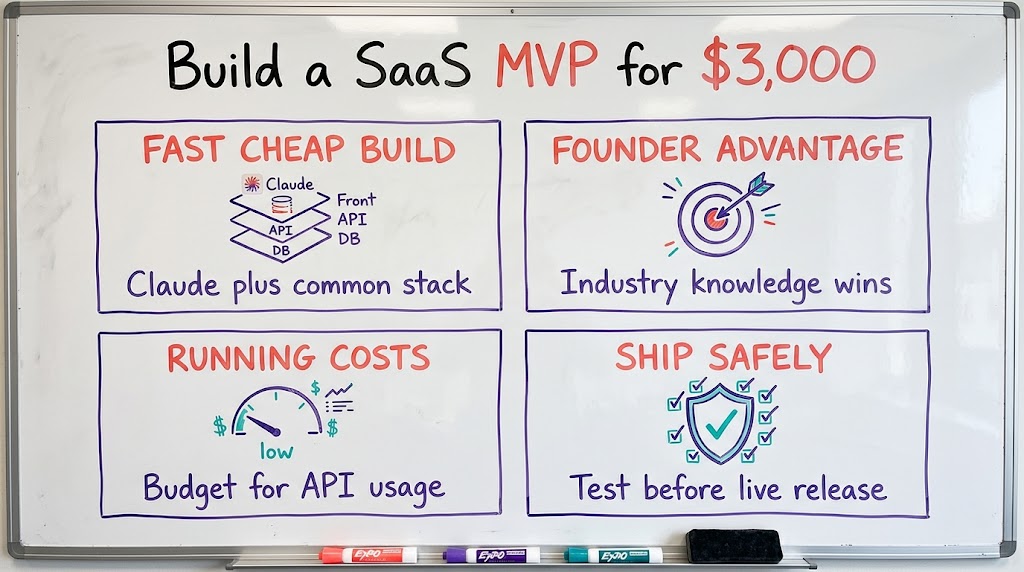
Build a SaaS MVP for $3,000
A software MVP that used to cost around $500,000 can now be built for about $3,000 in AI credits. Here is what it bought me, what it costs to run, and the step that still scares founders.

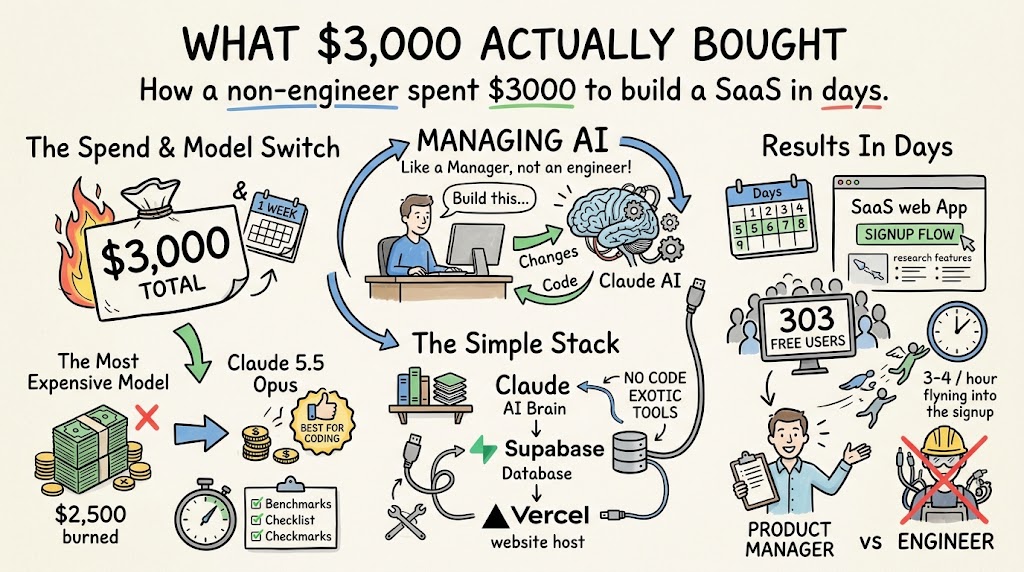
It used to take about $500,000 to build a good software MVP. I just did it for about $3,000, which is a whole different world. I have spent my career as the product manager, the strategy person and the marketing person on software teams, and this is the first time I have been able to build something myself. The product is Lounge, a community platform for AI founders, and I put the first version together in roughly nine days by typing what I wanted into Claude.
Several founders in our masterminds asked me about the costs and the heartaches, so this post covers what I spent, what it costs to keep running, and where the real risks are. If you have been putting off a product idea because you assumed you would need a development team and a six-figure budget, the math has changed.
What $3,000 actually bought
I spent about $3,000 over the first week or so, nearly all of it in credits for Claude. Early on, I used the most capable model available because I wanted the best results, and I burned through about $2,500 on it. A few days later I looked at the software engineering benchmarks and saw that Claude Opus 5.5 was slightly better at coding than the more expensive model, so I switched to it for the rest of the build.
The tools around it are not exotic. I use Claude to write the code, Supabase for the database, and Vercel to host the site. I typed my requirements into Claude and it walked me through setting up the accounts and connecting everything. The result was a working product with a public website, a signup flow and a set of research features, and we reached 303 free users within the first eight or nine days.
- About $3,000 in total. Most of that was concentrated in one week of heavy building on the highest-priced model.
- Check the benchmarks. The most expensive model isn't automatically the best for your task, and switching saved money without costing quality.
- A simple, common stack. Claude for the code, Supabase for data and Vercel for hosting are all tools that Claude knows well and can set up with you.
- Real users in days. Signups were arriving at about three or four an hour after launch.
None of this required me to become an engineer. I describe what I want, I look at what comes back, and I ask for changes. That loop is a lot closer to managing a very fast developer than to writing code, and my product management background turned out to be the skill that mattered most.
Why this changes who gets to build
When an MVP costs $500,000, the people who build products are the ones who can raise or spend that kind of money. At $3,000, the person with the best understanding of the customer can build it directly. I especially like what this means for vertical software. A founder in our community came out of one specific industry and built an AI training tool for salespeople in that industry, using what he knew from running a business there. I have grown to love vertical SaaS for exactly this reason, because a specific audience and real industry experience are very hard for a generalist competitor to copy.
- Industry knowledge becomes the advantage. The founder who knows the customer's daily problems can describe the product precisely, and that is most of the job.
- The cost of being wrong drops. If an idea fails after $3,000 and a couple of weeks, you move on with very little lost.
- You can test before you hire. A working version in front of real users tells you what a team should build next.
What it costs to keep running
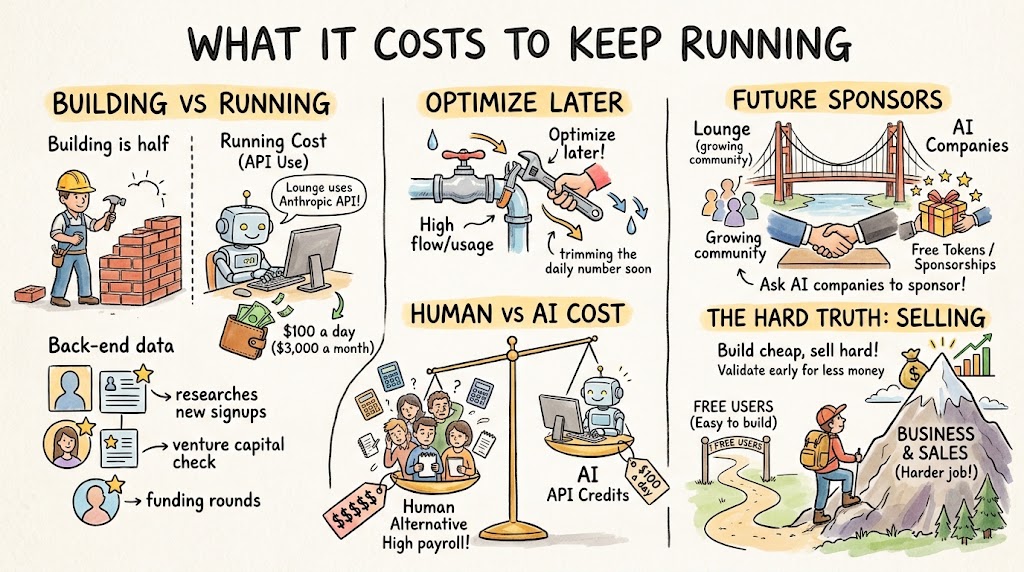
Building is only half of the budget. Lounge uses the Anthropic API inside the product itself. Every time a new member signs up, the system researches the person, checks whether they have raised venture capital or had an exit, and builds a profile. It also does deal research, news research and research on funding rounds. I have not optimized any of it yet, and right now I am probably spending about $100 a day in API credits through the Claude Console.
Here is the arithmetic, so you can plan around something similar. At $100 a day, the running cost is about $3,000 a month if usage holds steady. That is a meaningful monthly expense for an early product, and it is also far lower than the cost of a team that could do the same research by hand.
- Budget for the product's own AI use. If your features call a model, the usage costs are separate from the cost of building.
- Expect to optimize later. I haven't trimmed anything yet, and I expect there is room to bring the daily number down.
- Ask for sponsors. If the community gets large enough, I plan to ask AI companies whether they want to provide free tokens in exchange for being a sponsor.
- Compare with the human alternative. The relevant comparison is what it would cost to get the same research done any other way.
I also want to be clear about what this does and doesn't prove. A product that is cheap to build has not been proven to sell. We have a good group of free users, and turning a community into a business is the harder job. The new economics of building mean you can find that out far sooner and for far less money than before.
What Claude can take over from here
Once the first version exists, Claude can keep doing a lot of the work. I told a founder in our mastermind that he could probably take care of the UI and UX design and any new features through Claude, which would save him money. The redesign is one of the easier wins. If you haven't changed your interface in the last two years, you can use Claude Design to redo it. I would plan on about an hour for the initial build and six to eight hours of checking every page, which adds up to a weekend.
The founder I was talking to has a large, mature product used by many customers, and he is already well along on this path. He uses several AI tools together, with ChatGPT acting as a kind of general manager that hands out projects, Claude doing a lot of the prompt writing, and Cursor as his development environment. He told me that he is more skilled with the AI tools than his contract programmer, who has been the bottleneck because he only works with him on evenings and weekends.
- Redesign the interface. A weekend with Claude Design can refresh the whole product.
- Add features directly. New functionality can come from describing what you want in plain language.
- Use more than one tool. Some founders divide the work, using one assistant to plan and another to write code.
- Reduce dependence on one person. If a single contractor is your only route to production, AI can shorten the time you wait on them.
This is where the conversation turned to the part that still worries people. Writing code is no longer the hard part. The hard part is getting changes safely into a live product.
The scary step is shipping to production
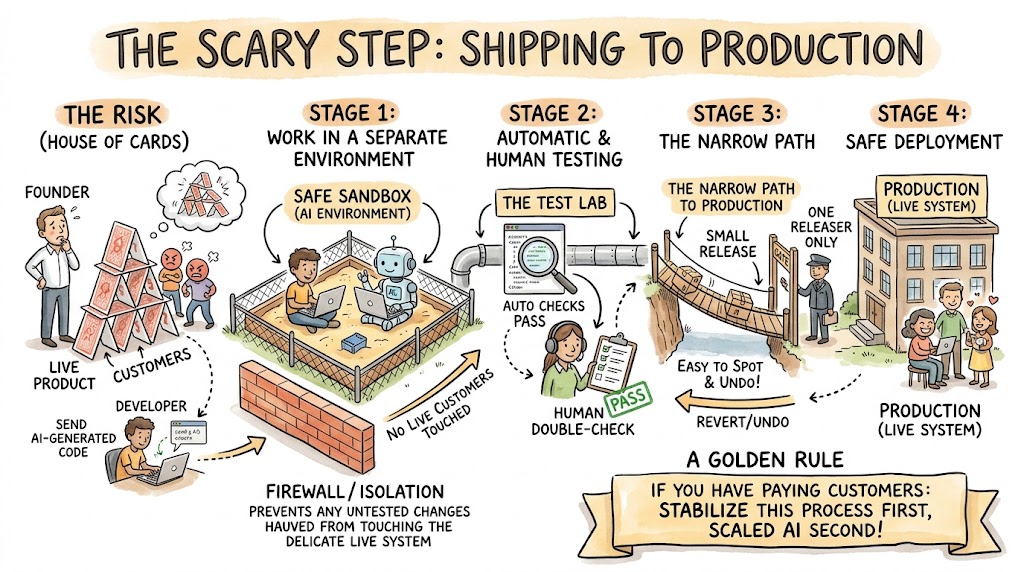
The founder described his real concern in one sentence. His product is very large, and one wrong move and the whole house of cards falls and all his customers are furious. He has a development environment and a way for his programmer to test and release, but he doesn't yet have a secondary environment of his own where he can work safely with AI, and he hasn't built the bridge from there to production.
I think that is exactly the right thing to worry about, and it deserves more attention than the cost of the AI. When a model can write code in minutes, the risk moves to what happens after the code is written. A solid process for testing and releasing changes is what lets you take advantage of speed without putting your customers at risk.
- Work in a separate environment. Build and test with AI in a copy of your product so that nothing you try touches live customers.
- Test before every release. Run your checks automatically, and have someone confirm the important flows work.
- Keep the path to production narrow. A single, well-defined way to release makes mistakes easier to spot and reverse.
- Make releases small. Smaller changes are easier to review, and easier to undo if something is wrong.
If you are starting from scratch, as I was, this matters less on day one because you have no customers to disappoint. If you already have a large product with paying users, I would build this process first and start using AI heavily second.
What I would do this week
If you have an idea you have been sitting on, pick the smallest version that would tell you something real and build it in Claude over a few days. Set a budget in advance, check which model is actually best for coding before you spend heavily, and keep track of your daily usage once the product is live. Then put it in front of real people, because that is the part that still takes just as much effort as it always did.
If you already run a software company, take a close look at where your development time goes, and ask whether a design refresh or a new feature could be done in a weekend rather than a quarter. Set up a safe place to test changes before you start. The founders I know who are moving fastest right now are the ones who treat building as cheap and shipping as the step that deserves care.