
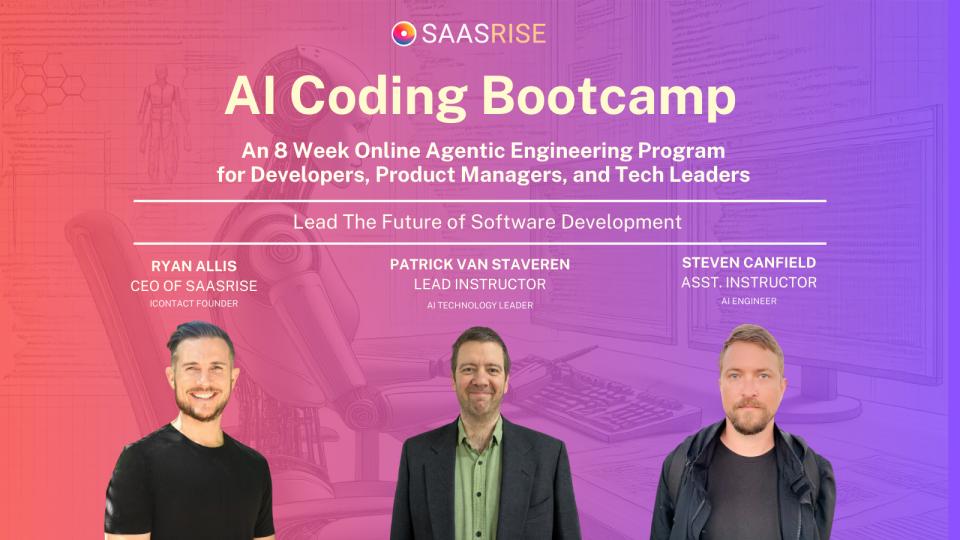
AI Coding Bootcamp Starts April 15
This week we announced the launch of our new AI Coding Bootcamp (starting April 15), an 8-week live program designed to help SaaS teams transition to AI-first engineering workflows. This explains how leading teams are achieving 5–10x productivity gains with agentic development using tools like Claude Code, and outlines the hands-on curriculum built to modernize product, engineering, and QA processes in just two months.

Announcement: Our New AI Coding Bootcamp Starts April 15
Over the past year, something extraordinary has happened inside the best SaaS engineering teams.
They’ve quietly become 5 to 10 times more productive.
Not because they hired more engineers. Not because they raised bigger rounds. And not because they magically became better programmers overnight.
It’s because they adopted a fundamentally different way of building software.
Instead of treating AI as a novelty tool, they rebuilt their entire development process around AI.
The result is what many people now call agentic engineering — a workflow where developers work alongside AI coding agents that can write code, debug systems, run tests, and even refactor entire applications.
After watching this transformation unfold across the SaaS ecosystem — and implementing these workflows ourselves — we decided it was time to create a structured program to help SaaS companies make this transition.
Today I’m excited to announce the launch of our new AI Coding Bootcamp, starting April 15, 2026.
.jpg)
The AI Coding Revolution Is Here
In 2025, using AI coding tools was still optional.
In 2026, it’s rapidly becoming essential.
Companies that implement AI-first engineering workflows are shipping features dramatically faster. Product iteration cycles that used to take weeks now happen in days. Entire prototypes can be built in a single afternoon.
Meanwhile, teams that are still operating with legacy workflows — traditional ticket queues, slow development loops, and limited automation — are increasingly falling behind.
This shift is not subtle.
It’s one of the biggest productivity breakthroughs in the history of software development.
The companies that adapt will become the disruptors.
The companies that don’t will eventually be disrupted.
.jpg)
Introducing the SaasRise AI Coding Bootcamp
To help SaaS companies make this transition, we created an 8-week online AI coding program designed specifically for:
- Software engineers
- Product managers
- Engineering leaders
- CTOs and founders
The goal of the program is simple:
Transform your company’s R&D process to be AI-first within two months.
By the end of the program, participants won’t just understand AI coding tools in theory. They’ll have a working personal agentic engineering workflow they use every day.
This program runs:
April 15 – June 5, 2026
Live on Zoom every Wednesday at 10am PT
Each session is 90 minutes
To keep the experience high quality, each cohort is capped at 50 participants.
Why We Built This Program
Inside the SaasRise community, we’ve been experimenting heavily with AI-first development.
We’ve seen founders and engineering teams achieve remarkable gains once they adopt the right workflows.
But we’ve also seen a common problem.
Most teams are AI-curious but not AI-capable.
They’ve tried tools like Cursor, Claude Code, or Lovable. Maybe they’ve generated some code. Maybe they’ve built a quick prototype.
But they haven’t yet integrated AI deeply into their product management, engineering, and QA processes.
That’s the gap this program is designed to close.
Instead of scattered experimentation, we guide teams through a structured transformation.
By the end of the program, participants know how to use AI across the full product lifecycle:
- Product ideation
- Rapid prototyping
- Code generation
- Debugging
- Testing
- Deployment
.jpg)
The Core Tool: Claude Code
The primary tool used throughout the program will be Claude Code, one of the most powerful AI coding environments available today.
Claude Code allows developers to load an entire codebase into context and collaborate with AI agents that can:
- Write new features
- Refactor legacy systems
- Debug complex issues
- Generate tests
- Review pull requests
- Improve documentation
Once developers learn how to structure prompts, manage context, and design workflows around this capability, the productivity gains can be dramatic.
What Participants Will Learn
Over the eight weeks, participants will develop practical skills they can immediately apply inside their own companies.
Some of the core capabilities include:
Rebuilding Legacy Applications with AI
Participants will learn how to load an existing SaaS codebase into Claude Code and use AI to refactor modules, upgrade the UI, or even migrate the application to a new language.
For many companies, this becomes the fastest way to modernize older systems.
Transforming the Product Management Workflow
In an AI-first organization, product development becomes much more collaborative between humans and machines.
Instead of writing tickets and waiting for development cycles, product owners learn how to structure prompts and specifications that allow AI agents to help implement and QA features simultaneously.
This dramatically accelerates iteration speed.
Rapid UI/UX Prototyping
Participants will build UI and UX prototypes using tools like Lovable and Google AI Studio, then hand those prototypes to engineering teams for full AI-assisted development.
This eliminates one of the slowest stages of product development.
Choosing the Right AI Tools
There are dozens of AI coding platforms emerging right now.
Participants will learn when to use tools like:
- Claude Code
- OpenAI Codex
- Lovable
- Bolt
- Base44
- Google AI Studio
Each tool has strengths depending on the task.
Knowing when to use which tool is a key productivity multiplier.
Debugging and Shipping AI-Generated Code
AI-generated code still requires thoughtful oversight.
Participants will learn how to build feedback loops with coding agents, write automated tests, and critically review AI output before shipping to production.
This is where experienced engineers still provide enormous value.
The Weekly Curriculum
The program runs over eight weeks with a clear progression.
Week 1 – Program Overview
Participants set up their development environment and get a live demo of Claude Code. We also survey the AI coding tool landscape.
Week 2 – Building an AI App
Participants build a complete working application from a single prompt in Claude Code.
Everyone leaves having shipped something real.
Week 3 – UI/UX MVPs
We explore how product development changes in an AI-first world. Participants create UI prototypes and hand them off to Claude Code for development.
Week 4 – Reading Existing Codebases
Participants learn how to load existing applications into Claude Code and analyze dependencies, git history, and security vulnerabilities.
Week 5 – Building from Specifications
Teams practice translating product specs into AI-driven development workflows.
Week 6 – Testing and Shipping
Participants implement automated tests, pre-commit hooks, and safe deployment workflows for AI-generated code.
Week 7 – Personal AI Workflows
Participants configure their own Claude workflows using skills files and prompt engineering techniques.
Week 8 – Program Recap
The program concludes with advanced exercises including language migration and long-term implementation planning.
.jpg)
.jpg)
What Makes This Program Different
There are many courses about AI.
Most of them are slides about AI.
This program is different.
It’s built around hands-on practice.
Every session includes real exercises where participants are actually building software with AI tools.
Participants also receive:
- Pre-work setup guides
- Exercise materials for each session
- Curated open source codebases for practice
- A GitHub Codespaces fallback environment for restricted IT setups
- An asynchronous support channel during the entire program
- Pre- and post-program skills assessments
The goal is measurable improvement — not just awareness.
The Instructors
The program is led by practitioners who are actively building with these tools every day.
Patrick van Staveren serves as the lead instructor. Patrick is a software engineer and technology leader with more than two decades of experience. Over the past year he has gone deep into AI coding tools and developed practical workflows that dramatically accelerate development speed.
I’ll be participating as the program organizer and bringing the product management and founder perspective throughout the program.
Our assistant instructor is Steve Canfield, an AI software engineer at SaasRise who builds daily with tools like Cursor, Claude Code, Vercel, and Supabase.
Together we designed the curriculum to reflect real engineering workflows, not theoretical concepts.
.jpg)
Who Should Attend
The program works best when companies enroll both technical and product leadership.
We recommend sending:
- At least one engineer
- At least one product owner or product manager
This allows teams to adopt AI-first workflows across both product definition and engineering execution.
Many companies are also sending their entire R&D team through the program.
Pricing
The program is priced per participant for the full two-month cohort.
$5,000 per participant
Discounts apply automatically for teams:
- 2 participants — $4,500 each
- 3+ participants — $4,000 each
- 5+ participants — $3,500 each
For companies that want to enroll large engineering teams, we can also create a custom cohort tailored to your organization.
.jpg)
Why This Matters
The software industry is entering a new phase.
For decades, software productivity improved gradually as tools evolved.
AI has changed that dynamic.
We’re now seeing step-function improvements in what small teams can build — and how quickly they can build it.
The companies that master AI-first engineering will move dramatically faster than their competitors.
Our goal with this program is to help SaaS teams make that transition in a structured, practical way.
If your team wants to become the disruptor rather than the disrupted, this is a great place to start.
The first cohort begins April 15, 2026.
If you'd like to participate, you can apply at:
saasrise.com/aiprogram.