
AI Coding and Agentic Engineering
AI coding has shifted from experimental to essential. We break down why AI-powered development is now mandatory for SaaS teams, what “agentic engineering” really means in practice, and how founders can restructure product workflows to achieve 2X (or greater) productivity without sacrificing quality.

There are moments in technology where something shifts from “interesting” to “mandatory.”
AI coding has crossed that line.
This isn’t about experimenting with ChatGPT on the side. This is about restructuring how software gets built. The companies that have fully adopted AI-native development workflows are operating at 2X productivity or more. And once that gap opens, it compounds fast
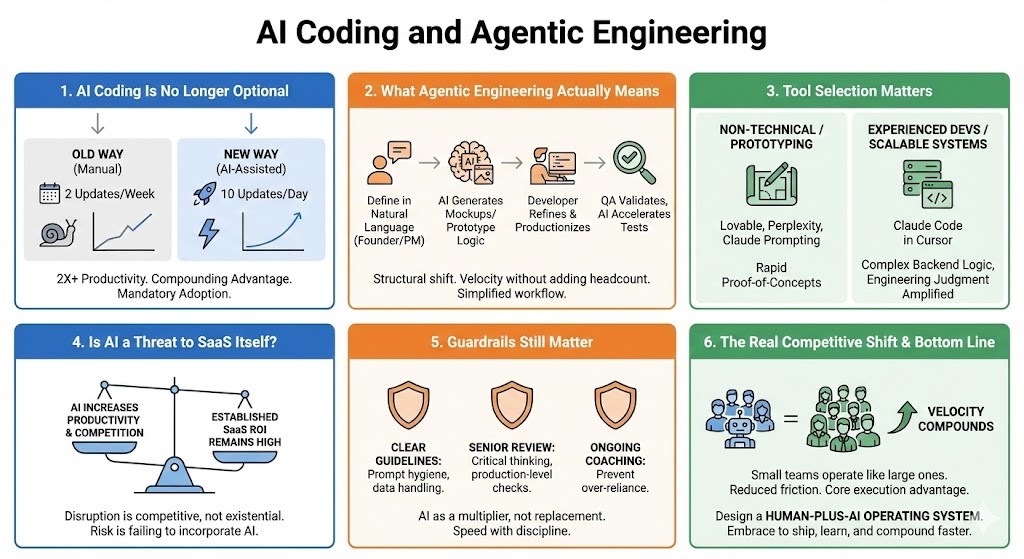
If your competitor is shipping ten meaningful product improvements per day while you’re shipping two per week, it doesn’t take long before you’re playing defense.
Let’s break down what’s actually happening inside real SaaS teams — and what agentic engineering really means for founders.
AI Coding Is No Longer Optional
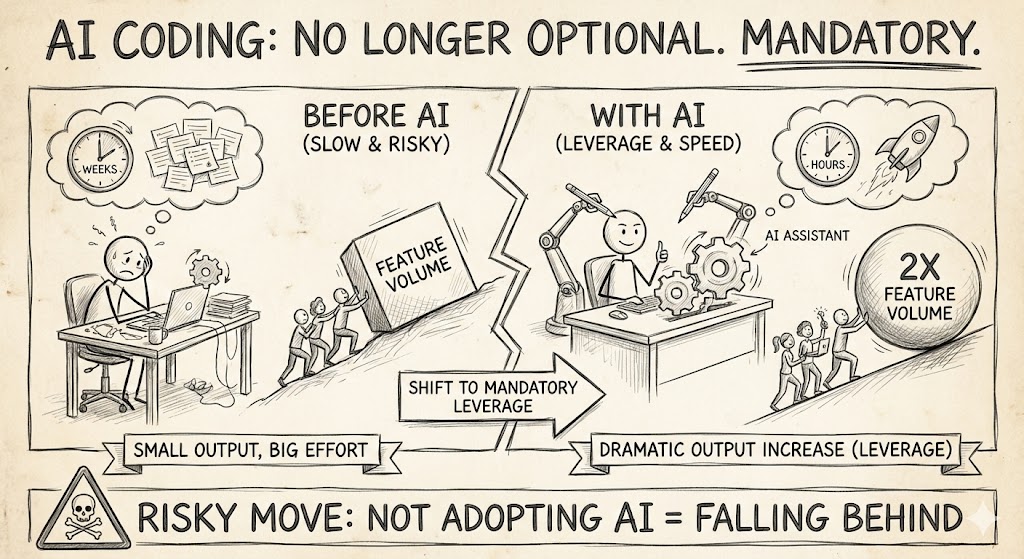
The most consistent theme across the discussion was simple: AI usage is mandatory
Not encouraged. Not optional. Mandatory.
Teams that have rolled out tools like Cursor with Claude are reporting dramatic output increases. QA teams expect similar gains after minimal onboarding. Even non-technical product owners are building real prototypes directly through AI tooling
What’s changing is not just speed — it’s leverage.
Here’s what that leverage looks like in practice:
- Developers producing at least 2X output using AI coding assistants
- Product updates that previously required a week of back-and-forth now completed in hours
- Small teams shipping feature volume that previously required far larger orgs
Once this becomes the norm in your category, not adopting AI is the risky move.
What Agentic Engineering Actually Means
Agentic engineering isn’t “AI writes some code for me.”
It’s a structural shift in how product gets built.
Instead of rigid ticket systems and heavy sprint bureaucracy, founders are using AI as a first-pass product collaborator. Requirements are written in plain English. Mockups are generated instantly. UI concepts are built 20 to 30 days ahead of dev cycles
Then developers take those AI-generated artifacts and build production-grade systems on top of them using tools like Cursor powered by Claude Code
The workflow becomes dramatically simpler:
- Founder or PM defines the feature in natural language
- AI generates mockups or prototype logic
- Developer refines and productionizes the system
- QA validates functionality while AI accelerates test cycles
The result is velocity without adding headcount.
In one example discussed, the team moved from shipping roughly two features per week to completing around ten per day
That’s not incremental improvement. That’s a new ceiling.
Tool Selection Matters
Not every AI tool fits every operator.
There’s a meaningful difference between tools for non-engineers and tools for experienced developers
For rapid prototyping, tools like Lovable can help non-technical founders spin up proof-of-concepts quickly. Combined with Perplexity and Claude for prompting, this creates a powerful early-stage product sandbox
But there’s a limit to what non-engineer tools can handle.
When you’re building scalable systems that process millions of rows or complex backend logic, experienced engineers using Claude Code inside Cursor remain essential
AI doesn’t eliminate engineering judgment. It amplifies it.
The stronger the engineer, the more leverage the tool creates.
.png)
Is AI a Threat to SaaS Itself?
It’s a fair question.
If AI can build software quickly, does it threaten SaaS products?
The consensus was pragmatic
Yes, AI will increase productivity across the board. It may reduce some seat counts in large enterprise tools. But the ROI of established SaaS platforms remains extremely high. Very few companies will rebuild critical infrastructure just to save $50 per month
The bigger risk is not AI replacing SaaS.
The bigger risk is SaaS companies failing to incorporate AI into both their internal workflows and their product offerings.
The disruption is competitive, not existential.
Guardrails Still Matter
Speed without discipline creates problems.
The teams succeeding with AI coding are implementing structure around usage. They aren’t blindly copying and pasting generated output. They’re coaching engineers to maintain critical thinking. They’re reviewing AI-generated code carefully. They’re protecting sensitive data inside prompts
In other words, they treat AI as a multiplier, not a replacement.
Healthy AI adoption requires:
- Clear guidelines around prompt hygiene and data handling
- Senior engineers reviewing production-level changes
- Ongoing coaching to prevent over-reliance
Agentic engineering is powerful — but it still requires leadership.
The Real Competitive Shift
The biggest takeaway is not “AI writes code faster.”
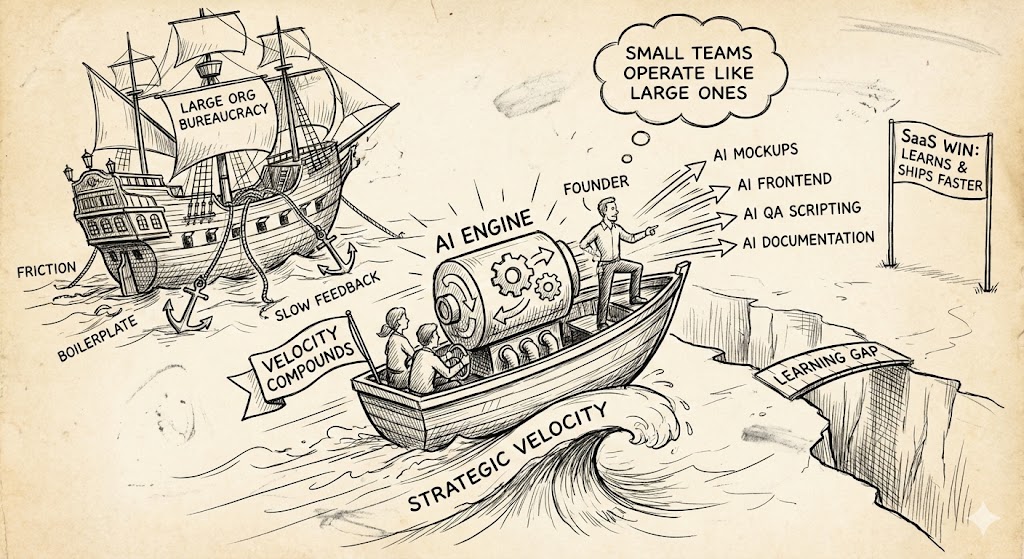
It’s that small teams can now operate like large ones.
When product mockups, frontend adjustments, QA scripting, and documentation are accelerated by AI, organizational friction drops dramatically. Founders can iterate directly. Engineers spend less time on boilerplate. Feedback loops shorten.
Velocity compounds.
And velocity is strategic.
In SaaS, the company that learns and ships faster wins. AI coding simply widens that learning gap between adopters and laggards.
The Bottom Line
AI coding is no longer a side experiment. It’s a core execution advantage
If you’re building in 2026, your job as a founder is to design a human-plus-AI operating system inside your company.
That means:
- Mandating AI adoption where it drives measurable output gains
- Restructuring workflows around AI-assisted product design
- Empowering engineers to become architects rather than typists
- Maintaining quality guardrails while increasing speed
Agentic engineering isn’t about replacing developers.
It’s about giving them leverage.
The companies that embrace this shift thoughtfully will ship faster, learn faster, and compound advantages faster.
The ones that hesitate will simply move slower.
And in SaaS, slower rarely wins.