
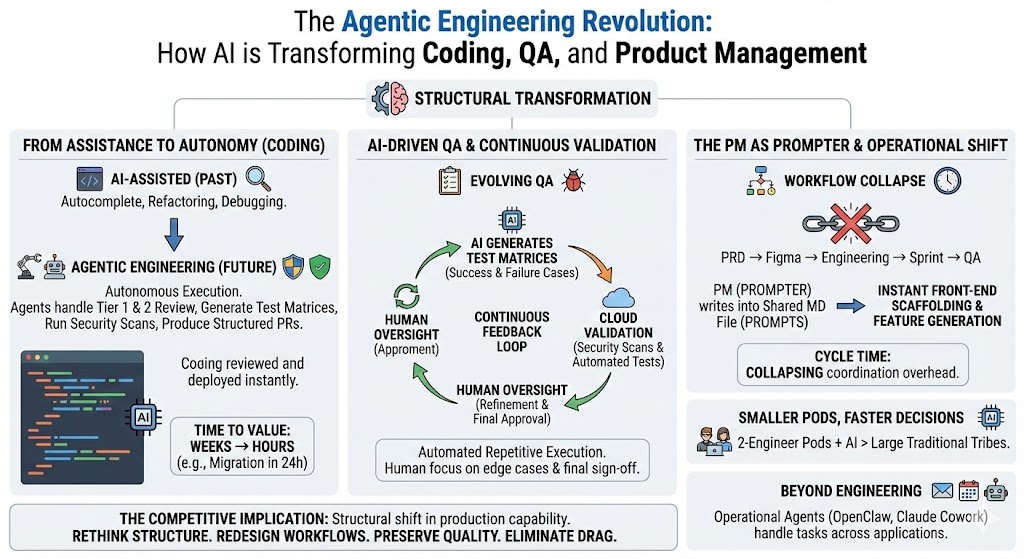
The Agentic Engineering Revolution: How AI is Transforming Coding, QA, and Product Management

Something structural is happening inside software teams right now.
This isn’t just AI helping engineers write code faster. It’s a shift toward agentic engineering — where AI systems autonomously execute meaningful parts of the development lifecycle: reviewing code, generating tests, running security scans, scaffolding UI, and even producing pull requests for approval.
And the speed difference is not incremental.
In one example, a complex Angular migration that used to take “a month or two of work” was completed in 24 hours — described as “the most disruptive thing” the team had seen .
That changes how you build, how you organize teams, and how you compete.
From AI Assistance to Agentic Execution
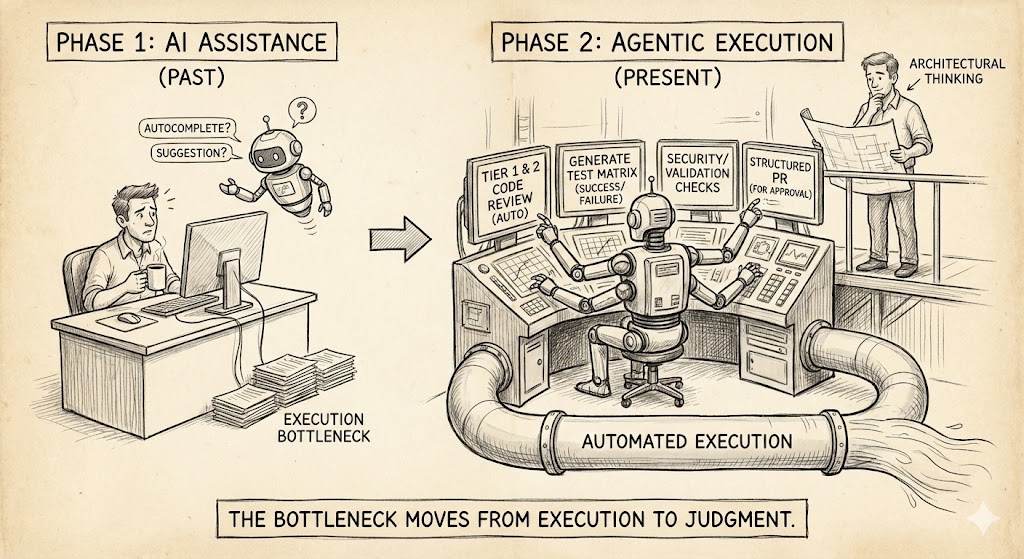
The first phase of AI in engineering was assistive. Autocomplete, code suggestions, debugging help.
Now we’re in a different phase.
Teams are deploying AI agents that:
- Handle Tier 1 and Tier 2 code review automatically
- Generate functional test matrices (success and failure cases)
- Run security and validation checks before merge
- Produce structured pull requests for final human approval
One team described building an “agentic code quality checker” that removed a major internal bottleneck by automating large portions of code review .
This isn’t about replacing engineers. It’s about reallocating their attention upward — from repetitive validation to architectural thinking.
The bottleneck moves from execution to judgment.
QA Is No Longer a Phase — It’s a System
Testing is also being rewritten.
Instead of manually building test coverage from scratch, teams are instructing AI to generate full suites of successful and failure cases. In one case, the AI built the entire matrix. About 40% required refinement, but the baseline speed was unprecedented .
At the same time, cloud-hosted agents automatically run security scans and other validations before presenting a pull request to a human engineer .
QA doesn’t disappear in this model. It becomes supervisory.
The focus shifts to designing guardrails:
- What must always be validated automatically
- What requires explicit human approval
- What categories of change cannot deploy without senior review
Speed without structured validation creates fragility. Agentic engineering only works when automation and oversight are balanced deliberately.
The PM Becomes the Prompter
The transformation isn’t limited to engineering and QA.
Product management workflows are compressing dramatically.
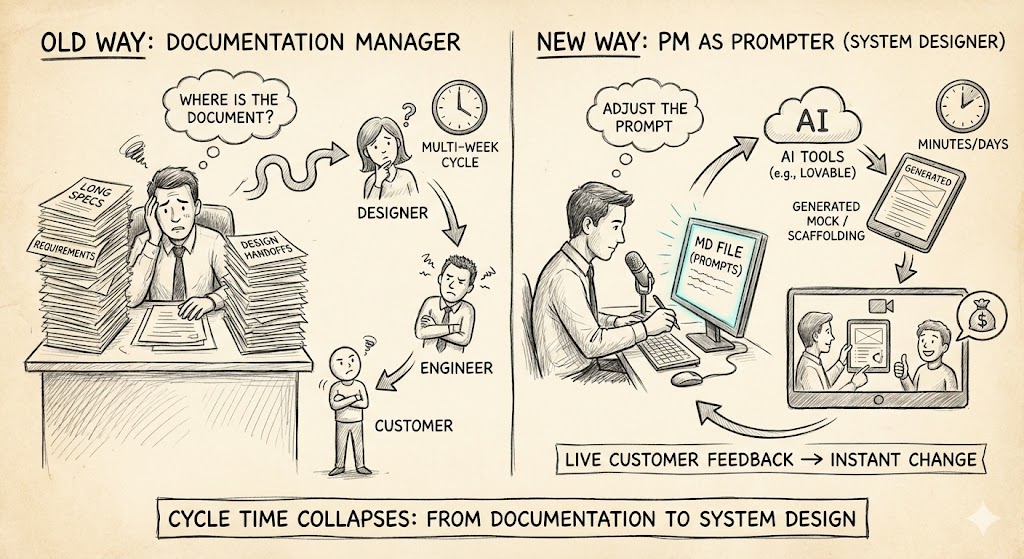
Long specifications and multi-week design handoffs are being replaced by prompt-driven development. PMs are writing structured instructions directly into shared MD files alongside engineers. Front-end scaffolding is generated instantly in tools like Lovable. A change request becomes a prompt adjustment, not a new document.
One example captured the shift clearly: during a live customer call, a PM generated a mock in minutes and showed it on the spot. The customer committed to buy if it shipped quickly .
When cycle time collapses, the entire customer-to-production pipeline changes.
The PM role evolves from documentation manager to system designer.
Smaller Pods, Fewer Bottlenecks
As development accelerates, traditional team structures start to feel heavy.
One leader put it plainly: “This organization is slowing us down now, because there are too many people” .
When something can be built overnight, alignment overhead becomes visible. Large tribes give way to smaller, focused pods. Fewer handoffs. Faster decisions.
Agentic engineering rewards clarity and decisiveness more than headcount.
Beyond Code: AI as an Organizational Multiplier
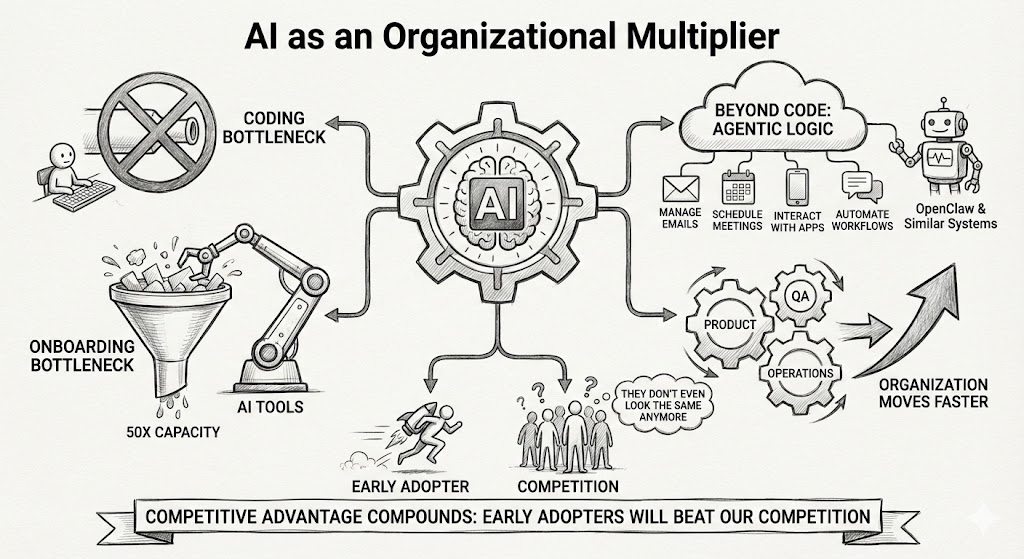
Perhaps the most interesting insight is that coding is no longer the primary constraint in some companies.
“Our big bottleneck… is actually not coding right now, it’s onboarding,” one leader noted, pushing to use AI tools to dramatically expand onboarding capacity .
OpenClaw and similar systems extend agentic logic beyond engineering. They can manage emails, schedule meetings, interact with apps, and automate workflows through chat interfaces .
This is where competitive advantage compounds. When AI accelerates product, QA, and operations together, the entire organization moves faster.
As one participant warned, early adopters will “beat our competition” — and in some cases, competitors may not even look the same anymore.
The Bottom Line
Agentic engineering isn’t a feature. It’s a structural change in how software gets built.
AI is now reviewing code, generating tests, validating security, scaffolding UI, and automating workflows. PMs are becoming prompters. QA is becoming orchestration. Teams are shrinking and accelerating.
The companies that thrive will redesign their structures to match the tools. The companies that don’t will feel inexplicably slow.
In a world where a migration that once took months now takes 24 hours, your competitive edge isn’t just technology.
It’s how quickly you adapt to what that technology makes possible.