
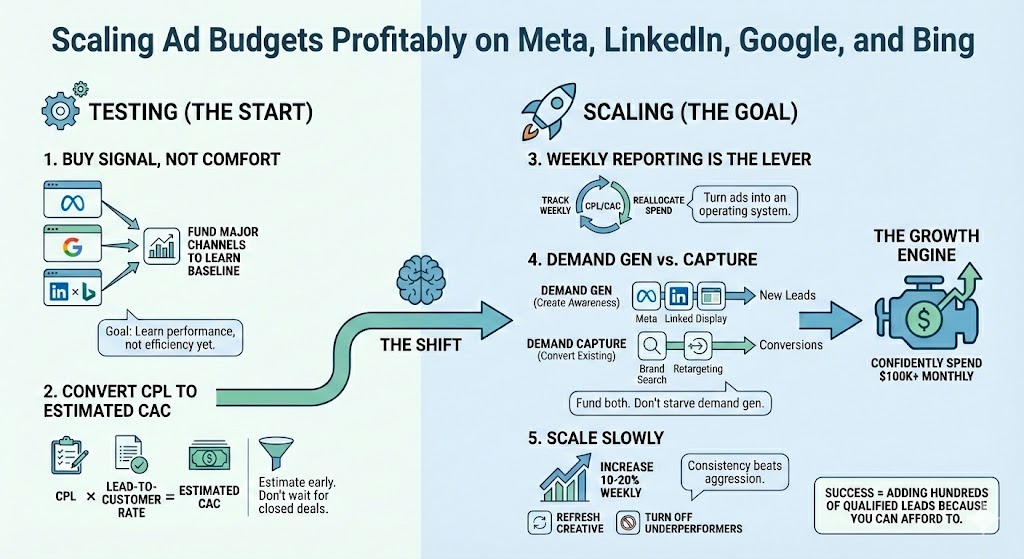
Scaling Ad Budgets Profitably on Meta, LinkedIn, Google, and Bing
A practical, founder-level guide to turning ads from small experiments into a scalable growth engine—covering how to interpret CPL and CAC, balance demand gen vs. demand capture, and confidently scale ad spend without breaking performance.

Most SaaS teams don’t fail at ads because the creative is bad or the targeting is wrong. They fail because they never make the mental shift from testing to scaling.
Spending a few thousand dollars a month, getting a handful of leads, and declaring victory is fine early on. But that’s not how you build a growth engine. If you’re serious about growing from $1M to $10M or $50M+ in ARR, the real question isn’t whether ads work. It’s whether you can reliably spend six figures a month on ads and get the money back quickly.
As I said on the webinar, “The goal isn’t to be happy spending $5,000 a month. The goal is to confidently spend $100,000 or $200,000 a month because you know it pays back.”
This is how to get there.
Start by Buying Signal, Not Comfort
Before you can scale anything, you need data you can trust. That means spending enough to learn something real.
One of the biggest mistakes I see is spreading tiny budgets across too many channels and then drawing conclusions way too early. If you only spend a few hundred dollars per platform, you’re not measuring performance — you’re guessing.
A practical starting point is to deliberately fund each major channel long enough to understand baseline performance:
- Meta (prospecting + retargeting)
- Google Search (brand and non-brand)
- Google Display or YouTube
- LinkedIn (matched audience or thought leadership)
- Bing (often overlooked, often profitable)
As I explained on the call, “You need enough volume to calculate cost per lead per channel. Without that, you’re flying blind.”
This phase isn’t about efficiency. It’s about learning which channels deserve more capital later.
Convert CPL Into an Estimated CAC Early
In B2B SaaS, especially with mid-market and enterprise sales cycles, you usually won’t see closed-won revenue from ads for months. Waiting that long to make decisions kills momentum.
.jpg)
Instead, you estimate.
The logic is straightforward: cost per lead multiplied by your historical lead-to-customer conversion rate gives you a directional CAC. It’s not perfect, but it’s good enough to decide where to lean in.
I put it this way during the session: “It’s much better to wait and see actual CAC, but you don’t need to wait three to six months to make smart decisions.”
If the estimated CAC fits inside your target payback window, that channel earns the right to scale.
Weekly Reporting Is the Real Growth Lever
Scaling ads isn’t about creativity first. It’s about discipline.
Every week, we review performance the same way, across every account we manage. Same structure, same metrics, same cadence. This turns ads into an operating system instead of a guessing game.
.jpg)
A weekly review should always answer the same core questions:
- What did we spend, and where?
- What did it cost to generate a lead or qualified lead?
- Which channels are improving week over week?
- Where should the next dollar go?
As I said plainly on the call, “Track your ad results weekly by channel and ad type, then reallocate spend to the channels doing the best.”
Most teams don’t have an ads problem. They have a review process problem.
Demand Generation vs. Demand Capture (Don’t Confuse Them)
One of the fastest ways to stall growth is to over-invest in channels that look good on paper but don’t create new demand.
Brand search and retargeting will almost always produce the lowest CPLs. That’s because they’re capturing demand that already exists. They’re necessary, but they’re not enough.
Prospecting channels like Meta, LinkedIn, and Display are doing a different job. They’re creating awareness that turns into brand search and retargeting volume later.
I made this point directly on the webinar: “Just because brand search looks cheaper doesn’t mean you should put all your budget there. If you turn off demand gen, brand search will eventually dry up.”
The goal isn’t to pick one or the other. It’s to fund both intentionally, knowing they play different roles in the system.
Scale Slowly or You’ll Break What’s Working
Once a channel proves it can hit your CPL or CAC targets, the instinct is to push hard. That’s where many teams get burned.
On Meta and LinkedIn especially, aggressive budget jumps can reset learning and tank performance. Scaling works best when it’s boring.
The rule we follow is simple:
- Increase budgets 10–20% per week on winning campaigns
- Turn off underperforming ads instead of endlessly tweaking them
- Refresh creative every 4–6 weeks, especially for retargeting
David summed it up well during the call: “The worst thing you can do is take a $30-a-day campaign that’s working and jump it straight to $200.”
Consistency beats aggression every time.
.jpg)
Understand Post-Click vs. Post-View Reality
In multi-channel B2B advertising, attribution is messy whether you want it to be or not. People see ads everywhere, click on some, ignore others, and convert later.
Post-click conversions are the most reliable signal. Post-view conversions still matter, but they need to be handled carefully to avoid double-counting.
Our internal approach is intentionally conservative:
- Full credit for post-click conversions
- Partial credit for post-view conversions
- Use third-party tools to de-duplicate when possible
As I explained, “We don’t say the ad caused it. We say the ad influenced it.”
That mindset keeps scaling decisions rational instead of emotional.
What Profitable Scaling Actually Looks Like
To ground this in reality, we walked through Clearstream, a SaaS company serving churches. There was nothing exotic about the strategy.
They started with matched audiences and search, optimized around leads first, then shifted toward purchases once volume supported it. Over time, they expanded into lookalikes, Bing, and additional networks, scaling spend only after results held steady.
The result wasn’t just better ads. Ads became the primary growth engine.
As David noted during the session, “There wasn’t anything unorthodox here. We followed the system and scaled as the data allowed.”
That’s the pattern we see over and over again.
The Real Goal
If there’s one takeaway from this entire conversation, it’s this: ads don’t matter until they scale.
Getting campaigns live is table stakes. Profitable scaling is the win.
.jpg)
That requires clear unit economics, enough spend to generate signal, disciplined weekly review, and patience when increasing budgets. Or, as I said near the end of the call, “Success isn’t five or ten leads a month. Success is adding hundreds of qualified leads because you can afford to.”
When you reach that point, ads stop being an experiment and start being a growth engine.