
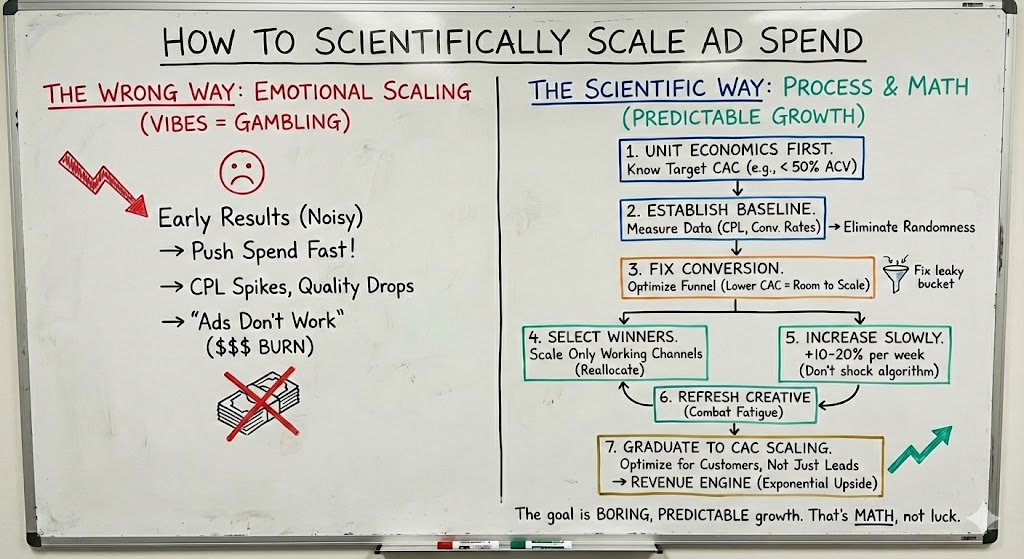
How to Scientifically Scale Ad Spend to Acquire More Customers
A data-driven framework for scaling ad spend the right way—using unit economics, baseline metrics, and controlled budget increases to grow faster without blowing up CPL or CAC.

Most SaaS companies don’t fail at ads because they pick the wrong channel.
They fail because they try to scale before they’ve earned the right to scale.
I’ve seen this pattern for more than twenty years now. A team gets ads live, sees a few leads come in, gets excited, and starts turning the budget dial up fast. For a week or two, things look okay. Then CPL spikes, lead quality drops, and suddenly everyone is saying, “Ads don’t work for our business.”
That’s not an ad problem. That’s a scaling problem.
As I said during our CRO and scaling session, “The difference between ad campaigns that work and ad campaigns that scale is whether you’re willing to treat this as a scientific process instead of a guessing game.”
Let’s walk through what that actually means.
Why Most Teams Scale Ads the Wrong Way
The most common mistake is emotional scaling.
Someone sees a lead come in. Or a demo. Or even a customer. And the instinct is to push spend immediately. That almost always backfires.
Why? Because early results are noisy.
Until you have enough volume, you don’t actually know:
- Your true cost per lead
- Your true lead quality
- Your conversion rates by channel
- Your real CAC
And without those numbers, you’re not scaling—you’re gambling.
That’s why I told the group very clearly, “You don’t scale ads based on vibes. You scale ads once you can prove the math works.”
Step One: Know Your Target CAC Before You Touch the Budget
Scientific scaling starts with unit economics, not ad platforms.
Before you increase spend, you need to know:
- Your ACV
- Your LTV
- Your acceptable payback window
From there, you can define a target CAC. Everything else flows from that number.
I usually give founders two guardrails:
- Target CAC ≈ 50% of ACV (six-month payback), or
- Target CAC ≈ one-sixth of LTV
Once you know that number, ads stop being scary. You’re no longer asking, “Is this expensive?” You’re asking, “Is this inside our math?”
As I put it on the call, “Once you know your target CAC, scaling becomes a math problem, not a faith exercise.”
.jpg)
Step Two: Establish a Clean Baseline Before Scaling
You cannot scale what you haven’t measured.
Before increasing spend, you need baseline data for each channel and ad type:
- CPC
- CTR
- Visitor-to-lead conversion
- Cost per lead
- Lead-to-customer conversion
And that data needs to be collected over enough volume to matter.
This is why I recommend modest but meaningful test budgets. You don’t need to spend a fortune—but you do need enough data to eliminate randomness.
As I explained to the group, “You need enough spend to get at least one or two real leads per channel, otherwise you’re optimizing noise.”
No baseline, no scaling.
Step Three: Fix Conversion Before You Increase Spend
This is where most teams skip ahead—and pay for it.
If your funnel isn’t converting, scaling spend just amplifies inefficiency. Every weak step becomes more expensive.
That’s why scaling must come after conversion rate optimization, not before it.
We walked through this idea extensively in the session, and it always clicks when people see the math. “If you improve each step of the funnel by just ten percent, your CAC drops by about thirty-three percent,” I told them.
Lower CAC gives you room to scale. Higher CAC removes that room.
If you’re not at:
- ~1%+ ad CTR
- ~1–2% visitor-to-lead conversion
- A reasonable lead-to-customer conversion
You should optimize before scaling.
.jpg)
Step Four: Scale the Right Channels, Not All Channels
Scientific scaling is selective.
Every channel behaves differently. Paid search converts differently than matched audiences. Retargeting behaves differently than cold display. LinkedIn behaves differently than Meta.
That’s why I stress this distinction so often: “You have to look at cost per lead and cost per customer by channel and by ad type, not just blended together.”
Scaling doesn’t mean increasing everything. It means reallocating budget toward what’s already working inside your target CAC.
And that reallocation should happen weekly, not quarterly.
Step Five: Increase Budgets Slowly (This Is Non-Negotiable)
This is one of the most important rules in ad scaling—and one of the most ignored.
Once you’ve proven a channel works, you scale gradually.
Ten to twenty percent per week is the sweet spot. Faster than that, and you often confuse the algorithm, reset learning phases, or exhaust audience pockets too quickly.
I was very direct about this on the call: “Scale no more than ten to twenty percent per week. Scaling faster almost always degrades performance.”
Think of it like strength training. Progressive overload works. Doubling the weight overnight gets you injured.
Step Six: Refresh Creative as You Scale
As spend goes up, frequency goes up. And when frequency goes up, performance eventually drops—unless creative stays fresh.
This is why ad scaling is inseparable from creative production. New headlines, new visuals, new offers, new formats.
When CTR drops below about 0.5%, that’s not a budget problem. That’s creative fatigue.
Scientific scaling assumes ongoing creative replacement. Scaling without new creative is like pouring water into a leaky bucket.
Step Seven: Graduate From CPL to CAC-Based Scaling
Early on, you scale based on CPL because that’s the fastest signal.
But once you have enough closed-loop data, the real milestone is shifting from lead optimization to customer optimization.
That’s when ads stop being a marketing experiment and become a revenue engine.
As I explained, “Once you have enough volume, the goal isn’t maximizing leads—it’s minimizing CAC.”
This is also when attribution and sales feedback become essential. You’re no longer optimizing for cheap clicks. You’re optimizing for customers who actually close.
Why Optimized Funnels Can Spend So Much More
Here’s the non-obvious insight most founders miss.
An optimized funnel doesn’t just perform a little better. It unlocks exponentially more scale.
Because ad auctions reward conversion efficiency, lower CAC lets you win more impressions at similar prices. That’s why the upside isn’t linear.
I emphasized this point toward the end of the session: “An optimized funnel doesn’t just spend twice as much—it can spend five to ten times more within the same target CAC.”
That’s how companies go from $5k/month in ads to $50k, $100k, or more—without blowing up their economics.
.jpg)
The Real Meaning of Scientific Scaling
Scientific ad scaling is boring by design.
It’s spreadsheets. Weekly reviews. Small budget changes. Constant measurement. Relentless optimization.
But on the other side of that discipline is something rare: predictability.
When you scale ads scientifically, growth stops being stressful. Spend becomes intentional. And customer acquisition turns into something you can actually plan around.
That’s not luck. That’s math.