
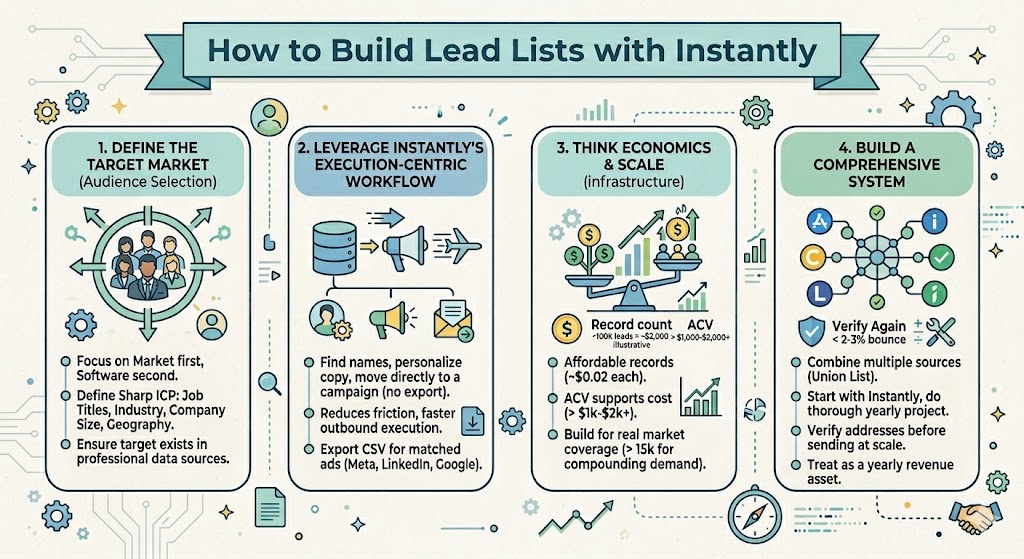
How to Build Lead Lists with Instantly
A founder-focused walkthrough of how to use Instantly to build lead lists and move quickly from prospect selection to campaign execution. It covers audience selection, list economics, deliverability considerations, and how Instantly fits into a practical outbound and ABM workflow.

Most founders start with the software question instead of the market question. Should we use Apollo, Instantly, ListKit, Clay, LinkedIn Sales Navigator, or some stack of all of them? That is not actually the first decision. As I mentioned in the session, “The first step of B2B marketing is audience selection,” and that is still the part that matters most.

Instantly is useful because it lets you go from market definition to action very quickly. Once you know the titles, industries, geographies, and company-size ranges you care about, you can build the list, move it into a campaign, and start using it right away. That speed is valuable because the list itself is not the goal. The list is the foundation for outbound, matched audiences, and the rest of your ABM motion.
What I like about Instantly is that it sits close to execution. In the walkthrough, I built a small list, showed how to personalize emails against it, and then moved those contacts directly into a campaign without needing to export first. For email, that saves time. For ads, you still export the CSV, but for outbound, the path from search to send is much shorter.
Start with the market, not the tool
The biggest mistake I see is people opening Instantly before they have real clarity on who belongs on the list. You need to know the market first. That means job titles, industry, company size, geography, and whether the buyers you are targeting are actually the kind of professionals who tend to exist in these databases.
As I said in the training, “The tools today I’m gonna show you work really well for B2B professionals.” I also made the point that “As long as your contacts are people that probably have a LinkedIn profile, or at least most of them do, then you can use Apollo, ListKit, and Instantly very easily and nicely.” That is a helpful filter to keep in your head before you go too far down the road with any one workflow.
This matters because Instantly is not there to tell you who your ICP is. It is there to help you operationalize an ICP you already understand. If your target market is vague, the list will be vague. If your target market is sharp, Instantly becomes fast and practical.
- Define the buyer titles before you build anything.
- Filter by industries and geographies that match real customer fit.
- Choose company sizes that align with your ACV and sales motion.
- Make sure your audience is likely to exist in professional data sources.
The founders who get the best results here are usually the ones who stop thinking in generalities. “We sell to mid-market” is not enough. You need to know which buyers, at which companies, in which markets, and why those accounts are worth pursuing.
Instantly is valuable because it is close to execution
One thing I like about Instantly is that it is not just a place to find names. It is also a place where the next step is already sitting there. In the session, after generating personalized copy for a small sample, I pointed out, “Because this is already in Instantly, I don’t have to export it.” That is a meaningful advantage when you are moving fast and want the list to become an actual campaign instead of another spreadsheet.
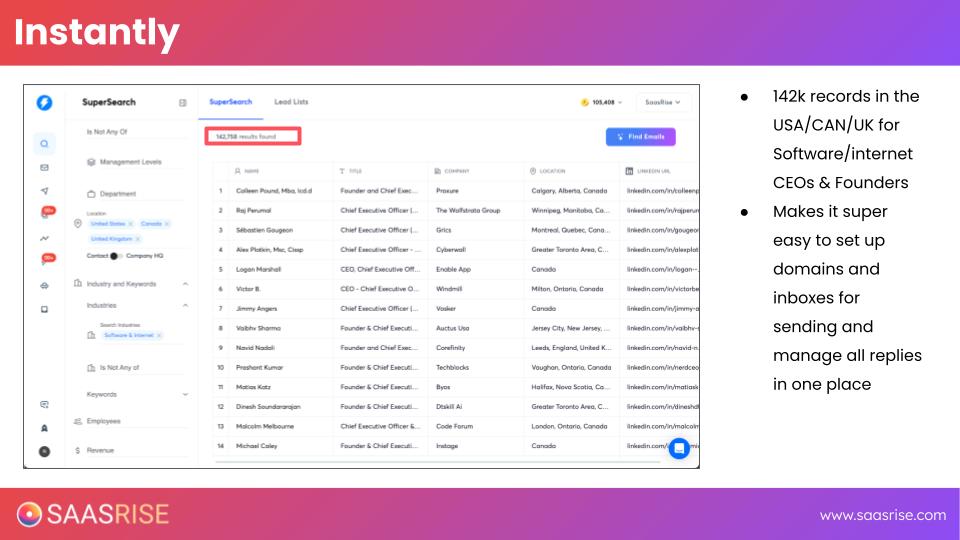
I showed a real example with 25 CEOs. After the list was in the system, all I had to do was click move, send them into a campaign that already had a sequence attached, and the outbound motion was live. That kind of workflow reduces friction, which matters a lot for founders and lean go-to-market teams because friction is one of the main reasons execution gets delayed.
The same list can still be exported when you need it for ads matching. As I explained in the demo, “If I wanna export it, all I gotta do is select all the results and click export, which is just called download selected, and then I have my CSV file.” So Instantly works well in both directions: direct use for outbound and export when you want to push the audience into Meta, LinkedIn, or Google.
- Use Instantly when you want list building and outbound to live close together.
- Keep the list in-platform for email execution when that is the fastest path.
- Export the CSV when you need the same audience for matched ads.
- Treat the list as an active operating asset, not a static file.
That is really the larger point. The best lead list is not the prettiest one. It is the one that gets used. Instantly is useful because it shortens the distance between identifying the right people and actually reaching them.
Think about economics and scale from the beginning
A lot of founders build lists without thinking about whether the economics justify the effort. That is a mistake. In the training, I was very clear that this approach works best when your ACV is at least around $1,000, and really better when you are a couple thousand dollars and up, because otherwise the cost of data, ads, and outbound effort can get too high relative to what you earn per customer.
Instantly is attractive partly because the data is relatively affordable. In the program, I explained that ListKit and Instantly are both around two cents per record, which means 100,000 leads is roughly a $2,000 decision, not a $7,000 one. That changes the math for earlier-stage SaaS companies that want to build meaningful audience coverage without immediately paying Clay-level prices.
Scale matters here too. As I said in the demo, “You need at least five thousand people to build a good matched audience with,” and “I would only really recommend building matched audiences if you have at least fifteen thousand people in your target market.” Those numbers matter because they force you to think bigger than a handcrafted list of a few hundred names. If you want demand generation to compound, you need enough market coverage for the channels to work.
- Make sure your ACV supports the cost of list building and outreach.
- Use Instantly when you want lower-cost records and faster execution.
- Build for real market coverage, not just a tiny pilot list.
- Size the list based on the channels you plan to run afterward.
This is also why I encourage founders to think of list building as infrastructure, not as a one-off task. If the economics are there, it is worth building the audience layer properly because you will use it across email, ads, retargeting, and future enrichment.
Instantly should be part of a larger list-building system
The wrong question is usually, “Which one tool should I use?” The better question is, “How do I build the most complete useful list of my market?” Different tools have different coverage, and that is why I do not like treating any one source as the whole answer.
As I said during the call, “Just use all of them. Just use all three that I just demoed. Build a comprehensive list of the union of all three.” In practice, when we do ABM list building, we tend to use multiple sources including Apollo, Instantly, Clay, ListKit, and LinkedIn Sales Navigator because each one has some non-overlapping data.

That does not mean every company should spend heavily from day one. If cash is tight, a lower-cost Instantly-based list can be a very reasonable place to start. But when resources are available, I recommend doing the project thoroughly, because as I told the group, “You really don’t wanna be doing this every couple months. You really wanna be doing this, like, once a year.”
There is also one important operational detail once you have the list. Even if the source platform verifies emails, I still recommend verifying again before sending at scale, because bounce rates above roughly 2% to 3% can hurt deliverability. In the Q&A, I explained that a verification tool can check whether addresses are still active without sending emails, and that is cheap insurance for list quality.
- Start with Instantly if you want a practical lower-cost source tied closely to outbound.
- Combine it with other databases when completeness matters.
- Verify addresses before sending at scale to protect deliverability.
- Build the list as a yearly revenue asset, not a disposable export.
That is really the founder takeaway. Instantly is not the strategy. It is one very practical tool for turning a clear market definition into a working list and then into actual execution fast. And as I said near the end of the session, “The way to breakthroughs is mistakes. The way to innovation is screw ups,” so the right move is to build the list, test the workflow, and learn from the market.