
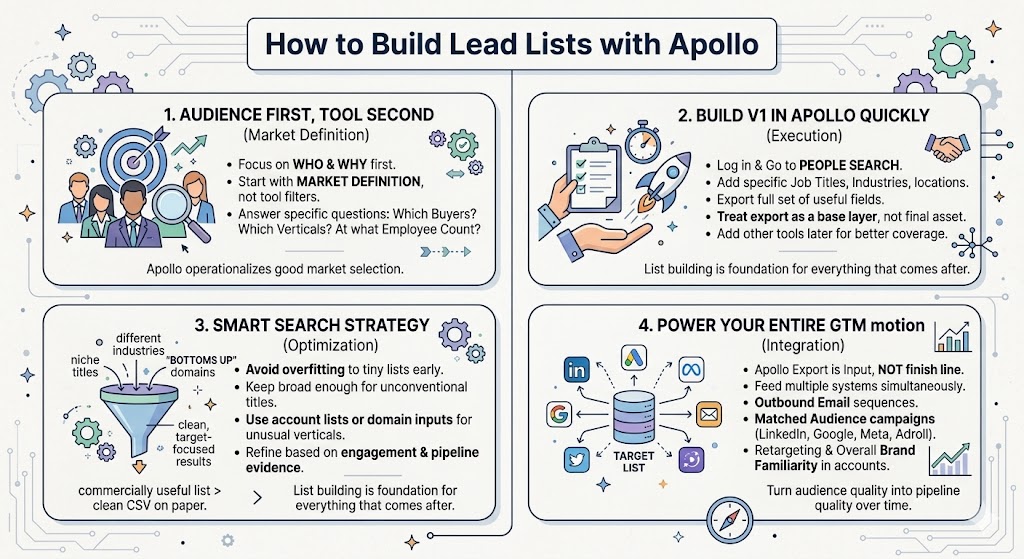
How to Build Lead Lists with Apollo
A practical founder’s guide to using Apollo to turn a clear ICP into a targeted lead list you can use across outbound, ads, and ABM. This post covers how to choose the right filters, avoid overcomplicating list building, and build a list that actually supports pipeline creation.

Most founders make lead list building harder than it needs to be.
They start with the tool question. Should we use Apollo? Clay? Instantly? LinkedIn Sales Navigator? All of the above? That is not actually the first question. The first question is who you want to target and why that market makes sense for your business. As I mentioned in the session, “The first step of B2B marketing is audience selection.” Once you know your target CAC, your target CPL, and your target market, list building stops feeling fuzzy and starts becoming straightforward operational work.

Apollo is one of the fastest ways I know to turn that clarity into an actual working list. In the training, I opened Apollo, picked job titles, added industries, chose countries, filtered by company size, and got from a giant database down to a focused ICP segment in a matter of minutes. Like I said during the session, “It’s really as simple as that.” For most B2B companies, it is. The hard part is not exporting the list. The hard part is choosing the market well.
The other reason this matters is that your list is not just for outbound. It is the raw material for matched audience ads, LinkedIn outreach, retargeting, and the broader omnipresence strategy that sits underneath a strong ABM motion. If you build the right list, you can use it everywhere. If you build the wrong list, you just end up scaling confusion.
Start with market definition, not tool filters
The easiest way to waste time in Apollo is to start clicking filters before you have defined the market. I like to go the other direction. Get clear first on the buyer titles, supporting titles, industries, countries, and company-size bands that actually line up with your best customers. Then take that definition and put it into Apollo.
In the example I walked through, I started with CEO and founder titles, narrowed to software-related industries, filtered for English-speaking countries, and then trimmed the company-size range to the segment we actually serve. Apollo’s database showed roughly 240 million people, but after those filters the list came down to about 15,800 CEOs and founders, with 15,764 people ready for export. As I shared with the group, “Now I’ve got a very targeted list.” That is the point. You do not need a giant list. You need the right list.

This is where founders have to act like founders. You cannot just say, “We sell to mid-market.” You have to get more specific than that. Which buyers? In which verticals? In which countries? At what employee count? If you cannot answer those questions, Apollo is not the problem. The market definition is the problem.
- Define job titles before you open the tool.
- Choose industries based on real customer fit, not guesswork.
- Filter by geography and employee count that match your actual sales motion.
- Keep narrowing until the list feels commercially useful, not just large.
That is the mindset shift. Apollo is not there to help you collect contacts. It is there to help you operationalize good market selection. When you do that well, the rest of the go-to-market motion starts getting easier almost immediately.
Build the first strong version fast
One reason Apollo is such a useful starting point is speed. The workflow is simple: log in, go to people search, add titles, add industries, add locations, add employee count, and export. You can move from strategy to a usable first-pass list very quickly, which matters because list building is not the end goal. It is the foundation for everything that comes after.

As I said in the meeting, “You can’t do outbound email without a list of people to send it to, and you can’t do matched audience ads or thought leader ads or sponsored messaging ads without a list.” That is why I start here. A lot of teams want to jump straight to messaging or campaigns, but until you know exactly who the audience is, the rest of it is mostly noise. The list comes first because audience comes first.
There is also a practical budget advantage here. In the program materials, Apollo was shown at normal pricing of about $3,700 per 100,000 B2B leads, with brokered access sometimes available around $600 per 100,000. The exact procurement path matters less than the underlying lesson: get a strong base layer first, then improve it over time.
At the same time, one source is usually not enough if you want a really complete ABM list. In practice, we often use Apollo, Instantly, Clay, ListKit, and LinkedIn Sales Navigator together because each source has some non-overlapping data. Apollo is a great place to begin. It just should not be the only place you ever look.
- Use Apollo to get the first strong version live quickly.
- Export the full set of useful fields so you have flexibility later.
- Treat that export as a base layer, not the final finished asset.
- Add other tools later if you need better coverage or more niche data.
That is a very founder-like way to do it. Get version one built. Put it into use. Learn from the market. Then enrich, expand, and refine. As I told the group, “The way to breakthroughs is mistakes.” You do not need to get perfect before you start. You need to build the list and learn.
Go broader than your instincts, then tighten with evidence
One of the most useful moments in the session came when we were looking at a niche use case involving librarian-related job titles. The issue was that real buyers often do not use the exact title you expect. If you get too surgical too early, you can accidentally filter out good prospects and make the market look smaller than it really is.
As I said on the call, “I think you’re getting too specific here,” and that advice applies to a lot of Apollo searches. Founders often think the goal is to build a perfectly clean list on the first pass. Usually it is not. Usually the goal is to build a commercially useful list that includes enough of the real market to make outbound and ads work. That may mean tolerating a few false positives so you do not exclude actual buyers.
There is also a good workaround for niche markets. If Apollo’s top-down filters are not precise enough, do not force it. As I mentioned in the session, “Instead of doing top down, which is what Apollo will do, you wanna do bottoms up.” Use ChatGPT, Claude, or another research tool to build an account list first, then bring those domains into Apollo and pull the relevant contacts from those companies. That is often the better move for unusual verticals, fragmented categories, or markets where the built-in industry labels are messy.
This is really the larger strategic point. The job is not to make Apollo magically solve market definition for you. The job is to use Apollo intelligently once you have a clear theory of the market. Sometimes that means standard filters. Sometimes it means domain-based targeting, exclusions, account uploads, or combining multiple data sources to get to the list you actually need.
- Do not overfit the first search to a tiny set of exact-match titles.
- Keep the market broad enough to include real buyers with unconventional roles.
- Use account lists or domain inputs when the category is niche.
- Refine based on engagement and pipeline, not just how neat the CSV looks.
That is where founder judgment matters. A list that looks perfect on paper but misses the buying committee is not a good list. A list with some noise but strong commercial relevance is usually much more valuable.
Your Apollo list should power your entire go-to-market system
The biggest mistake I see founders make is treating the Apollo export like the finish line. It is not. It is the input.
Your list should feed multiple systems at once. It should go into outbound email. It should get uploaded into Meta, LinkedIn, Google, and in some cases Adroll for matched audience campaigns. It should become the seed for broader market coverage, not just one email sequence. In one client example from the training, we built a list of 254,000 people in the target market and expected roughly half of them to match into ad platforms, creating an audience of about 120,000 people.
That is why the quality of the Apollo build matters so much. A strong list does not just improve outbound reply rates. It improves audience match rates, retargeting pools, LinkedIn follow-up potential, and overall brand familiarity inside the accounts you care about. Even if you already know your software solves a problem, that alone is not enough. As I said during the session, “They have to know that your software solves the problem, and they have to know why your software is better than alternatives.”
The founder takeaway is pretty simple. Apollo is not the strategy. Apollo is the tool that helps you operationalize the strategy. The strategy is to define your market clearly, reach it repeatedly, and turn audience quality into pipeline quality over time. Done that way, list building stops being admin work and starts becoming one of the highest-leverage things in your entire go-to-market motion.